 Economy
.jpg)
Thúy takes more bronze in para-athletics at Asian Para Games
1.
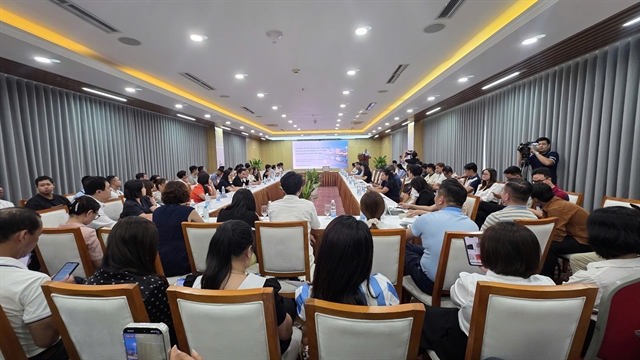 |
| Delegates at the event on Thursday afternoon. — VNS Photo Ly Ly Cao |
By Ly Ly Cao
HÀ NỘI — Businesses are being encouraged to diversify their sales channels, strengthen digital capabilities and improve product competitiveness as they seek more sustainable outlets at home and abroad amid changes in consumer behaviour and global trade.
The issue was discussed at a workshop titled 'Developing Multi-channel Markets: Solutions to Expand Sustainable Outlets for Vietnamese Goods', held in Hà Nội on October 22.
Participants examined how science and technology, innovation and digital transformation could help businesses reach customers through traditional distribution networks, e-commerce platforms and social media.
Lê Hoàng Tài, deputy director of the Vietnam Trade Promotion Agency (Vietrade) under the Ministry of Industry and Trade (MoIT), said the growing interaction between traditional distribution channels and digital platforms was changing the way consumers shop and businesses reach markets.
"The reality confirms that relying on a single sales method is no longer appropriate," he said.
Developing a multi-channel market strategy, connecting physical stores with online shops, was becoming an important approach to helping businesses optimise costs, increase customer touchpoints and secure more sustainable outlets for their products, he added.
However, many Vietnamese businesses, particularly small- and medium-sized enterprises (SMEs), still face difficulties in building integrated technology systems, managing customer data, optimising logistics and establishing systematic sales strategies.
Tài said Vietrade would continue strengthening cooperation among State management agencies, industry associations and digital platforms to provide businesses with more comprehensive support. This would include market information, improved technology adoption and business-matching activities combining in-person and online engagement.
According to the National Technology Innovation Fund (NATIF), retail sales of goods and consumer service revenue reached an estimated VNĐ5.9 quadrillion (US$229 billion) in the first nine months of 2026, up 13.4 per cent year-on-year in current prices and 7.8 per cent after adjustment for price changes.
Separately, the MoIT reported that Việt Nam's e-commerce market was worth about $31 billion in 2025, up 25.5 per cent. The two figures refer to different reporting periods and measures but illustrate the scale of the domestic market and the growing importance of digital channels.
For exporters, diversifying sales channels also means reducing dependence on individual buyers or platforms while strengthening their ability to serve customers consistently. A large order alone does not necessarily ensure sustainable business if profit margins are weak, customers do not return or the company cannot demonstrate product quality and compliance when requested.
Chử Đức Hoàng, chief of office of NATIF under the Ministry of Science and Technology, argued that businesses should assess whether they can retain customers through repeat orders, preserve value through healthy margins and brands, reduce dependence on a single channel, and provide evidence of product quality, origin and compliance with market requirements.
Việt Nam's merchandise exports reached an estimated $434.3 billion in the first nine months of 2026, up 24.5 per cent year on year, according to preliminary figures from the National Statistics Office cited in the presentation.
Of the total, the domestic economic sector accounted for nearly $84 billion, while the foreign-invested sector, including crude oil, contributed $350.41 billion. Export growth was 7.5 per cent for the domestic sector and 29.4 per cent for the foreign-invested sector.
The figures are classified by economic ownership and do not directly measure domestic value added or the technological contribution of individual businesses.
Hoàng said the data nevertheless highlighted the need for Vietnamese enterprises to improve their ability to meet customer standards, participate in higher-value activities, manage data and develop their own brands.
Technology, innovation and digital transformation can support those efforts, but they need to address specific business requirements. Technology can improve product quality and productivity, while innovation can create new products, services and business models, and digital transformation can help businesses integrate sales channels, manage traceability and make decisions based on data.
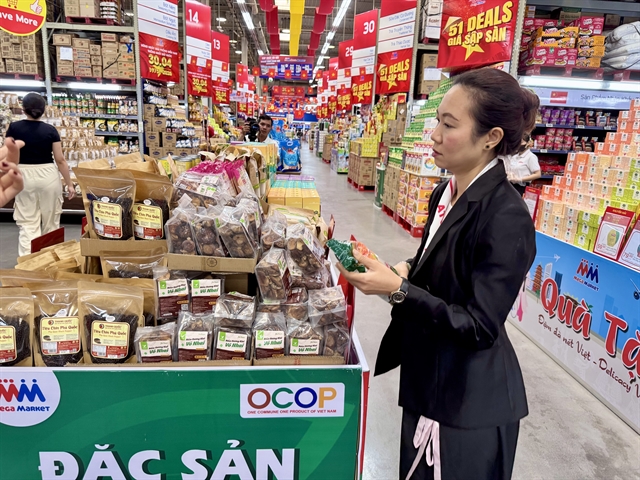 |
| One Commune One Product (OCOP) goods sold at a supermarket in HCM City. — VNA/VNS Photo |
He also identified common operational challenges, including inconsistent product quality, incomplete technical and origin documentation, fragmented inventory and customer data, rising channel fees and logistics costs, and limited access to specialised expertise.
Opening more sales channels without addressing these weaknesses could increase costs and operational risks. For example, separate inventory records across platforms can lead to overselling, while inadequate testing and product documentation can prevent businesses from meeting the requirements of distributors or export markets.
For businesses seeking international expansion, market selection and free trade agreement (FTA) utilisation also require careful preparation. The presentation outlined a process involving identifying the target market, selecting the relevant FTA, checking rules of origin, reviewing non-tariff measures and preparing the necessary export documentation.
Vietnam participates in several trade agreements, including the ASEAN Trade in Goods Agreement (ATIGA), the European Union (EU)-Vietnam Free Trade Agreement (EVFTA), the Comprehensive and Progressive Agreement for Trans-Pacific Partnership (CPTPP) and the Regional Comprehensive Economic Partnership (RCEP).
However, tariff preferences are not automatic, eligibility depends on the product, destination market, applicable rules of origin and supporting documentation.
Businesses also need to examine market-specific requirements. For example, EU rules on carbon-intensive imports and deforestation-related products apply to specified goods and activities rather than to every Vietnamese export. Exporters need to verify the relevant product codes, legal obligations and implementation schedules before deciding what documentation is required.
Hoàng stressed that technology can help companies organise product codes, raw-material records, test results and shipment documents, but software alone cannot establish that a product meets origin requirements or complies with a market's regulations. — BIZHUB/VNS
Economy
 Economy
 Economy
 Economy
 Economy
 Economy
 Economy
 Economy
 Economy
 Economy
 Economy
 Economy
 Economy
 Economy
 Economy