 Economy

.jpg)
Thúy takes more bronze in para-athletics at Asian Para Games
1.
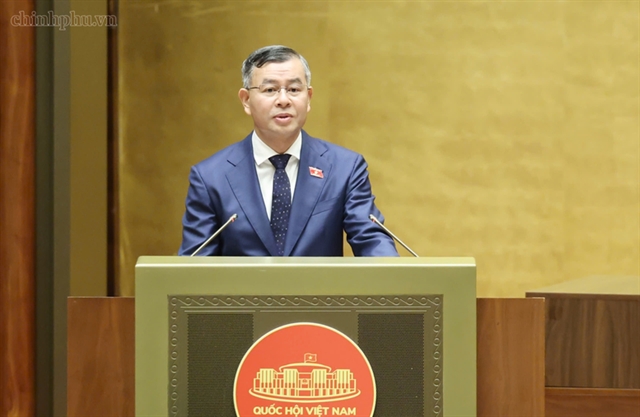 |
| Finance Minister Ngô Văn Tuấn, acting on behalf of the Prime Minister, presents the Government’s submission on the draft amended Law on Bidding. — Photo chinhphu.vn |
HÀ NỘI — The draft amended Law on Bidding aims to simplify procedures, strengthen decentralisation and enhance project owners’ autonomy and accountability, while ensuring fair competition and transparency in bidding activities.
Minister of Finance Ngô Văn Tuấn on Friday present the Government’s proposal to amend the law at the National Assembly's second session, on behalf of Prime Minister Lê Minh Hưng.
The amendments seek to improve the legal framework, streamline administrative procedures, mobilise resources, promote innovation and digital transformation and prevent corruption and waste.
The draft focuses on four policy areas: ensuring consistency in bidding legislation; improving bidding quality and efficiency; simplifying procedures and strengthening decentralisation; and enhancing state management, inspection and supervision.
Under the proposal, project owners would have greater authority to select appropriate contractor selection methods, including direct appointment and competitive bidding, thereby increasing their autonomy and accountability.
The draft comprises eight chapters and 59 articles, covering contractor and investor selection, state management of bidding, and the rights and responsibilities of relevant parties. Organisations not required by law to apply these provisions may choose to adopt the entire law or specific provisions.
Presenting the appraisal report, Phan Văn Mãi, chairman of the National Assembly’s Economic and Financial Committee, endorsed the need for amendments to address practical difficulties, simplify procedures and ensure consistency with newly enacted legislation.
However, the committee cautioned that the 2023 Law on Bidding had already undergone several revisions. Given the extensive changes proposed under an expedited procedure, it called for careful impact assessments and amendments limited to issues sufficiently clarified through practical experience.
Regarding prohibited acts, the committee urged clearer provisions to address bid rigging, fraud, conflicts of interest and the disclosure of state secrets. It also recommended defining violations at the time they occur, rather than only after outstanding debts arise when contractor selection proceeds without identified funding.
The committee broadly supported consolidating certain selection methods and introducing competitive negotiation. However, it stressed that open bidding should remain the primary method to safeguard competition.
It also called for clear conditions and limits on direct contractor appointment, order-based procurement and investor selection in special circumstances. For competitive negotiation, safeguards should protect trade secrets and intellectual property, ensure objectively verifiable pricing, and strengthen oversight and project owners’ accountability. — VNS
Economy
 Economy
 Economy
 Economy
 Economy
 Economy
 Economy
 Economy
 Economy
 Economy
 Economy
 Economy
 Economy
 Economy
 Economy