 Economy


Việt Nam rotates two officers to UN peacekeeping missions in Abyei, South Sudan
1.
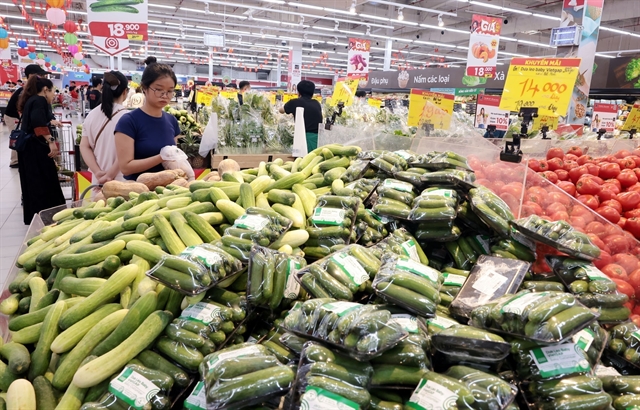 |
| Consumers shop at GO! Thăng Long supermarket in Hà Nội. Higher energy prices and housing costs push up inflation in September. — VNA/VNS Photo Trần Việt |
HÀ NỘI — Consumer price index rose 4.52 per cent in the first nine months of 2026 from a year earlier, driven mainly by increases in prices of energy, food, education and healthcare services as well as housing costs, the National Statistics Office (NSO) said on October 3.
The CPI in September rose 0.62 per cent from August, 5.08 per cent from the same month last year and 4.5 per cent from the end of last year. Average CPI growth in the third quarter was 4.8 per cent from a year earlier.
Amid global economic volatility and rising inflation pressures, the Government has implemented a number of measures to stabilise the macro-economy, control inflation and maintain major economic balances, NSO Director Nguyễn Thị Hương said.
Policy coordination between fiscal and monetary measures has been strengthened, while administrative reforms and measures to ease difficulties for businesses, particularly private firms and small- and medium-sized enterprises, have also been stepped up, she said.
Fuel market management has been carried out flexibly in line with global prices and domestic supply and demand, which helps limit the impact of energy costs on the domestic market, Hương said.
From the beginning of this year, inflation accelerated during the first five months, with year-on-year CPI growth reaching the highest level of 5.6 per cent in May. CPI then eased to 4.69 per cent in June and 4.45 per cent in July before rising again to 4.88 per cent in August and 5.08 per cent in September.
Nine of 11 major groups of consumer goods and services recorded price increases in September, while two declined.
The housing, electricity, water, fuel and construction materials group rose 6.68 per cent year-on-year in the first nine months, contributing 1.52 percentage points to overall CPI growth.
Transport prices increased 6.06 per cent, adding 0.6 percentage point to CPI, with fuel prices rising 10.89 per cent.
Food and catering services prices rose 4.72 per cent, contributing 1.69 percentage points to overall inflation.
Pork prices increased 4.46 per cent as supply was constrained during the holiday and festival periods and livestock production costs remained high.
Education and healthcare services also contributed to higher consumer prices during the period.
Hương said inflationary pressures from input costs, energy prices and other risks remain significant and are posing challenges for economic management in the coming months.
Core inflation rose 0.11 per cent in September from the previous month and 4.45 per cent from a year earlier. Its average increase of 4.26 per cent in the first nine months was below the headline CPI increase of 4.52 per cent.
The gap was mainly because fuel, gas, fresh food and healthcare prices, which are excluded from the core inflation calculation, recorded significant fluctuations and pushed up headline inflation, the NSO said.
Gold prices also recorded sharp movements during the period, broadly tracking global prices.
As of September 25, the average global gold price stood at $4,434.45 per ounce, up 1.31 per cent from the previous month on weaker US dollar, lower US bond yields and stronger investment flows into gold funds, while geopolitical tensions boosted demand for safe-haven assets.
Domestic gold prices rose 2.38 per cent in September from August and 12.42 per cent from a year earlier. However, they were down 4.04 per cent from December 2025. On average, domestic gold prices increased 42.67 per cent in the first nine months from a year earlier.
The domestic US dollar price index fell 0.69 per cent in September from August and 1.34 per cent year-on-year, while declining 1.07 per cent from December 2025. On average, the domestic dollar price index increased 1.01 per cent in the first nine months from a year earlier. — VNS
Economy
 Economy
 Economy
 Economy
 Economy
 Economy
 Economy
 Economy
 Economy
 Economy
 Economy
 Economy
 Economy
 Economy
 Economy