 Society
Malaysian tourist rescued after falling into 10-metre-deep hole in Đà Lạt
1.
|
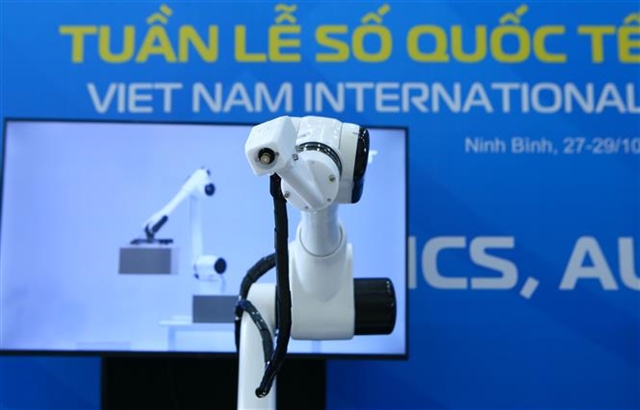
| A robotic arm is displayed at Vietnam International Digital Week in Ninh Bình province. VNA/VNS Photo |
HÀ NỘI — Việt Nam has put in place a broad legal framework for developing strategic technologies, with startups and small firms eligible to take part in government-backed programmes alongside large corporations, a Ministry of Science and Technology official said.
Hoàng Anh Tú, deputy head of the ministry's Department of Science and Technology, said the framework was largely complete and did not distinguish between companies based on size or corporate structure.
Tú said the legal framework for strategic technologies was largely comprehensive and applied equally to large and small enterprises, including startups and major corporations.
The framework covers the development and commercialisation of technologies considered strategically important to Việt Nam, including support for research, technology development, product certification and business incubation.
A number of strategic technology products have already moved from research into commercialisation, he said.
The ministry has advised the Government on Decree 260, which provides guidance on the Law on High Technologies and took effect on June 30, as well as five circulars related to strategic technology development.
Circulars 42, 48 and 49 cover strategic technology development tasks, while Circular 40 sets out procedures for certifying strategic technology products. Circular 38 provides rules on the incubation of strategic technology enterprises.
The regulations establish a framework covering several stages of technology development, from research and development tasks to product certification and the formation of technology companies.
Startups eligible to lead projects
Startups can also propose themselves as the lead organisation for strategic technology development tasks, Tú said.
He cited RT Robotics, a startup working in the drone sector, as an example. The company operates from a small facility in HCM City but has developed products for the US market and reached customers in the defence sector.
The company is among businesses registering to take part in strategic technology development tasks, he said.
The example illustrates the Government's intention to allow smaller technology companies to participate directly in programmes that could otherwise be dominated by larger corporations.
Participation, however, does not automatically guarantee state support. Companies must still propose or take part in specific strategic technology tasks and meet the relevant requirements.
The government is also looking to expand access to research infrastructure, particularly computing capacity needed for artificial intelligence development.
Tú said the Ministry of Science and Technology had submitted to the prime minister a proposal on laboratories and research centres under Decision 1493/QD-TTg.
The proposed centres and laboratories would include facilities for AI research, with an emphasis on shared use. Startups and other companies developing AI models could use common infrastructure, including computing resources, once the facilities are established, he said.
Access to computing power is a major cost for companies developing increasingly sophisticated AI systems, particularly smaller firms that may not have the resources to build their own infrastructure.
The planned shared facilities would allow computing resources and research infrastructure to be used by a wider group of companies and research organisations.
Tech sandboxes
The ministry is also considering the use of regulatory sandboxes for emerging technologies such as AI.
Tú said the first step would be to clearly define what is to be tested, including the particular sector or application covered by an AI sandbox.
Once the scope is defined, existing rules on controlled experimentation could be applied, he said.
Rather than creating a broad exemption from existing regulations, the approach would provide a defined environment in which a specific technology or application could be tested under controlled conditions.
Tú also referred to Articles 21 to 24 of the Law on Science and Technology, which provide a framework for controlled experimentation in areas beyond the digital technology sector.
The provisions could support testing and development in other fields as Việt Nam seeks to expand the use of strategic technologies across the economy. VNS
Society
 Society
 Society
 Society
 Society
 Society
 Society
 Society
 Society
 Society
 Society
 Society
 Society
 Society
 Society