 Society
Malaysian tourist rescued after falling into 10-metre-deep hole in Đà Lạt
1.
|
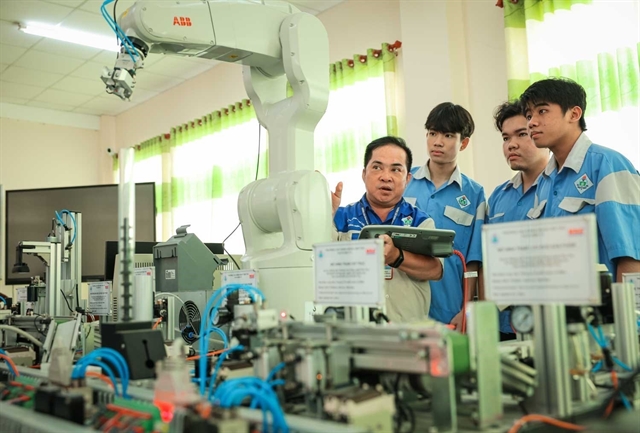
| An instructor explains the structure and operation of a robotic arm to a group of students at the Cần Thơ Vocational College. — VNA/VNS Photo |
HÀ NỘI — Việt Nam's technology output is outpacing the education, research and institutional base behind it, the latest Global Innovation Index shows, a gap that officials say must narrow if the country aims to join the world's 40 most innovative economies by 2030.
The index, published by the World Intellectual Property Organisation on September 29, lifted Việt Nam one place to 43rd of 139 economies.
Beneath that modest gain, the two halves of the index moved in opposite directions. Việt Nam's ranking for innovation outputs improved two places to 35th, while its ranking for inputs, the conditions that make innovation possible, fell four places to 54th.
Minister of Science and Technology Vũ Hải Quân said Việt Nam still had much to do and that the most important requirement was greater involvement from businesses.
Companies need to invest far more money and staff in research and development and use technology and digital tools to raise product quality, value, and productivity, he said.
Only with genuine commitment from the private sector can Viêt Janm meet its 2030 target and its longer-term goal of a top-30 place by 2045, he said.
The slide in inputs was broad. Việt Nam fell in institutions, to 64th from 59th; human capital and research, to 79th from 70th; infrastructure, to 59th from 56th; and business sophistication, to 48th from 45th.
Education stands out as the weakest area. Việt Nam ranked 112th for education spending relative to economic output and placed in the bottom half or lower for university enrollment, student-teacher ratios, foreign student intake and jobs in knowledge-intensive industries.
Funding and knowledge flows are also thin. Venture capital indicators fell six places to 68th, and Việt Nam ranked 134th for imports of ICT services, reflecting a limited ability to absorb know-how from foreign companies.
It placed 81st for rule of law and 91st for regulatory quality, and ranked outside the top 100 for scientific publications, income from intellectual property and exports of ICT services.
The output side tells a different story. Việt Nam again ranked first in the world for high-tech exports and creative goods exports as a share of total trade, and placed in the top 10 for high-tech imports, mobile app development and labour productivity growth.
Its knowledge and technology outputs rose four places to 35th, and the complexity of its production and exports jumped eight places to 44th.
The minister credited those gains to the aggressive rollout over the past year of Resolution 57, the Communist Party Politburo's directive on science and technology, which has brought a sharp rise in spending on research and digital transformation and a gradual overhaul of the legal framework.
Management of the sector is shifting from tracking inputs to measuring results, he said, with resources concentrated on research and strategic technologies.
A few input measures did improve. Access to information and communications technology rose 11 places to 66th, university-industry research collaboration climbed seven places to 24th, and startup financing strengthened.
Việt Nam now has three billion-dollar 'unicorn' companies and a growing number of science-based startups.
Over the longer term, Việt Nam has climbed 16 places in a decade, from 59th in 2016, and WIPO lists it among the seven middle-income economies that have risen fastest since 2013.
It ranks second among lower-middle-income economies, behind India, and third in Southeast Asia after Singapore and Malaysia, just ahead of Thailand.
The minister said Việt Nam also needs to train more highly skilled workers and postgraduates for strategic technology sectors and lift its output of international scientific publications and patents.
His ministry, which coordinates government efforts to improve the ranking, plans to refine regulations, encourage R&D spending, court multinationals to open research centres in Việt Nam, steer more funding to technology startups and help local companies adopt and master new technologies.
Published annually, the index rates economies on inputs such as institutions, human capital, infrastructure and market conditions, and on outputs in knowledge, technology and creative goods. WIPO says 93 member states draw on it when shaping innovation policy. — VNS
Society
 Society
 Society
 Society
 Society
 Society
 Society
 Society
 Society
 Society
 Society
 Society
 Society
 Society
 Society