 Economy


General Secretary and President Tô Lâm wraps up official visit to EU, Belgium
1.

|
| At a construction site on the North bank embellishment project of Hương River, Kim Long Ward, Huế City. — VNA/VNS Photo |
HÀ NỘI — Việt Nam will seek to reduce the number of public investment projects by at least 30 per cent during the current term to concentrate resources on key infrastructure and development priorities, said Prime Minister Lê Minh Hưng.
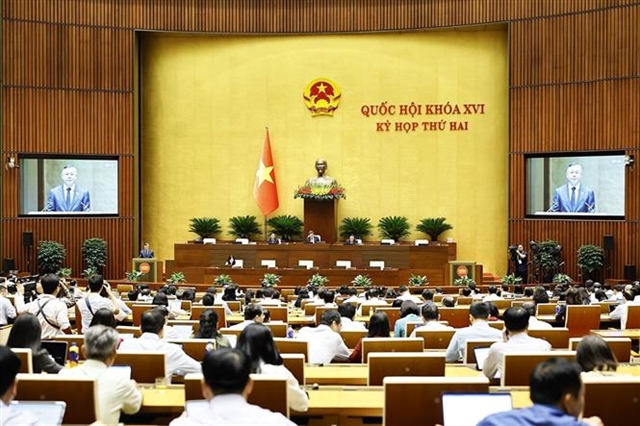
Speaking during a group discussion at the National Assembly on proposed amendments to the State Budget Law, tax legislation and the Bidding Law on October 23, Hưng emphasised the need to improve public investment efficiency while simplifying investment and procurement procedures without weakening oversight.
Under Conclusion No. 18 of the second plenum of the Party Central Committee, public investment must deliver stronger socio-economic returns, with project selection and implementation focused on tangible results.
Việt Nam had around 5,000 public investment projects during the previous term, a substantial reduction compared with earlier terms. However, the Central Committee has now called for a further reduction of at least 30 per cent in the number of projects during the current term, the PM said.
Resources should be concentrated on projects with broad spillover effects that provide a foundation for socio-economic development across regions and localities, particularly key economic regions.
Priority should also be given to poverty reduction, support for ethnic minority communities and disadvantaged areas, national defence and security, and essential services such as healthcare, education and culture.
Hưng said public investment performance should be assessed comprehensively, taking into account contributions to infrastructure development, improvements in living standards and social welfare.
Evaluation should cover the entire project lifecycle, from preparation, appraisal and approval through implementation, operation and post-investment use, rather than focusing solely on construction progress or capital disbursement.
The draft legislation also clarifies the responsibilities of parties involved in public investment decisions and implementation, according to the PM.
The Government will establish procedures for evaluating investment efficiency, while ministries and central agencies will provide sector-specific and field-specific criteria. Heads of budget-using units will be responsible for assessing projects when proposing, allocating, managing and using public investment capital.
The proposed amendments seek to streamline public investment procedures, particularly for Group C projects, which accounted for more than 60 per cent of all public investment projects during the previous term.
Under the draft, these projects would no longer require a separate in-principle investment approval stage. Instead, the necessary contents would be incorporated into the investment decision process.
Larger Group A and Group B projects, as well as nationally important projects, would still be subject to in-principle investment approval because of their scale and longer implementation periods.
Hưng said the Government would continue reviewing and simplifying administrative procedures and documentation while ensuring that projects meet their investment objectives and deliver the intended benefits.
The draft also revises procedures for preparing, allocating and assigning public investment capital, with the aim of integrating the allocation of development investment funds and recurrent expenditure into five-year financial plans and annual budget estimates.
On the transfer of budget balances between fiscal years, the PM stressed the need to preserve the central budget's leading role in financing key expenditure responsibilities, supporting localities and implementing major projects.
The draft legislation also introduces a principle requiring policymakers to assess the full impact of proposed policies and regimes, identify their funding sources and determine whether each level of government has sufficient budgetary capacity to implement them. — BIZHUB/VNS
Economy
 Economy
 Economy
 Economy
 Economy
 Economy
 Economy
 Economy
 Economy
 Economy
 Economy
 Economy
 Economy
 Economy
.jpg) Economy