 Sci-Tech

Quán Ăn Ngon Restaurant receives two top awards at World Top Gourmet Awards 2026 in Malaysia
1.
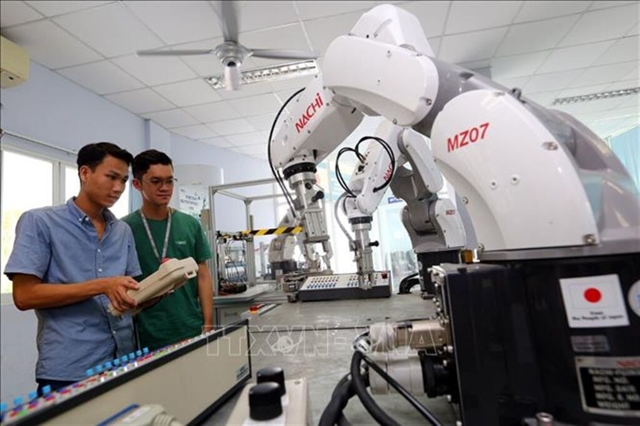 |
| Trainees practise robot programming and operation at the Hồ Chí Minh City Hi-Tech Park Training Centre. VNA/VNS Photo |
CẦN THƠ — Việt Nam’s digital technology industry now comprises more than 80,000 enterprises and employs over 1.9 million people, with revenue estimated at about US$198 billion in 2025.
Đinh Thị Linh Hương, Deputy Director of the Department of Information Technology Industry under the Ministry of Science and Technology, presented the figures at a scientific workshop on connecting digital technology providers with businesses seeking to adopt their solutions, held in Cần Thơ on September 10.
The workshop was organised by the Cần Thơ City Department of Science and Technology in co-ordination with relevant agencies. It aimed to connect technology providers with potential users and gather feedback from local authorities and businesses on the difficulties they face, helping improve policies, regulatory mechanisms and sandbox provisions.
According to Hương, the industry must not only continue expanding, but also make a decisive shift towards generating greater added value, strengthening research and design capacity, mastering core technologies, developing “Made in Việt Nam” products and participating more deeply in global value chains.
The institutional and policy framework needed to support this transition has also advanced significantly. The Law on Digital Technology Industry, which took effect on January 1, 2026, provides a legal foundation for developing digital technology enterprises, products, services and human resources.
It also introduces mechanisms to encourage technology adoption, expand markets and strengthen links between technology providers and agencies, organisations and businesses seeking digital solutions.
AI creates new opportunities for growth
Alongside the expansion of the digital technology industry, artificial intelligence (AI) is creating new opportunities for development. While the industry produces enterprises, products and technological platforms, AI provides additional capabilities that enhance the value of products and services and accelerate transformation across sectors.
The year 2026 marked a turning point with the Law on Artificial Intelligence and its guiding documents coming into force. On August 28, the Prime Minister issued Decision 1671/QĐ-TTg approving the National Strategy on Artificial Intelligence through 2030, with a vision to 2045.
The strategy seeks to move Việt Nam beyond simply researching and applying AI towards developing the technology comprehensively and using it to support national transformation.
AI solutions must be based on practical needs and address specific challenges facing businesses and society, thereby increasing productivity, reducing costs and improving governance.
These directions are particularly relevant to Cần Thơ and the wider Cửu Long (Mekong) Delta region. Digital technology and AI can help address local challenges in key areas such as agriculture, logistics, commerce, education, healthcare, urban governance and business operations.
They can generate new sources of productivity and value for the region while also providing technology enterprises with a broad, practical market in which to develop, test and refine their products. — VNS
Sci-Tech
 Sci-Tech
 Sci-Tech
 Sci-Tech
 Sci-Tech
 Sci-Tech
 Sci-Tech
 Sci-Tech
 Sci-Tech
 Sci-Tech
 Sci-Tech
 Sci-Tech
 Sci-Tech
 Sci-Tech
 Sci-Tech