 Sci-Tech
.jpg)
Điện Biên Province eyes trade, investment links with China, Laos
1.
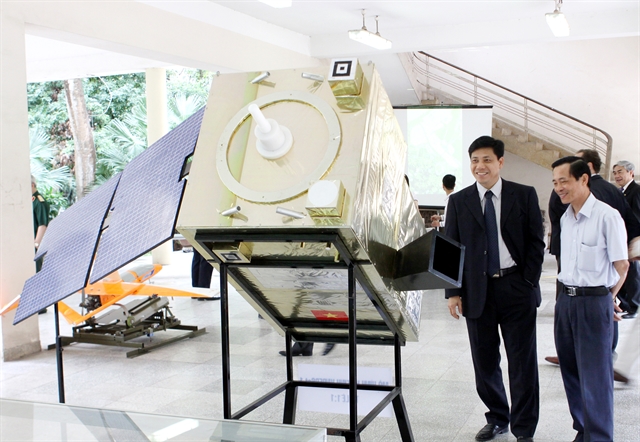 |
| A model of the VNREDSat-1 remote sensing satellite on display at the Vietnam Academy of Science and Technology. — VNA/VNS Photo Vũ Sinh |
HÀ NỘI — The achievements of the VNREDSat-1 programme have laid a foundation for cooperation in space technology between Việt Nam and France to enter a new phase, aimed at developing next-generation satellite systems, strengthening training and technology transfer, and gradually enhancing Việt Nam’s technological capabilities.
Trần Hồng Thái, president of the Vietnam Academy of Science and Technology, spoke to the Vietnam News Agency about the outcomes and prospects for Vietnamese-French cooperation in science and technology during Party General Secretary and President Tô Lâm’s visit to attend the Space Summit in Paris, France from Monday to Saturday this week.
The visit is expected to provide fresh momentum to the Việt Nam-France Comprehensive Strategic Partnership, with science, technology and innovation identified as areas offering considerable potential for cooperation.
The VNREDSat-1 satellite stands out as one of the most notable achievements of the scientific and technological cooperation between Việt Nam and France.
Thái said VNREDSat-1 should be viewed not merely as Việt Nam’s first Earth observation satellite, but more importantly as a national capacity-building programme in satellite technology.
The satellite was successfully launched on May 7, 2013, and the system was officially handed over to Việt Nam for operation in September 2013. As of 2026, its 14th year of operation, VNREDSat-1 has been still providing data, despite having an initial designed life of just five years.
This is a significant achievement, both in terms of the system’s durability and the capabilities of the Vietnamese technical team operating it.
The first and most evident capability developed was the ability to operate a relatively comprehensive satellite system. VNREDSat-1 comprises not only the satellite in orbit, but also a control system, receiving stations and ground-based data processing components.
Between 2011 and 2013, the academy worked with Astrium, now Airbus Defence and Space, to organise intensive training programmes for Vietnamese engineers in both France and Việt Nam.
After training, the engineers received system operation certificates and gained practical experience in system design and operation, as well as analysing and handling real-world technical issues involving satellite technology and ground stations.
Following the technology transfer process, the engineers became capable of independently operating and effectively using VNREDSat-1. More importantly, their capability went beyond simply following an operational procedure that had been transferred to them.
During its much longer-than-designed operational lifetime, the system encountered a number of technical problems. With their intelligence, flexible thinking and high adaptability, the team at the Vietnam National Space Centre addressed the problems and coordinated troubleshooting efforts to maintain the system’s stable operation.
This marked an important transition from knowing how to operate the system to fully understanding it, being able to identify unforeseen problems and come up with technical solutions to handle them.
Another capability is mastery of the remote-sensing data exploitation cycle. Việt Nam has established an integrated system covering imaging requirements, satellite control, data reception, processing, storage and the provision of image products.
VNREDSat-1 data has been used for natural resource and environmental management, disaster monitoring, scientific research, training, socio-economic development, and national defence and security-related tasks.
Since 2020 alone, the system has provided nearly 30,000 satellite images.
“This is highly significant, because having its own satellite enables a country to be proactive in determining when images are captured, which areas are observed and what data are required for priority tasks,” Thái said.
The third capability is the development of skilled personnel and a technical foundation for subsequent satellite programmes.
Engineers trained on VNREDSat-1 have not just served a single project. Their knowledge and operational experience, together with the ground infrastructure and methods for managing a space mission, have become part of Việt Nam’s national capabilities.
“The process has also helped us identify more clearly which tasks we can undertake independently and which core technologies still require further research and technology acquisition,” Thái said.
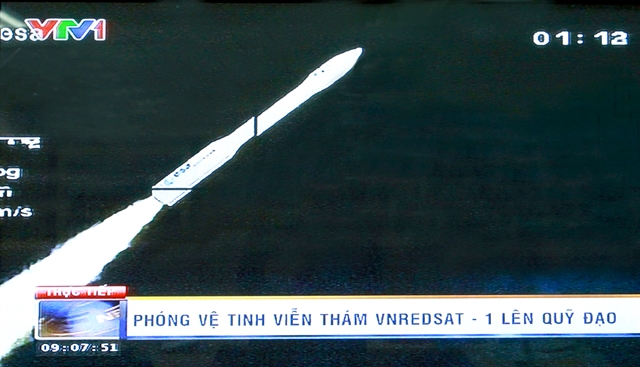 |
| A sreenshot of VNREDSat-1 launching into space from the Kourou launch site in French Guiana on May 7, 2013, which was broadcast on Vietnam Television. — VNA/VNS Photo Doãn Tấn |
Technological self-reliance
Thái stressed that Việt Nam’s ability to operate VNREDSat-1 independently does not mean the country has mastered the full range of technologies required to design and manufacture Earth observation satellites.
VNREDSat-1 has provided an important foundation.
However, to achieve greater technological self-reliance, Việt Nam needs to deepen its capabilities in system design, payload, satellite electronics, flight software, assembly, integration and testing, as well as ground-station technologies.
A new phase of cooperation started during French President Emmanuel Macron’s state visit to Việt Nam in May 2025, when the Vietnam Academy of Science and Technology, Airbus Defence and Space and the French National Centre for Space Studies signed a Declaration of Intent to promote long-term cooperation in space technology and Earth observation.
The three sides agreed to explore the development of a next-generation Earth observation system drawing on advanced technologies from the CO3D programme, while also considering training and technology transfer under future projects.
Building on the success of VNREDSat-1, Việt Nam and France are also discussing technological options, resources and an implementation roadmap for a proposed VNREDSat-2.
The objective is not only to develop a new-generation satellite, but also to increase Việt Nam’s participation in the development process and strengthen its technological capabilities.
In the longer term, Việt Nam aims to gradually master Earth observation satellites, satellite constellations and space data infrastructure.
Cooperation with countries possessing advanced space capabilities, including France, Japan, Russia and China, will therefore remain important.
“Our principle is selective cooperation, linking technology transfer with workforce training and the direct participation of Vietnamese scientists and engineers, shortening the path towards technological self-reliance,” Thái said.
He added that space technology requires the integration of numerous advanced disciplines, from precision engineering, optics and electronics to control systems, telecommunications, materials, software and data science.
It also demands extensive testing infrastructure, strict quality control and experience accumulated through successive generations of products.
For Việt Nam, international cooperation can help narrow the technological gap, reduce investment costs and support the gradual mastery of advanced technologies.
“However, technological mastery cannot be achieved in a single leap and requires a systematic, long-term roadmap,” he said.
Under future satellite programmes, the academy aims to ensure that Vietnamese scientists and engineers are involved from the outset, from mission definition and system design to the development and testing of subsystems, software and ground systems as well as data exploitation.
Particular importance will be attached to assembly, integration and testing, which can provide practical training for engineers and help them understand satellites as integrated systems.
Việt Nam needs to focus on areas where it can develop competitive advantages, including control software, image processing, AI for remote-sensing data, ground systems and selected sensors and payloads.
A technology-transfer project can only be considered successful when Vietnamese teams can independently operate, troubleshoot and improve systems after foreign experts have departed, and eventually design the next generation themselves.
“The goal is not simply to own another satellite, but to possess the capability to create and develop satellite technologies,” he said.
This is the approach that the academy seeks to pursue in its cooperation with France, moving from system procurement to co-development, from operational training to design training, and from the transfer of individual products to the development of sustainable technological capabilities in Việt Nam.
Assessing the significance of Lâm’s current official visit to France and attendance at the Space Summit, Thái said the trip was highly important to the Việt Nam-France Comprehensive Strategic Partnership, which is built on political trust and deep ties between the two countries.
He said the visit also helped uphold Việt Nam’s determination and resolve to master space capabilities, an area of growing strategic importance in the new era.
Thái expressed his belief that the visit would open up opportunities for substantive cooperation in science, technology and innovation, bringing into play France’s strengths, particularly in strategic and space technologies, in line with Việt Nam’s evolving development needs.
It also presents an opportunity for the academy to strengthen cooperation with French partners in research, training and technology development, thus gaining access to new knowledge, enhancing research capacity and gradually mastering technologies to address the country’s development challenges. — VNS
Sci-Tech
 Sci-Tech
 Sci-Tech
 Sci-Tech
 Sci-Tech
 Sci-Tech
 Sci-Tech
 Sci-Tech
 Sci-Tech
 Sci-Tech
 Sci-Tech
 Sci-Tech
 Sci-Tech
 Sci-Tech
 Sci-Tech