 Sci-Tech

AITO Looks Ahead to Europe, Building a Thriving Automotive Ecosystem
1.
 |
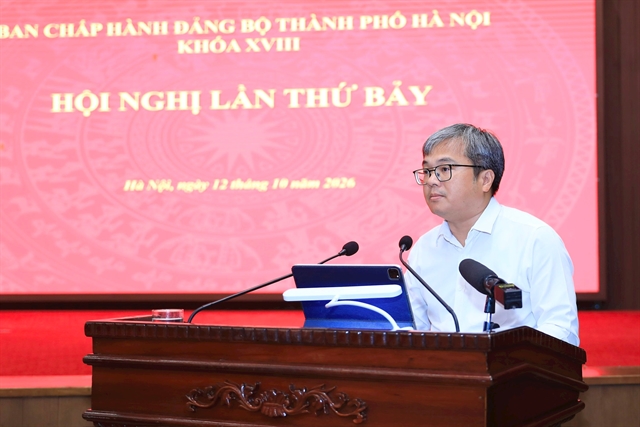
| Đào Ngọc Chiến, Director of the National Foundation for Science and Technology Development (NAFOSTED). — VNA/VNS Photo |
HÀ NỘI — The State can cover up to 100 per cent of funding for high-risk strategic technology research and development tasks, while projects closer to application and commercialisation may receive up to 70 per cent, according to Đào Ngọc Chiến, Director of the National Foundation for Science and Technology Development (NAFOSTED).
Speaking to clarify the implementation of Circular No. 49/2026/TT-BKHCN, recently issued by the Ministry of Science and Technology recently, Chiến said the financial mechanism was designed around risk-sharing, results-based funding and greater autonomy for research organisations, while maintaining accountability for public resources.
He expected the mechanism to create better conditions for organisations, businesses and scientists to master technologies, develop products, and bring research results into practical applications.
Chiến said Circular 49 was not a standalone policy, but rather a concrete implementation of new policies and legislation on science, technology and innovation.
Politburo's Resolution No. 57-NQ/TW calls for institutions and regulations to move ahead of development, prioritises national resources for strategic technologies and promotes policies to attract and make effective use of talent.
These principles have been further institutionalised through the 2025 Law on Science, Technology and Innovation, the Law on High Technologies, the Law on State Budget and relevant Government decrees on finance, investment and the management of science, technology and innovation tasks.
Against this legal backdrop, Circular 49 establishes detailed rules for budgeting, spending, payment and settlement, based on an approach in which the State shares risks while mobilising resources from society.
Funding linked to priorities and risks
A key feature of the new mechanism is that financial support will vary according to the priority, risk level and capacity to mobilise resources of each task.
For State-commissioned tasks aimed at developing core or foundational technologies, technologies of particular importance to national technological autonomy, national security or defence, or high-risk tasks, the State budget may cover up to 100 per cent of funding.
For strategic technology products that already have potential for application, technology transfer or commercialisation, State budget support can reach up to 70 per cent, with the remainder mobilised from businesses and other lawful sources.
The support rate is therefore not applied uniformly. Instead, it reflects the technology's objectives, the product's development stage, its risk level and its prospects for generating value.
“The philosophy is that the State will share risks at the most difficult stages, while creating incentives for the non-State sector to invest alongside it,” Chiến said.
Three shifts in task management
According to the NAFOSTED director, Circular 49 represents three important shifts in how resources for strategic technology R&D are managed.
First, from input management to results-based management.
Tasks are divided into work packages (WPs), each linked to specific outputs and assessment milestones. Funding is allocated according to the results achieved by each work package.
Second, from procedural control to milestone-based governance.
Each assessment milestone serves as a control point. If the required results are achieved, funding continues and subsequent work packages can be implemented. If they are not, the research approach can be adjusted or the task terminated.
The approach is intended to concentrate resources on research directions with stronger prospects and greater feasibility.
Third, from pre-control to autonomy combined with post-inspection.
Lead organisations and research teams will have greater discretion during implementation, while also being required to strengthen accountability and risk management.
The three shifts are closely connected: greater autonomy is intended to accelerate implementation; results-based management ensures more effective use of public investment; and stronger post-inspection safeguards accountability for public resources.
Up to VNĐ300 million a month for chief engineers
One of the most notable innovations in Circular 49 is its mechanism for remuneration in strategic technology development tasks.
Remuneration is determined according to the position, responsibilities, outputs and time spent on the project. The highest ceiling is VNĐ300 million (US$11,500) per month for a chief engineer, while the ceiling for a task leader is VNĐ150 million per month.
Different ceilings apply to key members, other members, scientific secretaries, and technicians according to their roles.
These are ceilings used for preparing, appraising and approving budgets, rather than mandatory payments for every task. Actual remuneration must reflect the nature of the work, an individual's capabilities, their participation time and the required outputs.
Chiến said the VNĐ300 million monthly ceiling for chief engineers was benchmarked against remuneration at Singapore's Agency for Science, Technology and Research (A*STAR), then adjusted according to purchasing power parity between the two countries and the scarcity of relevant talent.
In addition to regular project personnel, domestic and international experts may be hired under negotiated arrangements. In ordinary cases, the maximum remuneration may equal that of a task leader. In exceptional cases, higher remuneration may be approved by the competent authority.
Expert hiring is to be based on professional requirements, the scope of work, qualifications, experience, participation time, market rates and international practices.
Funding follows results
Under the new mechanism, State budget funding and counterpart contributions are allocated to individual work packages. Each package must clearly define its objectives, scope of work, outputs, budget, responsible organisation or individual and implementation timeline.
Work packages are grouped into assessment milestones. Assessment councils will focus on the outputs and evidence established from the outset, rather than simply examining how much money has been spent or how many procedures have been completed.
Results at each milestone will provide the basis for payment, financial settlement and the allocation of funding for subsequent work packages. Where requirements are not met, funding can be adjusted or stopped.
The core principle is therefore: “funding follows results.”
The mechanism also takes into account the inherent uncertainty of R&D. A technological problem may be approached through several independent research options. After each assessment milestone, the more promising approach can continue, while ineffective approaches can be adjusted or discontinued.
Circular 49 also sets aside 10 per cent of the total State budget funding as a contingency reserve to deal with unforeseen changes during multi-year projects.
Lead organisations may also advance lawful funding sources to immediately implement urgent activities while waiting for State budget disbursement.
Notably, counterpart contributions do not have to consist solely of cash. They may include machinery and equipment, laboratories, intellectual property rights and human resources. This expands the scope for collaboration among the State, research institutes, universities and businesses.
Accepting scientific risk, not management violations
Another important principle is the acceptance of objective risks inherent in scientific research and technological development.
If a research approach fails to deliver its expected result but was implemented in accordance with procedures, with full transparency and honesty and sufficient supporting evidence, the scientific risk may be accepted.
However, accepting scientific risk is fundamentally different from accepting violations in the management or use of resources.
Implementation of tasks will be monitored through the national digital platform. Lead organisations are required to provide monthly updates on implementation and results, giving management agencies an additional means of indirectly assessing the feasibility and progress of research.
According to Chiến, the new mechanism seeks to create space for innovation by accepting risks while managing those risks to safeguard public resources.
The new financial mechanism can be summarised through five elements: investment in people based on their roles; market-based recruitment of experts; results-based management through work packages and assessment milestones; greater autonomy coupled with accountability; and controlled acceptance of risk.
Together, these measures are intended to establish a continuous chain from mastering strategic technologies to developing products, transferring technologies and commercialising research results. — VNS
Sci-Tech
 Sci-Tech
 Sci-Tech
 Sci-Tech
 Sci-Tech
 Sci-Tech
 Sci-Tech
 Sci-Tech
 Sci-Tech
 Sci-Tech
 Sci-Tech
 Sci-Tech
 Sci-Tech
 Sci-Tech
 Sci-Tech