 Sci-Tech
Swiss President Guy Parmelin arrives in Hà Nội, beginning official visit to Việt Nam
1.
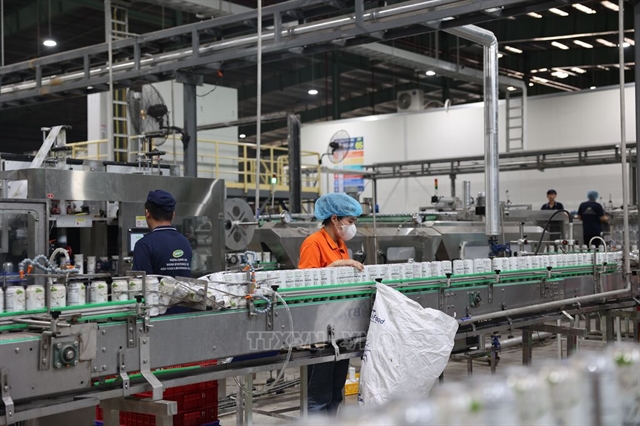 |
| Workers operate a production chain at a plant in the Châu Đức Industrial Park, HCM City. — VNA/VNS Photo |
HÀ NỘI — The National Technology Innovation Foundation (NATIF) is preparing a funding programme, as it seeks to accelerate AI adoption among businesses and expand opportunities for domestic AI solution providers.
The programme was discussed at a working session between NATIF and the Vietnam Association of Science and Technology Enterprises on September 26 at the Ministry of Science and Technology, focusing on proposals for technology innovation projects applying AI.
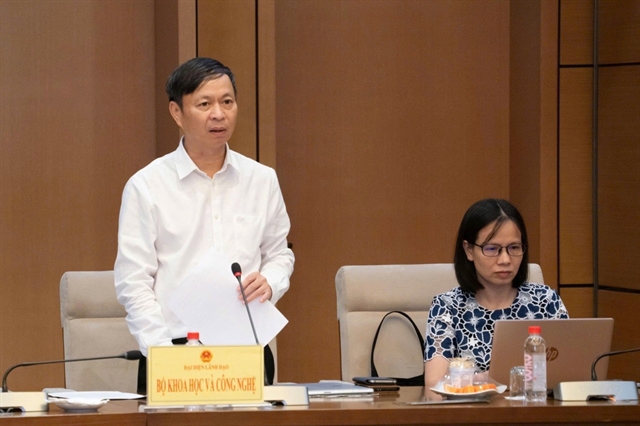
Chử Đức Hoàng, chief of NATIF's Office and head of its Funding and Commissioning Division, said the programme was being implemented under a new legal framework, including the 2025 Law on Science and Technology, and decrees like Decree No. 267/2025/NĐ-CP on science and technology tasks and Decree No. 268/2025/NĐ-CP on innovation activities.
NATIF plans to select and sign contracts for about 15 key AI application projects in 2026. From 2027, the programme is expected to expand to around 50 projects annually.
The programme is based on an adapted version of Singapore's 100 Experiment model, under which participating projects can receive funding of up to US$150,000, equivalent to about VNĐ3 billion.
The model has been adjusted to suit Việt Nam's business and technology environment.
Under the Vietnamese model, the programme brings together three groups.
The State, represented by NATIF, provides funding and strategic direction. Businesses identify practical problems and provide data, while research institutes, universities, experts, research teams and technology companies develop solutions.
Manufacturing and business enterprises of medium and large size that have practical AI needs and sufficient data are the priority group for submitting problems. Technology companies, including small and micro enterprises, can participate as solution providers.
The State will finance up to 50 per cent of the total cost of an approved project, capped at VNĐ3 billion. Participating businesses are responsible for the remaining funding, with cash contributions prioritised.
The funding mechanism is also designed to link disbursement to project progress rather than relying solely on final settlement.
"For example, under phased settlement, in the first stage, when the AI problem has been clarified and the data prepared, the enterprise will receive 20 per cent," Hoàng said.
"In the second stage, after successfully developing the AI model, the State will disburse 30 per cent. In the third stage, when the model is put into actual operation at the enterprise, its economic effectiveness is demonstrated and productivity is measured, and the enterprise will receive 50 per cent."
The mechanism is intended to tie public funding to measurable stages of AI deployment, from problem definition and data preparation to model development and production deployment.
The programme has received strong interest from the business community.
Nguyễn Thị Hương Liên, standing vice chairwoman of the Vietnam Association of Science and Technology Enterprises (VST) and vice chairwoman of Sao Thai Duong JSC, said the association had received 26 proposals shortly after being informed about the programme.
Of these, 14 enterprises registered as buyers, or businesses seeking to apply AI, while 12 registered as sellers, or providers of AI solutions.
Liên said the State's 50 per cent funding support was an important boost for domestic manufacturing businesses, helping them overcome cost barriers to AI adoption in areas including automation, sales management, quality control and competitiveness with foreign solutions.
At the discussion, businesses raised questions about application and evaluation procedures and how to define suitable AI problems. They also expressed a need to connect with expert networks to better understand their specific technology requirements and identify appropriate solutions.
Hoàng said NATIF would support businesses in clarifying their AI problems, accessing a structured approach to innovation and connecting with suitable experts.
He also proposed that VST establish a dedicated consulting team with appropriate training to provide direct guidance and support to its member enterprises nationwide. — BIZHUB/VNS
Sci-Tech
 Sci-Tech
 Sci-Tech
 Sci-Tech
 Sci-Tech
 Sci-Tech
 Sci-Tech
 Sci-Tech
 Sci-Tech
 Sci-Tech
 Sci-Tech
 Sci-Tech
 Sci-Tech
 Sci-Tech
 Sci-Tech