 Sci-Tech
NA Standing Committee urges inflation control, macroeconomic stability
1.
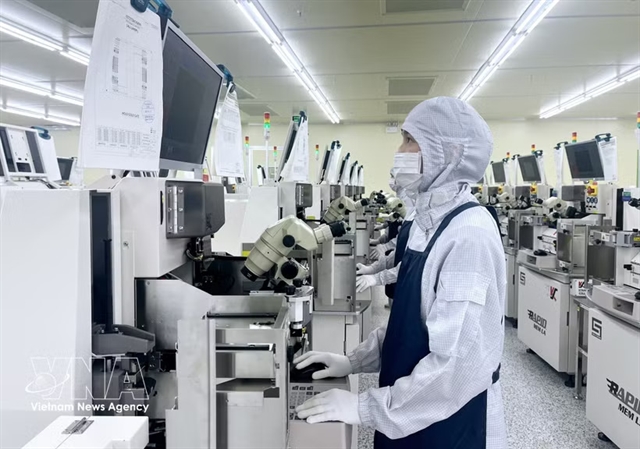 |
| The semiconductor industry is directly linked to the competitiveness, technological autonomy and security of each country, requiring domestic capabilities to develop in tandem with international cooperation. VNA/VNS Illustrative photo |
HÀ NỘI – The second Việt Nam–Japan Semiconductor Symposium 2026 (VJSS-2026) commenced in Hà Nội on Monday, seeking to promote academic exchanges and strengthen research cooperation between Việt Nam and Japan in the semiconductor sector
The event, co-organised by the Việt Nam Japan University (VJU) under Việt Nam National University, Hà Nội (VNU) and the Association of Vietnamese Intellectuals in Japan (AVIJ), is taking place until September 23.
Following the success of the first edition held in Japan's Osaka, it aims to become a forum connecting research, training and businesses in the semiconductor sector while expanding cooperation between Việt Nam, Japan and the international community.
VJSS-2026 provides a platform for scientists, experts and businesses to discuss the latest advances across a wide range of areas, from chip design, semiconductor components and materials to manufacturing, packaging and testing technologies, artificial intelligence and quantum computing.
Speaking at the symposium, Deputy Minister of Science and Technology Lê Xuân Định said the semiconductor industry is directly linked to the competitiveness, technological autonomy and security of each country, requiring domestic capabilities to develop in tandem with international cooperation.
He said Việt Nam has clearly identified this direction. The Politburo's Resolution No. 57-NQ/TW identifies science, technology, innovation and digital transformation as a top strategic breakthrough in which gradually mastering semiconductor technology is a requirement.
The deputy minister also noted that the two countries have complementary strengths. Japan possesses cutting-edge technologies, industrial experience and an advanced training system while Việt Nam has a young workforce, a developing electronics manufacturing sector and strong political determination. The Việt Nam–Japan Comprehensive Strategic Partnership provides a favourable framework for the two countries to expand cooperation in this field.
At the event, Assoc. Prof. and Dr Bùi Thế Duy, President of VNU Hà Nội, said the university welcomes international partners, particularly those from Japan, to cooperate in joint research, technology development and the establishment of joint semiconductor laboratories.
VJU Rector Dr Nguyễn Hoàng Oanh said the symposium is expected not only to facilitate the exchange of scientific research findings but also to open up new opportunities for cooperation in research, training, human resources development and collaboration with businesses.
It also provides a platform for young scientists, postgraduate researchers and students to present their research findings, expand the international academic network and connect with the regional research community, he added.
Through thematic discussions, career orientation activities, academic mentoring and exchanges with businesses, VJSS-2026 aims to contribute to the development of high-quality human resources to meet the semiconductor industry's growing demand and promote stronger links among research, training and the needs of the industrial sector. — VNA/VNS
Sci-Tech
 Sci-Tech
 Sci-Tech
 Sci-Tech
 Sci-Tech
 Sci-Tech
 Sci-Tech
 Sci-Tech
 Sci-Tech
 Sci-Tech
 Sci-Tech
 Sci-Tech
 Sci-Tech
 Sci-Tech
 Sci-Tech