 Politics & Law

ECO Expo Asia opens at Hong Kong AsiaWorld-Expo in late October
1.
|
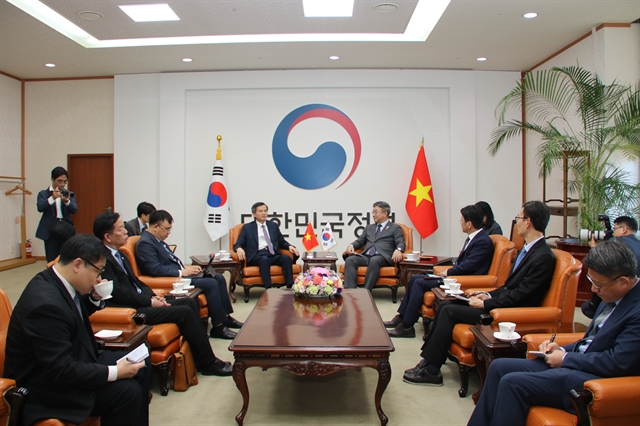
| The working session between representatives of the Hồ Chí Minh National Academy of Politics and the RoK Ministry of the Interior and Safety. VNA/VNS Photo |
SEOUL – A delegation of the Hồ Chí Minh National Academy of Politics (HCMA) led by its Director Assoc. Prof., Dr. Đòan Minh Huấn is paying a working visit to the Republic of Korea (RoK) from September 20-22 to strengthen cooperation in public governance, digital government and training of Vietnamese leaders and managers, particularly strategic-level cadres, to meet national development requirements in a new phase.
As part of the visit, the delegation held high-level meetings with representatives from Korean government agencies and leading economic groups.
At a Monday meeting in Seoul with Minister of the Interior and Safety Yun Ho Jung, Huấn, also a Politburo member, spoke highly of the RoK’s achievements in modernising public administration, developing digital government, improving local governance and ensuring public safety which are all areas of Việt Nam’s interest.
He said that Việt Nam is accelerating reforms in the organisation and operation of its political system, together with decentralisation, delegation of authority and national digital transformation. This requires increasingly strong capabilities among leaders and managers in policy implementation, inter-agency coordination and handling emerging issues.
As Việt Nam’s national centre for training and fostering senior and middle-level leaders and managers, conducting political-theory research and providing policy advice, the HCMA is seeking to link training more closely with research and policy consultation, he said.
Therefore, he proposed four priority areas of cooperation: strengthening public governance and policy implementation capacity; developing digital government and applying artificial intelligence (AI) in the public sector; enhancing local leadership and governance capacity; and sharing experience in responding to emergencies, natural disasters and other crises.
The two sides agreed to focus on two activities in 2027: organising a policy dialogue in Hà Nội on public governance and AI applications, with the participation of policymakers and experts from both countries; and establishing a cooperation framework between the HCMA and the RoK’s Local Government Officials Development Institute (LOGODI), with a view to signing a memorandum of understanding and organising the first training course for Vietnamese local leaders and managers.
At a meeting with Park Jong Min, Director General of the Department of Southwest Asia and Pacific Affairs of the Korea International Cooperation Agency (KOICA), Huấn expressed appreciation for the RoK’s long-term development cooperation with Việt Nam.
He called on KOICA to continue supporting Việt Nam in priority areas such as climate change response, green transition, science and technology, innovation, strategic infrastructure, social welfare and national governance capacity.
He also proposed the agency support a project to enhance the capacity to train Việt Nam’s strategic-level personnel for 2026-2030, as well as short-term training and study programmes in the RoK for Vietnamese officials and lecturers.
During the visit, the HCMA delegation also worked with Samsung Electronics Chief Financial Officer Park Soon Cheol. Huấn praised Samsung’s contributions to Việt Nam’s socio-economic development, particularly in job creation, exports and high-quality human resources training.
He proposed further developing the Việt Nam Official Strategic Program (VOSP), focusing on strategic thinking, digital transformation leadership, AI applications, talent development and innovation management, and expanding expert exchanges, joint research and practical training.
He stressed that Việt Nam considers science and technology, innovation and high-quality human resources key drivers of productivity and national competitiveness, and called on Samsung to expand high-tech investment, strengthen knowledge transfer and support Vietnamese enterprises in joining global supply chains.
The visit is expected to contribute to improving the quality of training for Việt Nam’s strategic cadres while further deepening the Việt Nam-RoK Comprehensive Strategic Partnership in the new development phase. — VNA/VNS
Politics & Law
 Politics & Law
 Politics & Law
 Politics & Law
 Politics & Law
 Politics & Law
 Politics & Law
 Politics & Law
 Politics & Law
 Politics & Law
 Politics & Law
 Politics & Law
 Politics & Law
 Politics & Law
 Politics & Law