 Politics & Law
Việt Nam, China urged to strengthen people-to-people ties, expand cooperation
1.
|
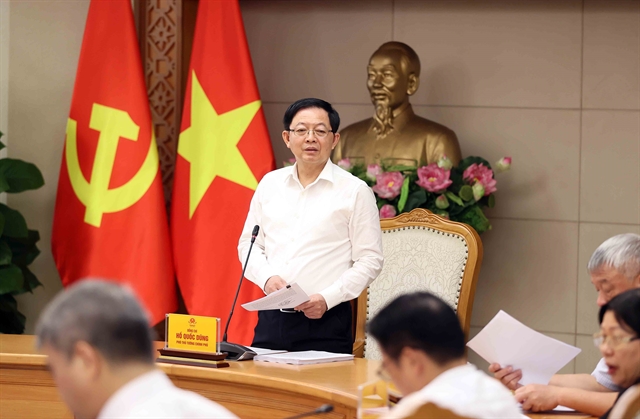
| Deputy Prime Minister Hồ Quốc Dũng speaks at the meeting with several ministries and agencies on the draft amended Land Law on Monday. VNA/VNS Photo |
HÀ NỘI — Deputy Prime Minister Hồ Quốc Dũng has called for a review of the draft amended Land Law with a view to including only framework and principle-based provisions, helping minimise the need for frequent amendments after the law takes effect.
He made the request on Monday while chairing a meeting with several ministries and agencies on the draft amended Land Law.
According to a report by the Ministry of Agriculture and Environment (MAE) on progress in drafting the law, the ministry has completed the draft law dossier and collected opinions from ministries, agencies, localities, affected groups, businesses and relevant organisations. It has also incorporated and provided explanations for comments from agencies and localities, as well as feedback from the Việt Nam Fatherland Front.
The ministry has reviewed 64 laws and codes directly related to the draft law, along with the Party's guidelines and policies and relevant legal documents. It has also studied and incorporated opinions raised by National Assembly deputies during group and plenary discussions on August 21, 2026, at the first extraordinary session of the 16th National Assembly.
Following appraisal by the Ministry of Justice, the MAE incorporated and explained the appraisal comments, completed the draft law dossier and submitted a report to the Prime Minister.
The draft law follows a new legislative approach set out in Resolution No. 66-NQ/TW, under which laws should provide framework and principle-based regulations, while matters subject to frequent changes should be assigned to the Government, ministries, agencies and local authorities for detailed regulation.
The draft comprises 13 chapters, three fewer than the 2024 Land Law. Some provisions on principles contained in the chapters removed from the structure have been incorporated into the remaining chapters.
The draft contains 115 articles, compared with 260 articles in the 2024 Land Law. The MAE has reviewed provisions of the existing Land Law that remain relevant, particularly those directly related to land users' rights, for inclusion in the draft. Detailed provisions on procedures and processes will be left to the Government to regulate.
The draft law is built around seven major land policy areas, including improving the quality of land-use planning and plans; completing regulations on land allocation, leasing and changes in land-use purposes; completing regulations on compensation, support and resettlement, as well as land recovery for national defence and security and for socio-economic development in the national and public interest; and improving land-related financial mechanisms and land pricing. Other policies are completing regulations on the rights and obligations of land users and land-use regimes; promoting administrative reform and digital transformation and strengthening State management of land, including decentralisation and delegation of authority; and reforming and strengthening inspection, examination, supervision and handling of violations, settlement of land-related disputes, complaints and denunciations, while tightening discipline and preventing corruption, waste and other misconduct.
At the meeting, representatives of ministries and agencies discussed several issues requiring further consideration, including the authority to carry out State land-management functions; notarisation and certification of contracts and documents related to land users' rights; regulations on deducting compensation, support and resettlement costs advanced by project developers from land-use fees and land rents; and land recovery for socio-economic development in the national and public interest.
Concluding the meeting, Deputy PM Dũng stressed that the draft law would have a profound and comprehensive impact on various aspects of social life.
He asked the MAE to proactively coordinate closely with relevant agencies to urgently review and thoroughly assess the issues covered by the draft law.
Commending participants for clarifying and proposing solutions to problems in the draft amended Land Law, particularly those concerning the decentralisation of authority for land recovery, notarisation regulations, compensation policies and land valuation, the Deputy Prime Minister reiterated the need to focus on framework and principle-based provisions in the law.
This approach, he said, would help minimise the need for frequent amendments when new issues arise in practice.
Regarding issues that remain subject to differing views, including notarisation and certification of contracts and documents related to land users' rights; the deduction of compensation, support and resettlement costs advanced by project developers from land-use fees and land rents; land valuation; and implementation of unified planning, the Deputy PM tasked the MAE with leading coordination with relevant agencies to continue reviewing and studying the issues carefully and reach agreement on the options to be included in the draft. — VNS
Politics & Law
 Politics & Law
 Politics & Law
 Politics & Law
 Politics & Law
 Politics & Law
 Politics & Law
 Politics & Law
 Politics & Law
 Politics & Law
 Politics & Law
 Politics & Law
 Politics & Law
 Politics & Law
 Politics & Law