 Sci-Tech
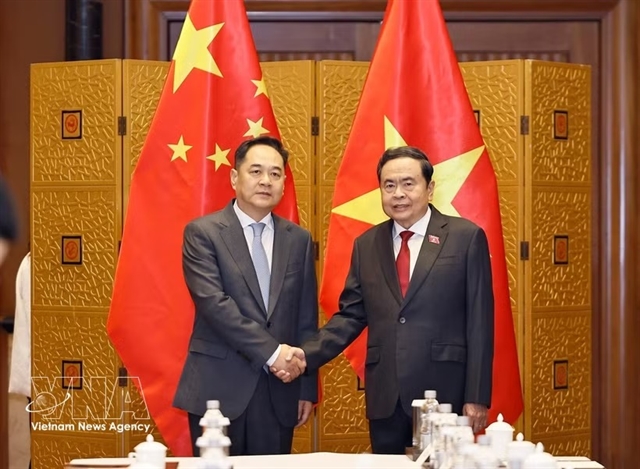
NA President meets with Chinese friendship figures in Beijing
1.
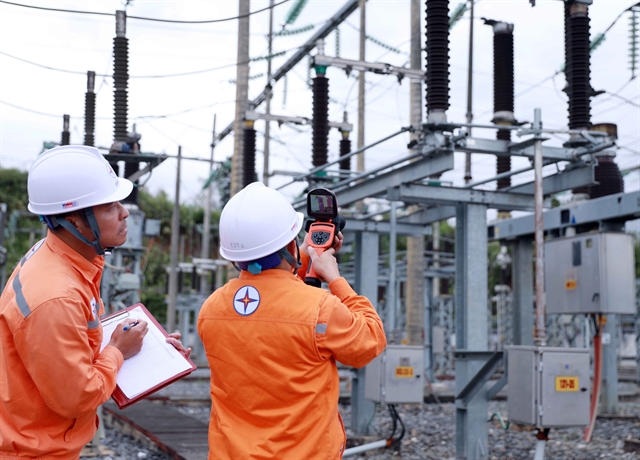 |
| Technical staff of Lai Châu Power Company use an electronic camera to check temperatures at connection points in the power grid to prevent incidents at a 110kV substation. — VNA/VNS Photo Quý Trung |
LAI CHÂU — Faced with rugged terrain, scattered communities and hard-to-reach areas, Lai Châu Province is turning to science, technology and digital transformation to improve production and management, expand development opportunities and create new drivers of sustainable growth.
Accelerating digital transformation in production and business
During the 2020–25 period, Lai Châu Province implemented 57 science and technology projects, including 52 at the provincial level and five at the national level. They focused on researching and conserving valuable medicinal plants, developing agriculture, forestry, fisheries and speciality products, protecting intellectual property and applying scientific advances in practice.
The province also supported 13 innovation initiatives and developed 173 pilot models involving science and technology, innovation and digital transformation.
Nearly 80 per cent of administrative procedures were submitted online, while 99 per cent of applications were processed on or ahead of schedule.
Mobile broadband coverage has reached 99.68 per cent of villages and hamlets, while the specialised data transmission network connects all provincial departments, agencies and commune-level People’s Committees.
Lai Châu Province has also issued its Digital Architecture framework and deployed shared digital platforms, gradually developing a data ecosystem to support digital government, the digital economy and digital society.
In terms of production and business, the digital economy accounted for 6.43 per cent of the province’s gross regional domestic product in 2025. A traceability system has been introduced for 83 OCOP and other agricultural products, while the province’s e-commerce platform lists 407 products, including 191 OCOP products.
However, rugged and fragmented terrain, scattered communities and remote areas continue to impede efforts to bring technology to where it is most needed.
The province is therefore seeking practical technological models suited to local conditions, with the aim of applying technology to production, management, natural resource management, environmental protection and disaster response in hard-to-reach areas.
Bringing technology to hard-to-reach areas
 |
| Farmers in Lai Châu Province have livestreamed to promote the freshest pears from Tân Phong Ward, helping bring the fruit to consumers nationwide. —VNA/VNS Photo Quý Trung |
Dương Đình Đức, Director of the provincial Department of Science and Technology, called on scientists, experts and businesses to share practical and highly applicable models at a workshop titled ‘Science, Technology and Innovation: Key Drivers of Socio-economic Growth in Lai Châu Province’ on September 20.
The workshop was organised by the provincial Department of Science and Technology in coordination with the Intellectual Property Office under the Ministry of Science and Technology.
Đức also called for solutions to promote research, technology application and transfer, develop innovative start-ups and strengthen links between technology supply and demand.
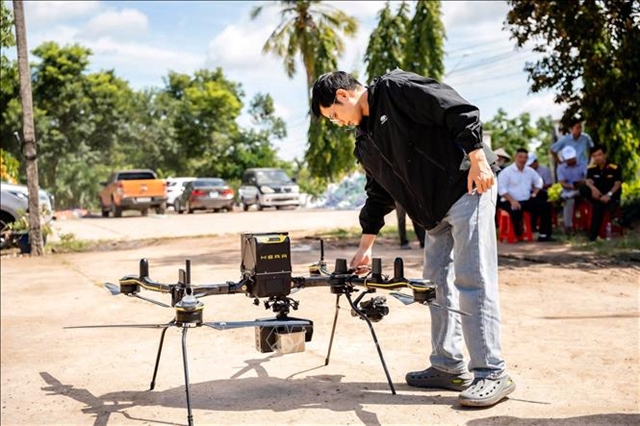
One area attracting attention is the use of UAVs combined with AI and other emerging technologies to address the province’s specific challenges.
UAVs can collect large amounts of data across wide areas in a short time, reach difficult terrain, continuously capture information and transmit data to processing centres.
In Lai Châu Province, with its rugged terrain, long border and dispersed infrastructure, UAVs could support agriculture, forestry, environmental protection, land management, digitalisation and infrastructure monitoring.
UAV data could help authorities rapidly assess conditions and monitor agricultural production, forests, land and natural resources, as well as support disaster response.
The province plans to initially select areas with clear practical needs for pilot projects, assess their effectiveness and refine operating procedures before deploying the technology more widely.
Khổng Quốc Minh from the Agency for Innovation said each centre could serve as a hub connecting stakeholders and promoting cooperation, support and innovation, helping address problems faced by businesses, local authorities and residents.
Nguyễn Tuấn Anh, Standing Deputy Secretary of the Lai Châu Provincial Party Committee, said the province needed to establish a safe legal environment and treat intellectual property rights as a ‘birth certificate’ for products and initiatives once they are officially recognised.
The province also aims to reform methods for assessing and valuing technologies and strengthen links among the responsibilities and interests of scientists, investors and local authorities.
Lai Châu Province also plans to become an open laboratory that proactively receives and tests new technologies suited to its development needs. It is calling for cooperation to attract promising technology projects and ideas for pilot implementation.
The province has proposed that the Ministry of Science and Technology consider Lai Châu Province as a site for the controlled testing of new technologies, UAVs and digital platforms. — VNS
Sci-Tech
 Sci-Tech
 Sci-Tech
 Sci-Tech
 Sci-Tech
 Sci-Tech
 Sci-Tech
 Sci-Tech
 Sci-Tech
 Sci-Tech
 Sci-Tech
 Sci-Tech
 Sci-Tech
 Sci-Tech
 Sci-Tech