 Sci-Tech
Việt Nam promotes hot spring tourism at Algerian forum
1.
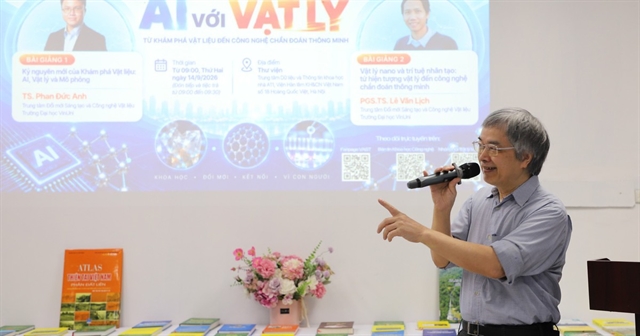 |
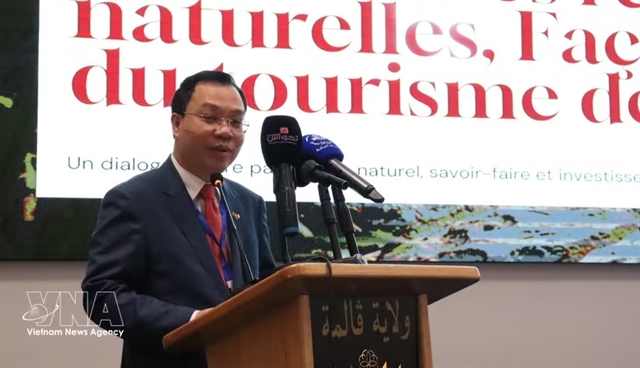
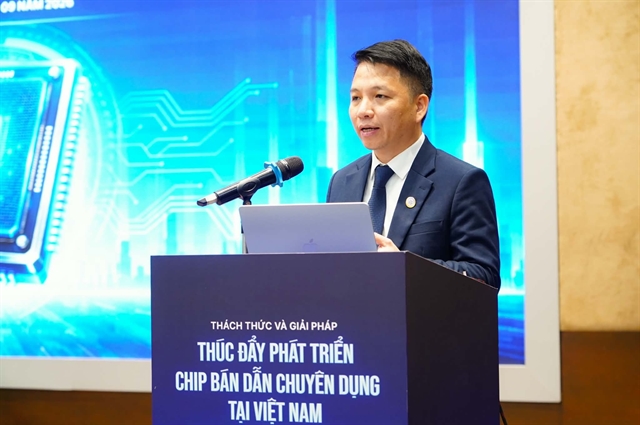
| Assoc. Prof. Dr Nguyễn Hồng Quang, Vice President and Secretary-General of the Vietnam Physical Society, addresses the programme. Photo chinhphu.vn |
HÀ NỘI — Artificial intelligence is expanding the possibilities for materials discovery and smart diagnostics, according to researchers speaking at a recent lecture programme on AI and physics.
Associate Professor Dr Nguyễn Hồng Quang, Vice Chairman and Secretary General of the Việt Nam Physical Society, said the rapid development of AI was ushering in a new technological era. This requires the scientific community not only to understand AI, but also to find effective ways to apply it within each specialist field.
Dr Phan Đức Anh from the Centre for Innovation and Materials Technology at VinUniversity delivered a lecture entitled “A New Era in Materials Discovery: AI, Physics and Simulation”.
According to Đức Anh, materials research has undergone several stages of development, from traditional experimental methods to the use of computer simulations to study complex physical systems. Advances in computing power and AI have now given scientists additional tools to process large volumes of data, predict properties and identify new material structures.
One notable approach is inverse design. Rather than beginning with a material structure and then predicting its properties, researchers can define the desired properties in advance and use AI to identify a suitable structure.
This opens up a new direction in materials discovery, in which humans define the scientific questions and objectives, while AI helps search and analyse vast numbers of possibilities across an enormous data space.
AI can also help scientists find, synthesise and analyse published research, identify emerging trends, suggest unresolved questions and predict the properties of various materials, including polymers, pharmaceuticals, metals and alloys.
However, Đức Anh stressed that AI could not replace scientists. The effectiveness of a model depends heavily on the quality, scale and relevance of its data. Researchers must therefore continue to define problems correctly, select appropriate data, evaluate models and verify results.
While AI is expanding the possibilities for materials discovery, it is also being applied in nanophysics to address problems with more immediate practical applications.
Associate Professor Dr Lê Văn Lịch, also from the Centre for Innovation and Materials Technology at VinUniversity, delivered a lecture entitled “Nanophysics and Artificial Intelligence: From Physical Phenomena to Smart Diagnostic Technology”.
His research group is using AI to detect and quantify the hepatitis B virus (HBV) through a combination of gold nanoparticles, nano-optical phenomena and machine-learning models.
Gold nanoparticles have distinctive optical properties, meaning that changes in the colour of a solution can indicate reactions taking place within the system. The research group is using this property to develop biosensors, with AI analysing images and converting colour information into quantitative data on viral load.
The research dataset comprises 990 images of samples with virus concentrations ranging from zero to 10⁸ copies per reaction. Of these, 810 data points were used for training, 162 for validation and 18 for testing. The group selected and compared three machine-learning models and three deep-learning models to assess their suitability for the task.
Its long-term objective is to integrate image-processing algorithms and AI models into smartphones. Users would then be able to photograph a sample with their phone, allowing the system to analyse the image automatically and produce a quantitative result.
To prepare the technology for real-world use, the research group is focusing on selectivity and specificity, its potential application to other pathogens and its integration into a point-of-care diagnostic solution.
These research directions demonstrate the potential of combining AI with specialist knowledge to address practical problems. They also reflect the spirit of the lecture series, with “AI and Physics” following “AI and Mathematics” in promoting academic exchange, connecting scientific disciplines and bringing new AI applications closer to the public. — VNS
Sci-Tech
 Sci-Tech
 Sci-Tech
 Sci-Tech
 Sci-Tech
 Sci-Tech
 Sci-Tech
 Sci-Tech
 Sci-Tech
 Sci-Tech
 Sci-Tech
 Sci-Tech
 Sci-Tech
 Sci-Tech
 Sci-Tech