 Sci-Tech

Panama’s export processing zones offer opportunities for Vietnamese firms
1.
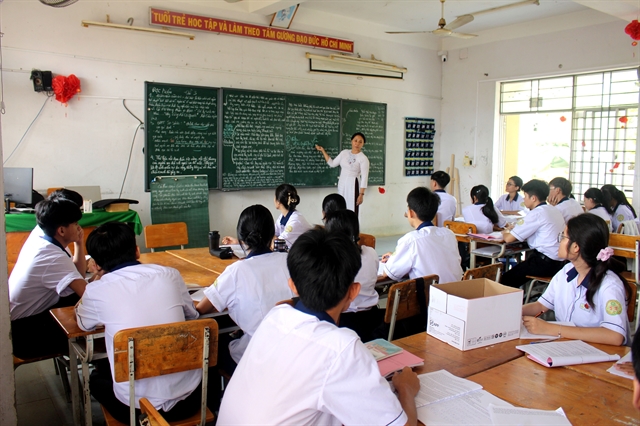 |
| An lesson at Hàm Thắng Boarding School for Ethnic Minority Students in Lâm Đồng. — VNA/VNS Photo Hồng Hiếu |
LÂM ĐỒNG — Lâm Đồng will introduce artificial intelligence (AI) education for students across the province in the 2026–2027 academic year, following a pilot programme at 47 schools in the previous academic year.
The programme will provide 12 core AI education periods for each grade per academic year. Schools will have flexibility in delivering the content through thematic lessons, integration into existing subjects and educational activities, as well as additional activities tailored to students’ needs.
AI integrated into school subjects
During the 2025–2026 academic year, Lâm Đồng piloted AI education at 47 schools, comprising 16 primary schools, 16 lower secondary schools and 15 upper secondary schools. All administrators and key teachers at participating schools completed training in accordance with guidance from the Ministry of Education and Training.
According to the provincial Department of Education and Training, most schools chose to integrate AI content into existing subjects, particularly Informatics. Lessons covered data, algorithms, computational thinking, AI tools and principles for the safe and responsible use of AI.
Some schools also incorporated AI into Mathematics, Literature, English, Natural Sciences, History, Geography, Civic Education and experiential activities.
Schools organised thematic sessions, AI, STEM, Informatics and Robotics clubs, technology days, AI forums and competitions to develop AI-powered products. Activities covered a range of topics, from identifying AI applications and writing prompts to using chatbots for learning, understanding AI ethics, protecting personal data and using AI responsibly.
The pilot showed that students were more engaged in practical activities, hands-on experiences and AI-related projects. Many learned to use AI tools to support their studies, prepare presentations, design products and complete project-based tasks.
They also began developing skills to verify information and assess the reliability of AI-generated results.
For teachers, the pilot helped shift perceptions of AI from a simple support tool to a means of improving teaching methods, personalising learning and assisting with assessment.
Trần Minh Hải, Principal of Trần Hưng Đạo High School for the Gifted, said students had shown strong interest and actively participated in lessons, thematic sessions and practical activities involving AI tools.
He added that teachers had also gradually developed a better understanding of AI education and become more proactive in adopting new teaching methods and organising technology-related activities.
From pilot to wider rollout
Based on the pilot results, the provincial Department of Education and Training has developed a plan to introduce AI education across schools from the 2026–2027 academic year.
Phan Thanh Hải, Deputy Director of the department, said the programme aimed to equip students with basic AI knowledge and practical skills, while helping them understand and assess the role of the technology in learning and daily life.
It also seeks to develop essential qualities and competencies, strengthen students’ critical thinking and information-verification skills, and promote the safe, ethical and responsible use of AI. At the same time, it will support the implementation of the national general education programme and innovation in teaching, learning and assessment.
The initiative is also expected to encourage independent learning and creativity among students, Hải said.
The AI education programme will consist of two components: core and extended content. The core component will include 12 periods for each grade per academic year, covering essential AI knowledge and skills that students can apply directly to their studies and educational activities. Schools will determine the extended content based on students’ needs and their own conditions.
AI education will be delivered in three forms: thematic lessons covering the core content; integration into school subjects and educational activities; and additional activities for students who wish to explore AI in greater depth.
Thematic AI lessons will be included in schools’ two-session-per-day education plans and tailored to different groups of students without creating additional academic pressure. Integrating AI into existing subjects will neither change nor increase the required learning outcomes of those subjects or educational activities.
Alongside technological knowledge and skills, the programme will emphasise the safe, ethical and responsible use of AI.
The rollout, however, faces several challenges. Some schools in remote and mountainous areas, as well as those with large ethnic minority student populations, still have limited computer facilities, equipment and internet connectivity. Teachers’ AI capabilities also remain uneven, according to the department.
To ensure effective implementation, the Department of Education and Training has asked schools to participate in training and provide further professional development for all administrators and teachers. Schools must incorporate AI education into their annual education plans and provide the required 12 core periods for each grade per academic year.
They must also secure the resources needed for two-session-per-day education, including staff, funding, facilities, equipment, learning materials, maintenance and technical support. — VNS
Sci-Tech
 Sci-Tech
 Sci-Tech
 Sci-Tech
 Sci-Tech
 Sci-Tech
 Sci-Tech
 Sci-Tech
 Sci-Tech
 Sci-Tech
 Sci-Tech
 Sci-Tech
 Sci-Tech
 Sci-Tech
 Sci-Tech