 Sci-Tech

ECO Expo Asia opens at Hong Kong AsiaWorld-Expo in late October
1.
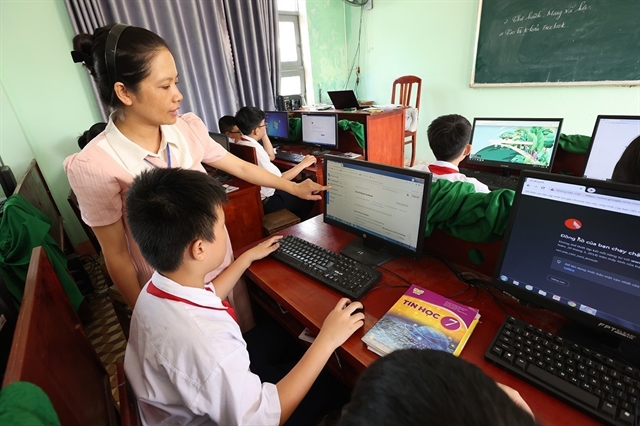 |
| An Information Technology class for eighth-grade students at Phước Quang Secondary School, Tuy Phước Bắc Commune, Gia Lai Province. —VNA/VNS Photo Vũ Sinh |
GIA LAI — Gia Lai Province is accelerating digital transformation in education, with digital school records, online learning resources and emerging technologies such as AI, STEM and robotics being used to modernise school management and teaching while strengthening students’ digital skills.
Digital transformation in management and teaching
Digital transformation in education in Gia Lai Province focuses on digitising records and managing data, as well as renewing teaching methods.
Currently, 100 per cent of general education institutions in the province have implemented digital school records and completed self-assessments of their level of digital transformation. They have also adopted the education sector's database, digital signatures and management software.
The sector's electronic system currently manages nearly 2.4 million records. Its digital learning resource repository contains more than 720,400 resources, while its examination question bank has more than 1.05 million questions.
The standardisation and use of data help improve management efficiency, reduce paperwork and support educational institutions in organising professional activities.
Alongside digital administration, technology is being increasingly integrated into teaching and learning. Many schools have introduced online learning platforms, digital learning resources and simulation tools. They are also gradually applying artificial intelligence to support teachers in renewing teaching methods and creating a more active learning environment for students.
Bringing STEM, AI and robotics into schools
Gia Lai Province has identified STEM education as an important direction for strengthening students' practical skills and access to technology. Under Plan No. 285/KH-UBND dated July 17, 2026, the province aims to ensure that 100 per cent of general education students have access to STEM through mainstream lessons and practical activities.
It also aims for 5 per cent of students to gain exposure to technology-related STEM fields such as robotics, artificial intelligence, the Internet of Things and biotechnology.
The provincial final round of the ROBOTACON WRO 2026 Robot Talent Competition attracted 107 teams from 73 educational institutions.
Technology was also a highlight at the first Gia Lai Youth and Children’s Creative Competition in 2026.
The three first-prize projects all applied technology, including a Block2Code programming platform combined with Arduino; RedictAI, which uses AI to analyse retinal images; and an AI and Internet of Things (IoT) model for the early detection of landslides.
Linking technology with real-world needs
For these technologies to deliver practical benefits, education experts said human resources and implementation conditions remain important. Teachers need to be equipped not only with the ability to use digital platforms but also with the skills to select, verify and apply appropriate technologies for different subjects and groups of students.
Educational institutions also need to gradually improve infrastructure for digital learning, particularly practical equipment, STEM and robotics classrooms, and internet connectivity in disadvantaged areas.
Implementation should also be based on actual needs, rather than following technological trends without clear educational objectives, experts said.
Gia Lai could further develop digital school models, STEM classrooms and creative spaces while strengthening links between schools, businesses, universities and technology organisations. This would give students not only access to technology but also opportunities to help solve practical problems in the locality, ranging from agriculture and environmental protection to urban management and disaster prevention.
The increasing use of digital data, AI, STEM and robotics is helping make technology a practical tool for education management and teaching in Gia Lai Province, providing a foundation for students to develop scientific thinking, digital skills and the ability to adapt to the changing demands of learning and work. — VNS
Sci-Tech
 Sci-Tech
 Sci-Tech
 Sci-Tech
 Sci-Tech
 Sci-Tech
 Sci-Tech
 Sci-Tech
 Sci-Tech
 Sci-Tech
 Sci-Tech
 Sci-Tech
 Sci-Tech
 Sci-Tech
 Sci-Tech