 Life & Style
Việt Nam, Switzerland to turn education, sci-tech, innovation into cooperation focus
1.
.jpeg)
|
| 'Tonight Uncle Hồ doesn't sleep', by Văn Giáo. |
HCM CITY — The Country in Spring, a new exhibition of the life's work of the celebrated late artist Văn Giáo, opened on September 26, bringing some of his best pieces to art lovers in the city.
A special exhibition dedicated to his entire career, the show is jointly organised by the artist's family, the May Living Design Joint Stock Company and the HCM City Fine Arts Museum.
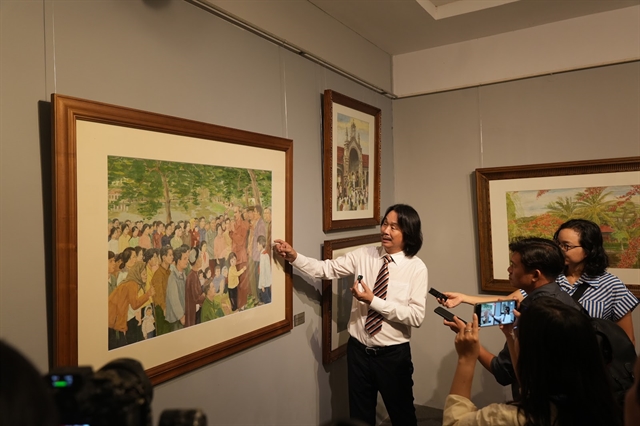
Two of his works will be gifted to the museum: Trên thao trường (On the Training Ground) and Đón Bác ở Đình Hồng Thái (Welcome Uncle Hồ to Hồng Thái Communal House). A book titled Văn Giáo will also be launched at the exhibition.
|
| Văn Đức presents his father's work at the exhibition. Photos courtesy of the organisers |
More than 100 works by Văn Giáo spanning his 60-year-career are on show along with a collection of 10 portraits of the artist, giving visitors diverse perspectives of the man as well as of his work.
Deputy director of HCM City Museum of Fine Arts Trần Minh Công spoke highly of the works presented by Văn Giáo's family to the museum.
"These are the first works of artist Văn Giáo that we at the museum are honoured to include in our permanent collection, which shows a close-knit bond between the museum and art collectors, as well as families of the artists," he said.
"Our museum will continue our mission to preserve, store and spread art, for the benefit of the public to contemplate the work of great Vietnamese masters."
|
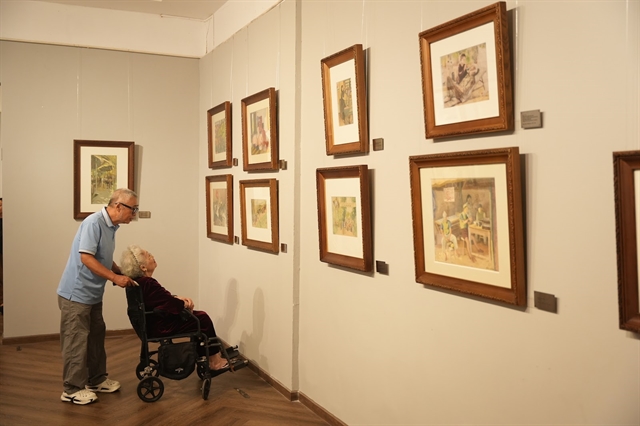
| Visitors at the exhibition enjoy the artwork of Văn Giáo. |
Văn Giáo returned to HCM City, formely Sài Gòn, where he had held two personal exhibitions before the August Revolution. He believed that holding exhibitions was not just to broaden an artist's circle of influence, but to meet and talk to viewers of his works. For this exhibition his family, represented by his son Văn Đức, who is also an artist, presented the two works to the museum.
In contemporary Vietnamese art, Văn Giáo best represents the avant-garde movement. He spent most of his 80 years of life observing and breathing in historic moments for the country, capturing the era with brilliant, fresh colours and a touch that is full of humanity.
|
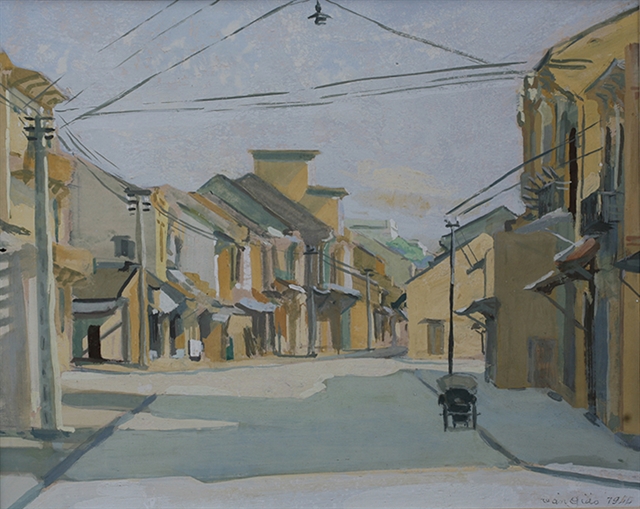
| Hàng Bè Street in Hà Nội. |
He faced the challenges of his life and time with a positive attitude and a smile, making it his mission to dedicate his art to the Vietnamese people and country.
Four years of study at the revered Indochina School of Fine Arts resulted in his first major work, Tam quan nội Văn Miếu (The three-passage gate of the Temple of Literature) in 1939, which is currently in the Việt Nam Museum of Fine Arts collection. This opened a rich period in his life as an artist until the August Revolution arrived.
After the revolution, he became a fighter, then a true master artist, using pastel colours to depict scenes from across the country.
Over the course of his long and storied career, he created thousands of works and held more than 100 personal exhibitions from 1945 until the last years of his life. After his death in 1996 he left behind a rich artistic journey and an in-depth emotional exploration of the people whose portraits he drew.
|
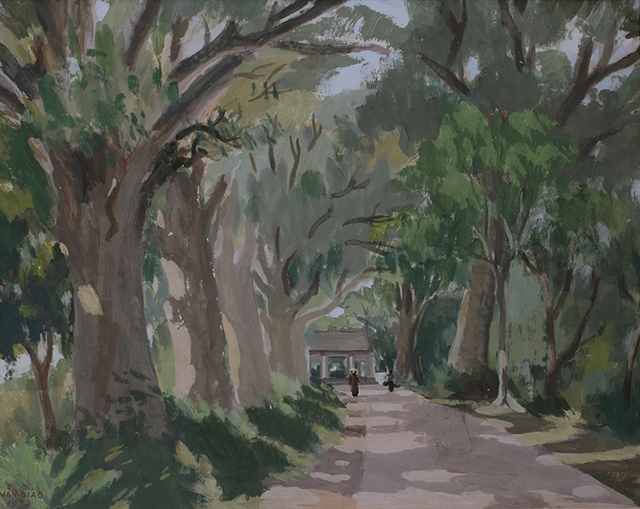
| The Kneeling Elephant Temple in Hà Nội, by Văn Giáo. |
From the late 1930s, Văn Giáo emerged on the Hà Nội arts scene. His first personal exhibition at his home at No. 18 Lò Sũ Street were artworks depicting the capital city, Văn Miếu (the Temple of Literature) and self-portraits, showing the young artist's desire to find self-expression.
.jpeg)
|
| Drying clothes for soldiers by Văn Giáo. |
Văn Giáo liked to travel and couldn't stay in one place for too long. For him, art wasn't just found in natural landscapes. It was also closely connected with people from a wide variety of backgrounds, including ethnic communities, and to the artist's social responsibility. When the country started its resistance war, he gave up his role as an up-and-coming artist without a second thought to follow the call of the revolution.
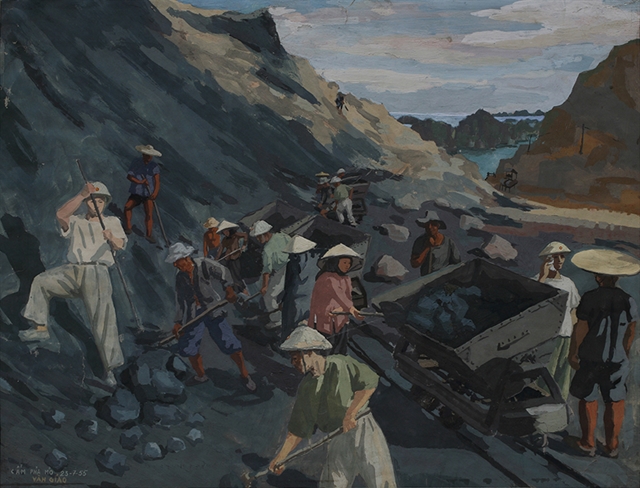
|
| Cẩm Phả Mine in Quảng Ninh Province, by Văn Giáo. |
The first days of the Democratic Republic of Việt Nam left Văn Giáo with memories not many artists were lucky enough to have. He created a portrait of President Hồ Chí Minh at the Northern Palace, which took him about 10 days. This experience earned him professional recognition and left a lasting impact on his artistic career.
Drawing portraits of Uncle Hồ and scenery and people related to him became a theme for nearly half a century. From 1970 to 2000, Văn Giáo made portraits of the President.
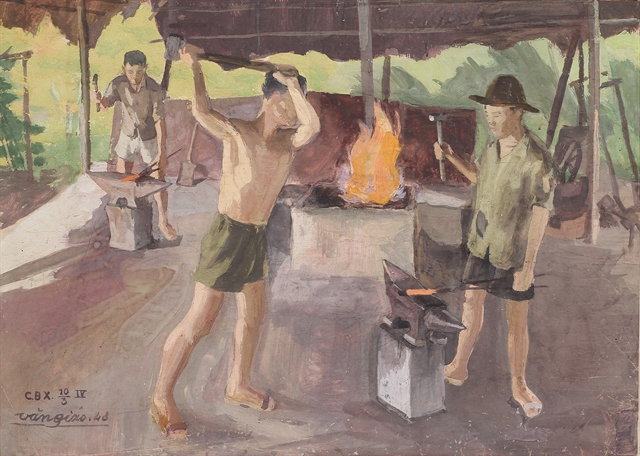
|
| Firing steel at the military arsenal, by Văn Giáo. |
Another major focus of his career was his passion for landscapes. Despite his work depicting the revolution and resistance war, he never stopped portraying scenery as well. In his greatest revolutionary works, nature became an important figure. Văn Giáo always used a pure, bright and hopeful palette. It was an artistic choice that reflected his positive attitude towards the future of his country.
.jpeg)
|
| President Hồ Chí Minh, by Văn Giáo. |
One of his most important contributions to Việt Nam's contemporary arts scene was to uphold pastels as a form of expression. No matter the subject, whether the city of Hà Nội, the resistance war or portraits of President Hồ, pastels were always his medium of choice.
Following the European academic tradition as well as the style taught at his alma mater, pastels were mainly used for sketches, artistic studies or outlining. Văn Giáo's choice to use pastel was an artistic statement.
Many of his most important paintings, including The three-passage gate at Temple of Literature (1939), Cẩm Phả Mine (1955), The Kneeling Elephant Temple (1957), Both ends of the Hiền Lương Bridge (1957) and Drying soldiers clothing (1962) were done with pastels.
Văn Giáo took advantage of the expressive power of pastels. Due to the hard-to-change characteristics of the material, he had to decide quickly on the composition, hues, lines and lighting of his works.
The artist was known for depicting real scenes in nature, often including multiple human figures. He faithfully captured each moment he saw in his works.
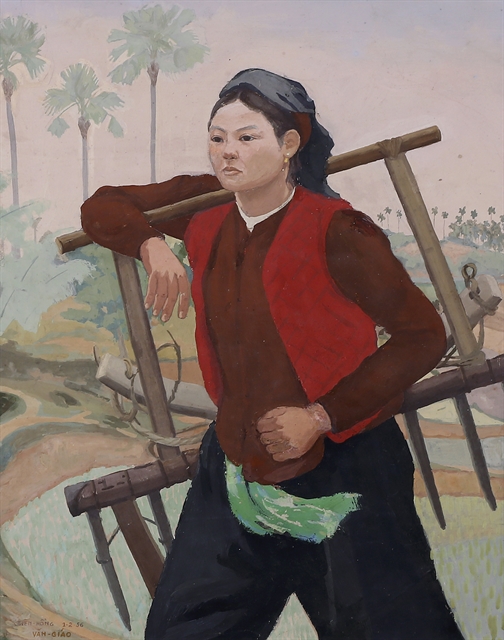
|
| Woman farmer of Diên Hồng, by Văn Giáo. |
Văn Giáo's last work, 'The willow tree by Uncle Hồ's house', he painted in 1995, just one year before he died. His choice became a symbol. After a long and arduous journey through war, then peace, construction sites and farms, the mines, the mountains and the plains, the artist decided to close his career with a very simple image: an ageing willow tree by President Hồ's stilt house.
The painting marked a graceful ending to Văn Giáo's life as an artist. His work was a way to preserve the simple yet most durable value of a man and a country.
.jpeg)
|
| Woman Militia in Hà Nội in 1966, by Văn Giáo. |
Today, looking back at Văn Giáo's heritage, we are not just impressed by the large number of artworks he made or the resilience of his life, but also his consistent path.
In the end, he spent nearly 60 years walking on different paths, observing and copying what he saw to paper. Out of all of the artists in Việt Nam in the 20th century, Văn Giáo — seemingly quiet, yet resilient — became the narrator of the country's history through his artwork.
He left behind not just beautiful paintings, but also a concept: art makes sense only when it is born from life, from relentless journeys and a deep love for people, land and history. — VNS
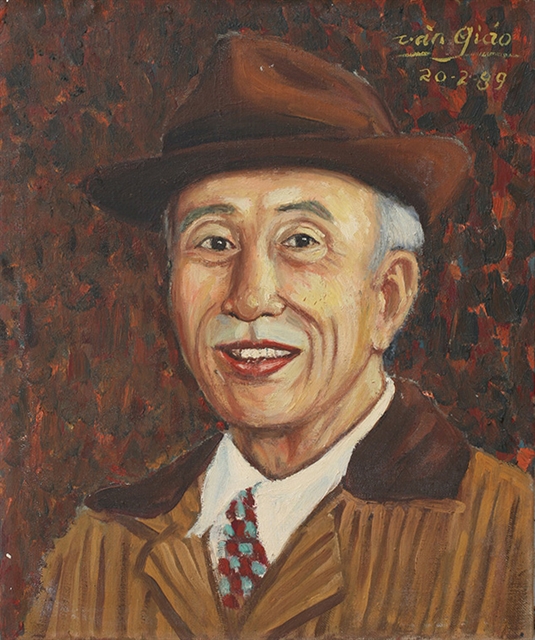
|
| Self portrait titled 'Văn Giáo the artist'. |
AWARDS:
• August Exhibition Prize in 1946 (First National Fine Arts Exhibition)
• Second Prize, National Fine Arts Exhibition in 1955, and many works at other National Fine Arts Exhibitions
• Fine Arts Exhibitions of the Capital City (Hà Nội), Prize in 1991
• Thăng Long Fine Arts Prize from Hà Nội People's Committee in 1996
• National Awards in the Arts and Literature in 2022
Exhibition: Country in Spring is open to the public at the HCM City Museum of Fine Arts at 97 Phó Đức Chính, Bến Thành Ward, HCM City
Life & Style
 Life & Style
 Life & Style
 Life & Style
 Life & Style
 Life & Style
 Life & Style
 Life & Style
 Life & Style
 Life & Style
 Life & Style
 Life & Style
 Life & Style
 Life & Style
 Life & Style