 Life & Style
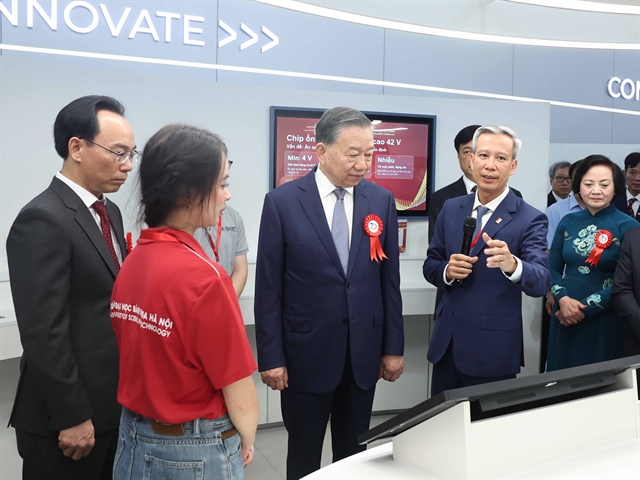
Top leader asks Hà Nội University of Science and Technology to become leading research university
1.
.jpeg)
|
| Ceramic mooncakes showcased at Vườn Nhà Gốm workshop in Lái Thiêu Ward, HCM City. — Photo courtesy of Vườn Nhà Gốm workshop |
HCM CITY — In the lead-up to the Mid-Autumn Festival, artisans at pottery workshops in Lái Thiêu Ward, HCM City, are busy crafting distinctive ceramic mooncakes and lanterns.
Shaped from clay by skilful hands, these familiar festive icons are reimagined with vibrant glazes, intricate patterns and lifelike forms.
More than decorative objects, the handcrafted creations evoke cherished Mid-Autumn memories while celebrating the rich cultural heritage of southern Việt Nam.
According to Nguyễn Thế Quỳnh, who works at a local workshop, Vườn Nhà Gốm, ceramic mooncakes are handcrafted through a meticulous multi-stage process.
From mould making and slip casting to demoulding, refining, drying, glazing and high-temperature firing, each piece demands exceptional precision, patience and craftsmanship.
Quỳnh said artisans must first make suitable moulds to create ceramic mooncakes that closely resemble the real thing.
Ceramic slip is then poured into the moulds and left for about five to six hours before the mould can be removed, allowing the piece to be cleaned and its shape refined.
After shaping, the pieces are left to dry for several days before being glazed and fired in a kiln. For these products, the firing temperature can reach around 1,600°C. The firing process takes about 12 hours, followed by another 12 hours for the kiln to cool before the pieces can be removed and inspected.
Crafted by skilled artisans, the ceramic mooncakes come in a variety of shapes, colours and patterns, with some pieces looking remarkably like real mooncakes. Every detail is carefully refined to create a realistic appearance while retaining the distinctive character of ceramic as a material.
The distinctive appeal of ceramic mooncakes lies in their lasting durability. While original mooncakes are enjoyed for only a short time, ceramic versions can be preserved for years, retaining their shape, colours, patterns and the cultural stories they embody.
Creating a finished ceramic design also requires repeated rounds of testing and refinement. According to Minh, some designs take three to four months to adjust their size, shape and patterns before meeting the desired standards. For others, it can take as long as six to eight months from the initial idea to producing the first prototype.
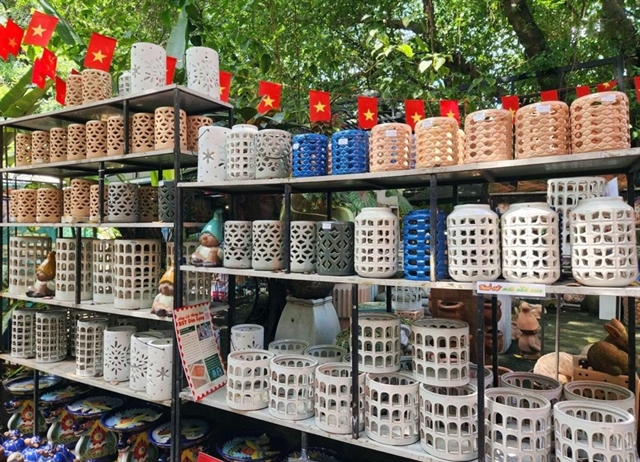
Artisans are also giving traditional lanterns, another Mid-Autumn symbol, a fresh take through the material.
Nguyễn Lê Trâm Anh, 29, from HCM City, came to the workshop to learn how to make a jellyfish-shaped lantern. To shape the piece, she first had to learn how to knead clay with water to remove air bubbles and improve its plasticity, making it easier to shape while reducing the risk of cracking during firing.
Anh said the most challenging part is creating a perfectly round and even body, which requires considerable focus and patience.
Throughout the process, she received hands-on guidance from the artisan, from sketching the initial idea and calculating dimensions to shaping the piece.
|
| Ceramic lanterns are displayed at Vườn Nhà Gốm workshop in Lái Thiêu Ward, HCM City. — VNA/VNS Photo |
Telling cultural stories
While a conventional mooncake is enjoyed through taste, a ceramic mooncake is savoured through memories, cultural stories and an appreciation of handcrafted beauty.
According to workshop owner Khang Minh, the idea of turning mooncakes and lanterns into ceramic pieces stems from a desire to tell stories about the Mid-Autumn Festival and the warmth of family reunions.
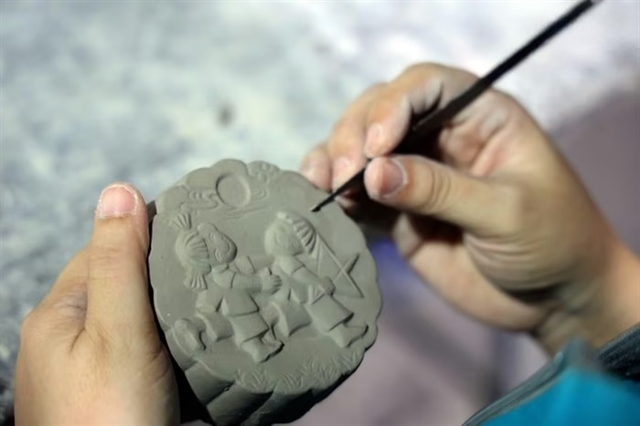
Traditional patterns and motifs are incorporated into the works to help viewers recognise distinctive elements of Vietnamese culture, including those with a distinctly southern character like roosters, fruit and other folk-inspired decorative motifs.
|
| Traditional patterns and motifs are incorporated into the pieces. — VNA/VNS Photo |
“Mid-Autumn Festival is a time for family reunions. So, we want to bring familiar Mid-Autumn images to ceramics to preserve memories and traditional values in a different way,” Minh said.
For ceramic artisan Dương Minh Tâm, who has more than 30 years of experience in the craft, the greatest challenge is not the making itself but conceiving an idea and transforming it into a finished ceramic mooncake or lantern.
Each piece must do more than truthfully recreate its original form — it also needs to tell its own story through carefully designed patterns and motifs. Artisans often remake a design repeatedly until it meets both aesthetic and cultural expectations.
“The greatest challenge is creating something beautiful. But in ceramics, beauty lies not only in form, but also in the patterns, motifs and the meaning conveyed through each piece,” said the artisan.
|
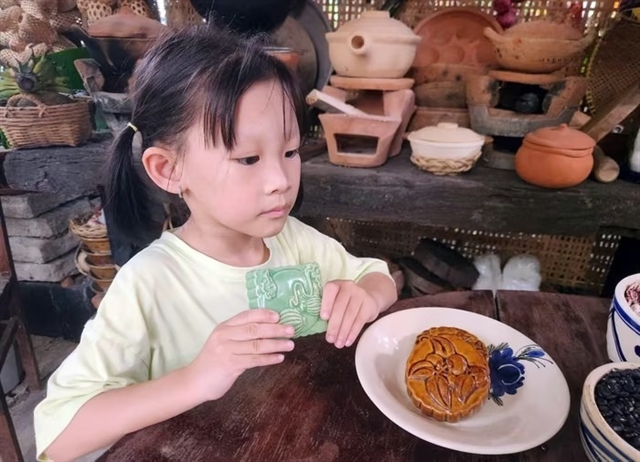
| Ceramic mooncakes are a way of bringing pottery closer to everyday life. — VNA/VNS Photo |
According to Minh, choosing the mooncake as a ceramic subject is also a way of bringing pottery closer to everyday life. Familiar foods and cherished Vietnamese cultural symbols are transformed into ceramic artworks, offering people a lasting way to preserve memories of Mid-Autumn celebrations with their families.
“The makers hope the products will remind younger generations of Mid-Autumn Festivals when family members gathered together. At the same time, the ceramic pieces provide a way to pass on stories of culture, traditional motifs and regional identities to future generations,” he said. — OVN/VNS
Life & Style
 Life & Style
 Life & Style
 Life & Style
 Life & Style
 Life & Style
 Life & Style
 Life & Style
 Life & Style
 Life & Style
 Life & Style
 Life & Style
 Life & Style
 Life & Style
 Life & Style