 Life & Style

ONYX Hospitality Group Wins Best Local Hotel Brand – Thailand for the Second Consecutive Year at the TTG Travel Awards 2026
1.
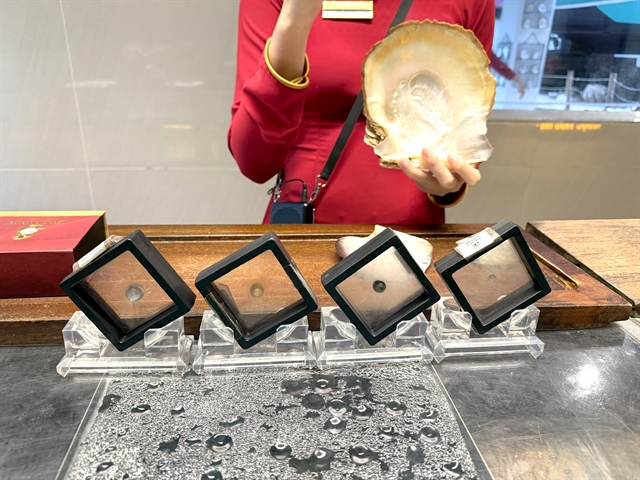 |
| Pearls cultivated in Phú Quốc are displayed alongside oyster shells, offering visitors a glimpse into the island’s pearl-farming tradition. — VNS Photo Văn Châu |
AN GIANG — As Phú Quốc prepares to host APEC Economic Leaders’ Week in 2027, its pearl-farming industry offers a distinctive tourism experience that connects the island’s marine heritage with local craftsmanship and products.
Phú Quốc Special Zone, part of An Giang Province, is known for its beaches, forests and marine tourism.
The island is also home to a long-established pearl-farming industry, which has become part of its economic and cultural identity.
With preparations for APEC 2027 expected to bring greater international attention to the island, local products and traditional industries such as pearl farming could provide visitors with a deeper understanding of Phú Quốc beyond its beaches and resorts.
At Ngọc Hiền Pearl, visitors can learn about oyster cultivation and pearl production, as well as the patience and technical knowledge required to create the small, lustrous gems.
The experience begins with an introduction to the farm’s cultivation areas, where oysters are raised in seawater under carefully monitored conditions.
Guides explain how oysters are selected, cared for and inspected throughout the growing process.
Unlike ordinary shellfish farming, pearl cultivation requires close attention to water quality, oyster health and environmental conditions.
Even after an oyster has been implanted with a nucleus, there is no guarantee that it will produce a high-quality pearl.
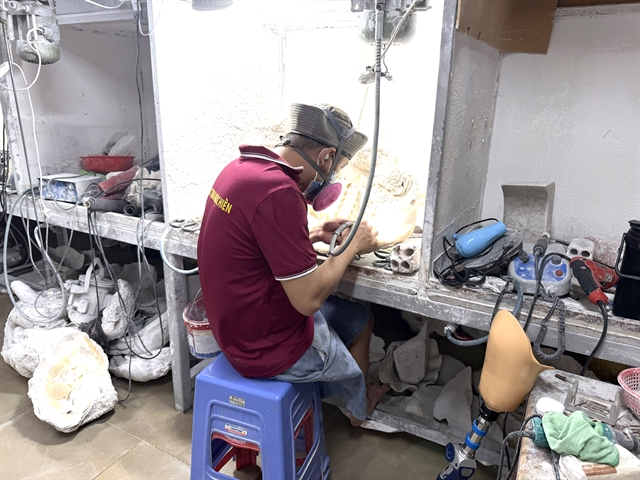 |
| A craftsman works on an oyster-shell product, turning marine materials into decorative handicrafts in Phú Quốc. — VNS Photo Văn Châu |
The patience behind pearls
Pearl production is a lengthy process. Depending on the oyster species and cultivation conditions, it can take several years before a pearl is ready for harvesting.
During this period, oysters must be regularly inspected and maintained.
Changes in seawater temperature, pollution, disease and other environmental factors can affect their growth and the quality of the pearls.
At the farm, visitors are shown oysters at different stages of cultivation.
Some are opened to demonstrate the formation of pearls, while others are displayed to illustrate differences in size, shape, colour and lustre.
The guide explains that not every pearl is perfectly round. Some are oval, teardrop-shaped or irregular, while their colours can range from white and cream to pink, silver and darker shades.
These variations influence the value and use of each pearl. Round pearls are often preferred for necklaces and earrings, while irregular pearls may be used in more contemporary designs.
For visitors, the demonstration helps explain why pearls are not simply natural products collected from the sea, but the result of a long and delicate cultivation process.
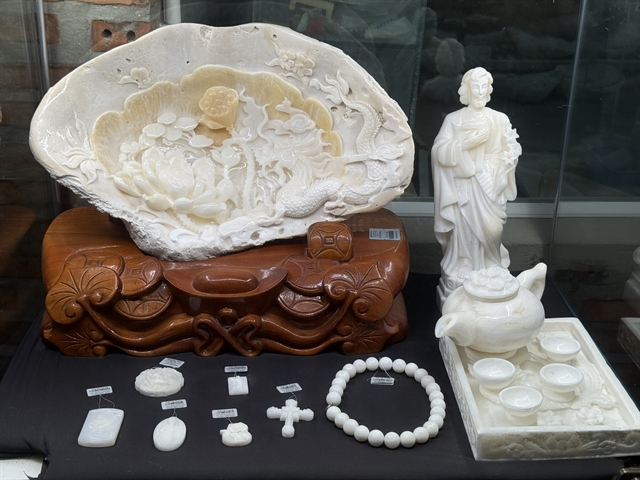 |
| Pearl jewellery and handicrafts showcase the variety of products made from Phú Quốc’s cultured pearls and oyster shells. — VNS Photo Văn Châu |
From oysters to jewellery
The tour continues at the processing and exhibition area, where visitors can see how pearls are cleaned, sorted and prepared for use.
Skilled workers assess each pearl according to several characteristics, including surface quality, shape, size, colour and lustre. Pearls with similar characteristics are matched before being incorporated into jewellery.
At the Ngọc Hiền showroom, pearls are presented in a variety of products, including necklaces, earrings, bracelets, rings and decorative items.
The designs combine traditional pearl jewellery with more modern styles intended for domestic and international visitors.
The showroom also provides information about the differences between cultured pearls and imitation pearls.
Staff explain that cultured pearls are formed inside oysters through a controlled cultivation process, while imitation pearls are manufactured from materials such as glass, plastic or other synthetic substances.
For tourists, the distinction is important when choosing a souvenir. A pearl’s value depends not only on its appearance but also on its origin, quality and processing.
British visitor, Anna Williams, said the experience helped her understand the work behind a piece of pearl jewellery.
“I had seen pearl necklaces before, but I had never understood how much time and care were needed to produce them,” she said. “The farm visit made the jewellery feel more meaningful because I could see the process behind it.”
For Vietnamese visitors, the farm also offers an opportunity to discover a local industry closely linked to the island’s marine environment.
Nguyễn Minh Anh, a visitor from Hà Nội, said she was interested in the combination of farming, craftsmanship and tourism.
“The visit gives tourists a better understanding of Phú Quốc’s natural resources and traditional products,” she said.
APEC and local products
Phú Quốc is preparing to host the APEC Economic Leaders’ Week in 2027 as part of Việt Nam’s APEC Year.
Preparations for the event include improvements to transport infrastructure, utilities, conference facilities and other supporting services on the island.
The event is also expected to generate greater international attention for Phú Quốc and could provide momentum for the development of local products and tourism experiences that reflect the island’s identity.
Beyond beaches and resorts, Phú Quốc has a range of products and traditional industries that can be introduced to international visitors, including seafood, fish sauce, handicrafts and pearls.
Developing these products into structured tourism experiences could help local businesses move beyond conventional retail activities.
Pearl farming is well suited to this approach. Instead of being presented only as a product for sale, pearls can be introduced through a complete visitor experience, including a tour of the cultivation process, an explanation of oyster care, a demonstration of pearl harvesting and an introduction to jewellery-making.
Such experiences are expected to open up opportunities for local businesses to increase the value of their products by combining education, craftsmanship and shopping. They could also help international visitors better understand the time, skills and marine conditions behind each pearl.
The attention generated by APEC 2027 may encourage businesses to improve product presentation, service quality, traceability and design.
These improvements could help local pearls reach wider markets while retaining their connection to Phú Quốc.
The development of the industry should, however, be accompanied by responsible marine practices.
As pearl farming depends on healthy seawater and coastal ecosystems, environmental protection remains essential to its future and to Phú Quốc’s wider ambition to develop sustainable tourism.
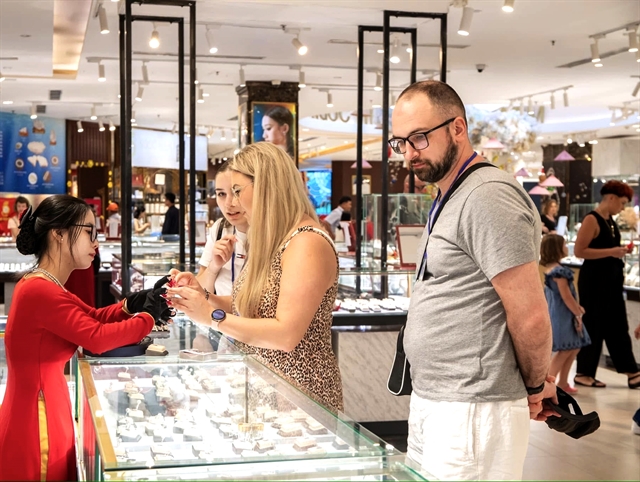 |
| International visitors explore pearl jewellery, one of Phú Quốc’s distinctive local products and souvenirs. — VNS Photo Văn Châu |
A memorable souvenir
For many visitors, the most appealing part of the tour is the opportunity to choose a pearl product as a souvenir.
Unlike mass-produced items, a pearl carries a connection to the place where it was cultivated. Its colour, shape and surface are shaped by a combination of oyster species, cultivation conditions and natural processes.
Visitors can select jewellery according to their personal preferences and budget.
Staff members explain how to identify pearl quality and how to care for the products, including avoiding exposure to chemicals, cosmetics and excessive heat.
A pearl necklace or pair of earrings can therefore serve as both a personal accessory and a reminder of a visit to Phú Quốc.
However, the value of the experience lies not only in purchasing a product.
Learning about the cultivation process helps visitors appreciate the time and labour behind each item.
More than shopping
Pearl farming remains closely associated with Phú Quốc’s tourism image, but its significance extends beyond the showroom.
The industry reflects the island’s relationship with the sea and demonstrates how marine resources can support livelihoods through specialised knowledge, craftsmanship and responsible production.
As tourism expands and Phú Quốc prepares for major international events, experiences such as pearl-farm visits can help connect visitors with local production and cultural identity.
APEC 2027 is expected to open further opportunities to promote distinctive local products and encourage tourism businesses to develop experiences with greater cultural and educational value.
For pearl farms, this could mean placing more emphasis on storytelling, demonstrations and responsible production alongside sales.
In the longer term, these experiences could contribute to the promotion of Phú Quốc’s local brand, ensuring that the attention generated by APEC extends beyond the event itself. — VNS
Life & Style
 Life & Style
 Life & Style
 Life & Style
 Life & Style
 Life & Style
 Life & Style
 Life & Style
 Life & Style
 Life & Style
 Life & Style
 Life & Style
 Life & Style
 Life & Style
 Life & Style