 Society

Vietnamese NA President’s China visit facilitates bilateral cooperation: Chinese researcher
1.
 |
| Residents of Hà Nội's Hai Bà Trưng Ward submit their feedback on the adjustment of the Red River urban zoning plan via a digital platform. — VNA/VNS Photo Hùng Mạnh |
HÀ NỘI — Experts have called for Hà Nội’s Red River urban zoning plan to be studied as part of the capital’s broader development strategy while addressing specific challenges related to heritage conservation, residential organisation and infrastructure connectivity.
Professor Dr Trần Đức Nhiệm, director of the Hà Nội Institute for Urban Development Research, said the plan should further clarify what would be inherited from the existing zoning plan and what would be adjusted to ensure legal consistency.
A coordinated management mechanism is also needed to prevent individual projects from being developed in isolation, he said.
Nhiệm made the remarks at a recent hybrid conference held by the Việt Nam Fatherland Front Committee of Hà Nội to gather public feedback on the comprehensive adjustment of the Red River urban zoning plan.
He said renovation efforts should prioritise less intrusive approaches and maximise opportunities for residents to be resettled in their existing communities to build social consensus.
The proposed Red River Landscape Boulevard should be viewed as only one component, he said, adding that the planning vision should be broader and aim to create a safer, greener Hà Nội with a strong sense of identity.
Associate Professor Dr Bạch Thành Định, chairman of the Advisory Council for Ethnic and Religious Affairs under the city’s Việt Nam Fatherland Front Committee, said the riverside plan must address how local residents would continue to earn their livelihoods.
Resettlement is also closely linked to preserving traditional communities and craft villages.
Public facilities such as parks and squares should be designed to enable local people to participate in and benefit from their development, he said.
Planning must reflect identity
The area covered by the proposed adjustment to the Red River urban zoning plan contains 123 heritage sites.
Experts have called for individual areas to be reviewed and classified so that appropriate approaches can be adopted in line with heritage protection laws.
Particular attention should be paid to preserving the core areas of craft villages and other communities with architectural, historical and tangible and intangible cultural value.
Another key task is ensuring that the reorganisation of riverside space simultaneously addresses residential stability, the preservation of traditional identities and public safety.
Architect Đào Ngọc Nghiêm, vice chairman of the Việt Nam Association for Urban Planning and Development, told Hà Nội Mới (New Hà Nội) newspaper that the number of people living outside the dikes has risen sharply from just over 100,000 in 2000.
Plans should thus focus on developing and upgrading these areas to help residents maintain stable lives, while clearly identifying areas where relocation is necessary and those that embody the distinctive identity of Hà Nội, he said.
“Bát Tràng and some other craft villages, for example, should be preserved and developed because they are part of what gives Thăng Long and Hà Nội their identity,” he added.
Experts also said that, alongside residential reorganisation and the preservation of traditional values, riverside areas could be developed under new models suited to the specific characteristics of the Red River corridor.
Associate Professor Dr Trần Minh Tùng from the Faculty of Architecture and Planning at Hanoi University of Civil Engineering said: “We must strike a balance between honouring traditional values and ensuring people’s safety.
“Alongside the craft villages, we should develop different scenarios, particularly ones that seek to limit the growth of new residential areas.”
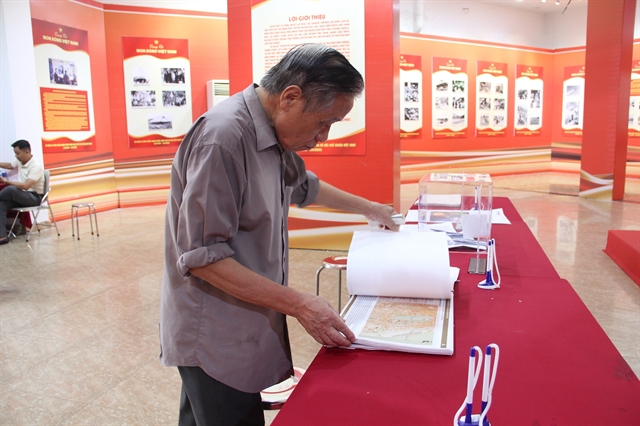 |
| An elderly man contributes his opinion on adjusting the Red River urban zoning plan. — VNA/VNS Photo Hùng Mạnh |
Key ecological landscape corridor
The city is currently collecting public feedback on the comprehensive adjustment of the Red River urban zoning plan, covering the section from Hồng Hà Bridge to Mễ Sở Bridge.
The adjustment is being carried out in line with new orientations for the construction and development of the capital.
Politburo Resolution 02 on building and developing Hà Nội in the new era sets out a 100-year vision for the city’s master plan, based on an open development model and a “multi-layered, multi-tiered, multi-polar and multi-centred” urban structure, with the Red River serving as the key ecological and cultural landscape axis.
The consultation process aims to promote people’s right to participate, improve planning quality and build consensus, while ensuring that implementation is open, transparent and compliant with regulations.
The study area stretches about 40km from Hồng Hà Bridge to Mễ Sở Bridge and covers nine communes and seven wards, with a total area of approximately 11,418ha.
Deputy Director of the Hà Nội Institute of Construction Planning Đào Duy Hưng said the adjustment was being made in response to major changes in urban development orientations and new policies adopted by central and municipal authorities.
According to Hưng, the adjustment aims to reorganise development space on both sides of the river and translate the major objectives of the capital’s master plan, with its 100-year vision, into concrete planning measures.
One of the objectives of the zoning adjustment and investment in the Red River Landscape Boulevard is to establish a backbone for Hà Nội’s development structure, connecting infrastructure and urban spaces inside and outside the dikes on both sides of the river.
Spirit of openness
On September 12, during an inspection of the public consultation process in Hồng Hà Ward, the city People’s Committee Chairman Vũ Đại Thắng said Hà Nội is seeking public views in a spirit of openness and receptiveness, listening to residents to continue revising and finalising the planning proposal.
Thắng said the goal of upgrading the Red River area is to create a new development space and generate additional resources and momentum for Hà Nội.
However, the process must take full account of policies and mechanisms for affected residents, he said.
“Resettlement should not simply provide new housing, but must also be linked with schools, employment, technical infrastructure and social infrastructure to ensure people’s livelihoods and quality of life,” he said.
Public feedback is being collected at planning exhibition sites and through thematic conferences.
Chairwoman of the city’s Việt Nam Fatherland Front Committee Bùi Huyền Mai said that public consultation was not merely an administrative procedure, but a means of promoting people’s right to participate and mobilising social expertise to improve the quality and feasibility of the plan.
All feedback will be objectively consolidated and classified before being submitted to the relevant authorities for consideration during the finalisation of the planning scheme. — VNS
Society
 Society
 Society
 Society
 Society
 Society
 Society
 Society
 Society
 Society
 Society
 Society
 Society
 Society
 Society