 Economy



Remains of 93 martyrs reburied in Tuyên Quang
1.
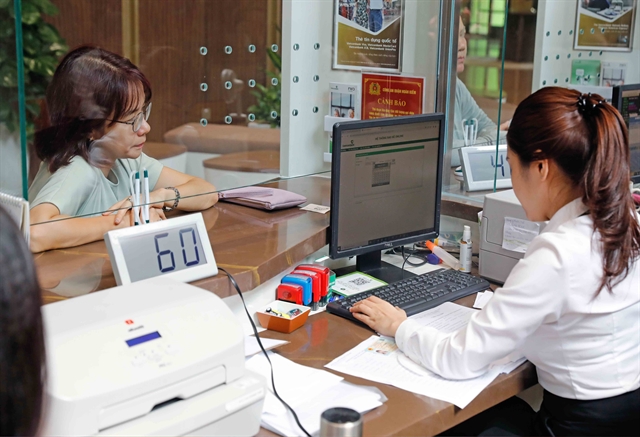 |
| A customer at Vietcombank in Hà Nội. Connecting tax and credit information can provide an additional source for credit analysis and risk management. — VNA/VNS Photo Trần Việt |
HÀ NỘI — Banks are set to gain access to tax data so that they can broaden credit assessments beyond traditional credit histories and promote lending based more heavily on data and cash flows.
The General Department of Taxation and the National Credit Information Centre of Vietnam (CIC) have signed a cooperation agreement on exchanging and using data to create a framework for closer information sharing between the tax and banking sectors.
Under the agreement, credit information held by CIC will be used as a supplementary source for the tax authority’s management, analysis and assessment of taxpayers’ compliance. In the other direction, tax data supplied to CIC will support the centre in assessing the creditworthiness of taxpayers.
However, authorities have not yet specified the full range of data that will be connected or how individual pieces of data will be used in lending decisions.
Mai Xuân Thành, director general of the Department of Taxation, said data had become increasingly important to public administration as Việt Nam moves towards digital and data-driven management.
Data related to cash flows, assets and credit relationships would help tax authority to have a more comprehensive picture of taxpayers, Thành said.
CIC’s Chairman Cao Xuân Thành said connecting tax and credit information can provide an additional source for credit analysis and risk management.
The data exchange could also improve transparency and encourage taxpayers to fulfil their tax obligations before seeking credit for investment, production and business activities, he added.
The agreement on data exchange comes as the State Bank of Vietnam (SBV) plans to encourage commercial banks to expand lending models based on data and cash flows, with effective access to and use of tax data seen as an important condition for this transition.
Effective use of tax data will be an important prerequisite for the SBV to encourage commercial banks to expand this new lending model, he said.
SBV Deputy Governor Phạm Tiến Dũng said tax information can help CIC improve its database and assess customers’ financial capacity more accurately.
But he added that further efforts are needed to define specific areas of cooperation between banks and tax authorities while ensuring data security, confidentiality and compliance with personal data protection rules.
In banking, information from CIC is a key source for assessing borrowers before lending decisions are made.
CIC currently collects nine groups of information from credit institutions, including customer identification, credit contracts and credit card information. Its database does not include card numbers, security codes or payment transaction histories.
Previously, SBV Governor Phạm Đức Ấn said the banking sector was studying a pilot scheme to analyse cash-flow data for credit evaluation based on the exchange and use of available data sources.
He also called on commercial banks to explore credit-assessment models that place greater weight on business plans, cash flows, credit histories and corporate management capacity. — VNS
Economy
 Economy
 Economy
 Economy
 Economy
 Economy
 Economy
 Economy
 Economy
 Economy
 Economy
 Economy
 Economy
 Economy
 Economy