 Society

Vietnamese creators vie for honours at TikTok’s first Southeast Asia Awards
1.
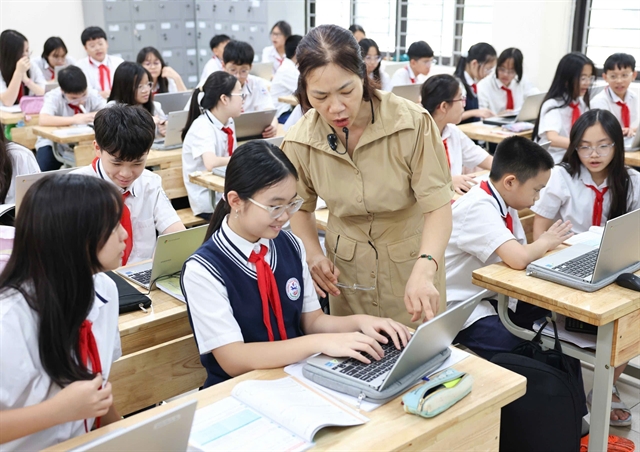 |
| A teacher and her students in a lesson at the Giảng Võ Junior Secondary School in Hà Nội. — VNA/VNS Photo Thanh Tùng |
HÀ NỘI — Students in Hà Nội are enhancing their skills and mastering the digital environment through the use of AI, informatics lessons and the inter-school open classroom model.
Improving students’ digital competence is no longer limited to teaching theory or mechanically introducing technology into classrooms — it is gradually transforming approaches to teaching and learning.
In a bid to carry out Politburo Resolution 57 on promoting science, technology, innovation and digital transformation, many schools in Hà Nội have integrated technology, online lessons and AI into a variety of subjects, including informatics, mathematics, literature and history.
At Phú La Junior Secondary School in Kiến Hưng Ward, innovations in teaching methods have yielded positive signs.
Teacher Hoàng Văn Tươi said that the effectiveness of technology can be immediately perceived through students’ learning attitudes. Their focus in lessons and their initiative in solving exercises demonstrate that they are participating more actively in class.
Beyond merely supporting teachers in instruction, technology is also helping students shift their mindset from passive recipients to active explorers of knowledge.
Nguyễn Phương Thanh, an eighth grader at the Giảng Võ Junior Secondary School, said that she usually completes exercises on her own first, then uses AI to check her answers and asks teachers to verify information.
“Technology truly helps me understand lessons better, especially in literature. I use AI to summarise key events and facts so I can grasp the content more easily,” Thanh said.
But Thanh said the teacher’s role remains crucial to guide learning.
“Teachers inspire me and bring passion to every lesson. This is something technology can hardly provide when analysing situations and literary works,” she said.
Some primary school teachers have also shared how they use AI to create visuals and characters for teaching, with images closely related to the lessons.
As a result, students not only absorb content more easily, but also grow to love the character, even designing their own programming products.
Open classrooms
Another breakthrough in efforts to build digital competence and share educational resources across Hà Nội is the open classroom model.
Giảng Võ Junior Secondary School recently completed a pilot open classroom lesson under Plan 3018 issued by the municipal Department of Education and Training. As one of four junior secondary schools selected as central hubs, Giảng Võ connected online with two satellite sites: Đại Xuyên Junior Secondary School and Phú Nghĩa A Junior Secondary School.
At the Giảng Võ central hub, Tạ Thị Thu Hương from the Mathematics, Technology and Informatics Group conducted a Grade 6 Informatics lesson about the internet for around 48 students, while simultaneously connecting with 90 students at the two satellite sites, supported by on-site teachers.
Starting from a real-life scenario of booking flight tickets online, students at all three sites followed the lesson while engaging in continuous two-way interaction.
Through a synchronised camera and audio system, along with the ClassPoint interactive tool, mind maps and visual videos, students at Đại Xuyên and Phú Nghĩa A were able to listen, observe, raise their hands to speak and receive direct feedback from the teacher at the central hub.
Schools are showing that building students’ digital competence does not depend on the quantity of devices or expensive technology, but on how that technology is introduced into teaching with the right objectives and at the right time.
Technology needs to be used selectively and for the right purposes. When appropriately leveraged, it not only makes lessons more lively, but also contributes to changing students’ roles – from mainly receiving knowledge to actively participating in the learning process.
As technology becomes an effective tool supporting teachers and inspiring students’ creativity, the spirit of Resolution 57 is manifested in every informatics lesson, every digital lecture and every remote classroom in the heart of the capital. — VNS
Society
 Society
 Society
 Society
 Society
 Society
 Society
 Society
 Society
 Society
 Society
 Society
 Society
 Society
 Society