 Sci-Tech

A bookstore truck on the road
1.
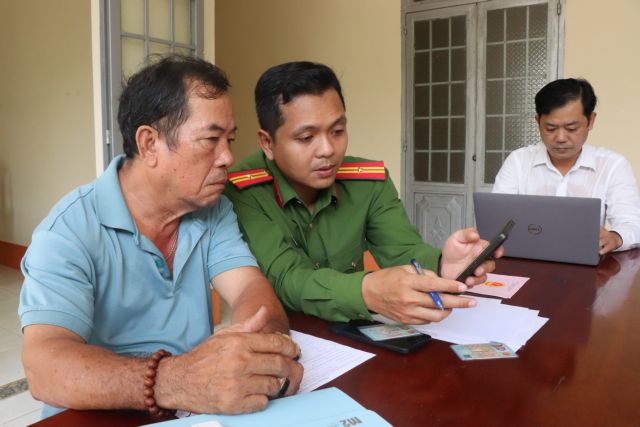 |
| A digital team member helps a resident of Thới Hòa B Hamlet file paperwork on VNeID. — VNA/VNS Photo |
CẦN THƠ — By the time the sun dropped behind the rice paddies of Thới Hòa B Hamlet, the farmers were finally home. That was when the tech team came calling.
Trương Minh Thắng, 62, had already done what local officials asked of him. Months earlier, he'd downloaded VNeID, the national digital identity app, onto his phone. But the icon sat mostly untouched.
He didn't know how to file paperwork through it, and no one had shown him how. When word went around the hamlet that a digital team was making house calls that evening, he asked for their help.
They sat with him and walked him through the app, step by step.
"Now I know that in the future I just need to stay home and open VNeID to check on my results. It's very convenient for me," he said.
Across the Mekong Delta province of Cần Thơ, 1,227 digital teams make house calls like this one in all 103 of the city's wards and communes – Thắng was simply one name on a very long list.
Their mandate, distilled into a local slogan, is to go 'down every alley, into every home, guiding every person', closing the gap between the apps residents have installed and the ones they actually know how to use.
The teams are a patchwork of local government – commune officials, Youth Union members, Women's Union volunteers, neighborhood security officers and whichever local resident happens to be good with a phone – doing work that is small in scale but essential.
 |
| The Thới Hòa B digital team assists residents every Saturday under the 'Digital Saturday' initiative. — VNA/VNS Photo |
They activate VNeID accounts, walk people through the online public services portal, teach market vendors to accept QR code payments instead of cash and warn residents about online scams.
In Cái Răng Ward, 16 such teams – 98 members in all – do the legwork, leaning on neighborhood chiefs, Party cell secretaries and young officials who staff community offices to help residents file paperwork, pay taxes through the eTax Mobile app and use the services bundled into VNeID.
"It's an extended arm that stays close to the people," said Trần Văn Thậm, vice chairman of the People's Committee of Cái Răng.
He said the teams have made up for a chronic shortage of ward-level staff, wearing down public reluctance the way steady rain wears down stone – with patient, repeated persuasion rather than a one-time campaign.
The numbers bear that out, at least in the ward's Thanh Mỹ neighbourhood. Roughly 80 per cent of residents now have VNeID installed, and cashless payment has taken hold firmly among people under 55.
Uptake of eTax Mobile is thinner, at 15 to 20 per cent, but officials say even that has begun to squeeze out the old habit of settling tax bills in cash – a practice that left room for graft.
The picture looks different in Cờ Đỏ, a rural commune of nearly 34,500 people across nearly 45 square kilometres of farmland. Almost 1,650 of its 7,856 households are ethnic Khmer, and more than 5,000 residents practise organised religion – a mix that makes any one-size-fits-all approach useless.
"The requirements for digital transformation here are enormous," said Lê Chí Phương, chairman of the People's Committee of Cờ Đỏ.
His solution was to fold the effort into existing structures, with nine teams, one per hamlet, each led by a Party cell secretary and the hamlet chief as deputy.
The work is deliberately practical: opening digital payment accounts for pensioners, promoting QR code transactions and helping farmers list Government-certified local produce on e-commerce platforms.
 |
| A resident uses a QR code to access the Public Administrative Centre of Cần Thơ online. — VNA/VNS Photo |
Because most residents are out in the fields by day, the teams adjusted their own schedules rather than asking farmers to adjust theirs, holding sessions in the evenings and on weekends, and folding basic tech instruction into party meetings, hamlet gatherings and neighbourhood mutual aid groups.
That flexibility mattered most in Thới Hòa B, a hamlet of 1,142 households where Khmer residents make up more than 56 per cent of the population. There, resistance to the new technology ran deep at first – an unease common among older residents everywhere.
The hamlet's team of 10 members aged 18 to 40 built a rhythm around a weekly 'Digital Saturday' initiative and a hamlet-wide group chat, fielding questions remotely and showing up in person to walk residents through VNeID's more advanced features, such as online tax payments. They also helped set up the bank accounts needed to receive pensions directly rather than in cash from a passing official.
Multiplied across the city, the small visits add up to a real number.
In the second quarter of 2026 alone, Cần Thơ's digital teams helped residents complete 5,445 online public service applications, process 319 electronic payments through the national public services portal and open 11,548 new accounts on various digital platforms, according to Ngô Anh Tín, director of the city's Department of Science and Technology.
Those figures represent a shift away from pure messaging and toward hands-on help – the difference between telling people a digital government exists and sitting beside them while they actually use it, he said.
None of it has come easily. Most team members are volunteers with day jobs, so the time they can give is limited. In some areas, residents still lack phones capable of running the apps smoothly, and internet service can be patchy.
Underneath the logistics sits something harder to fix: a lingering wariness of technology and fear of fraud or data misuse that persists, especially among older residents.
"This work requires patience – holding people's hands through it, step by step," said Đặng Hữu Nhân, head of Cái Răng's Thanh Mỹ neighbourhood.
Pushing adoption of Government apps above 50 per cent will take deeper training for the volunteers themselves, he argued. It will also take fixes on the technical side: smoother apps and an end to the data lags between banks, the treasury and tax authorities that have occasionally left residents with erroneous debt notices – the kind of glitch that can undo months of patient persuasion in one bad afternoon.
City officials have tried to make the volunteer work less of a sacrifice. Under a resolution passed by the People's Council of Cần Thơ this year, each team now receives VNĐ1.5 million (roughly US$58) a month from the municipal budget to cover fuel, phone bills and mobile data.
Cái Răng has also enlisted telecom companies to donate smartphones for members to use on the job, while Cờ Đỏ has worked with network operators to install an additional 4G and 5G towers to close gaps in coverage.
For Thậm in Cái Răng, the goal now is less about installation numbers than durable habits – teaching people not just to download an app, but to actually rely on it.
"The teams are the pillar," he said, describing his ward's role as organising training and making sure members can troubleshoot on the spot rather than recite a script.
In Cờ Đỏ, Phương has asked the city and its Department of Science and Technology to keep the funding flowing and to offer more advanced instruction, so the volunteers do not fall behind the technology themselves.
Officials describe the teams as the 'golden key' to closing the digital divide – putting in the work, hamlet by hamlet, for a national push to build a digital government, economy and society from the ground up.
In a digital revolution written into national policy, the deciding factor may turn out to be nothing more sophisticated than someone willing to knock and wait for the door to open. — VNS
Sci-Tech
 Sci-Tech
 Sci-Tech
 Sci-Tech
 Sci-Tech
 Sci-Tech
 Sci-Tech
 Sci-Tech
 Sci-Tech
 Sci-Tech
 Sci-Tech
 Sci-Tech
 Sci-Tech
 Sci-Tech
 Sci-Tech