 Sci-Tech
.jpg)
HCM City to host Nordic-Việt Nam Business Summit
1.
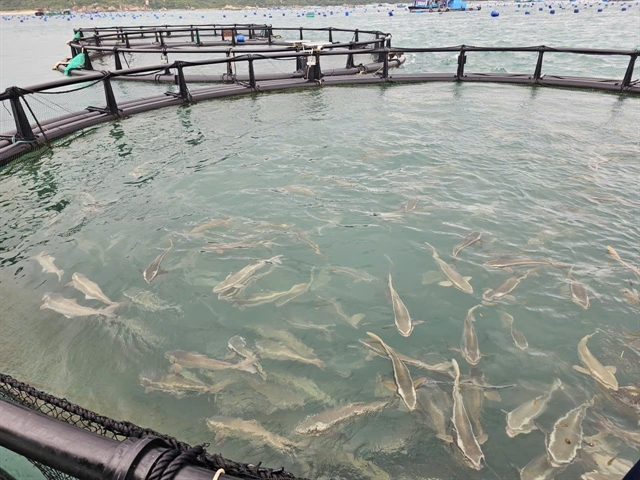 |
| Marine fish farming using high-density polyethylene floating cages in Khánh Hòa is a technological solution that offers high efficiency. — VNA/VNS Photo |
KHÁNH HÒA — Khánh Hòa Province is speeding up the application of science and technology, innovation, and digital transformation in its marine economy, aiming to raise productivity, reduce emissions, and develop a modern, sustainable green economy.
The move is in line with the Politburo’s Resolution No. 57 on breakthroughs in science, technology, innovation and national digital transformation issued in December 2024.
The south-central coastal province, which has more than 490km of coastline and over 200 islands, is among the localities pioneering high-tech marine farming in open waters.
It has piloted high-tech offshore aquaculture and is developing modern farming technologies to reduce pressure on coastal waters.
It is implementing a high-tech marine aquaculture project using high-density polyethylene floating cages, artificial microclimate systems, and automatic water-monitoring equipment to help control disease and pollution.
In 2026–29, the province will allocate VNĐ59.2 billion (US$2.3 million) to support farmers switching from traditional wooden floating cages to high-tech ones to help reduce losses caused by natural disasters and improve efficiency and sustainability.
It is also applying new technologies to monitor marine ecosystems and data, including marine environmental monitoring, remote sensing, geographic information systems, and sensor networks.
Surveys of coral reef ecosystems are being conducted to collect data for environmental assessment, management, and conservation.
The marine and coastal economy accounts for 80 per cent of the province's GRDP, and seafood for 44.8 per cent of its total exports.
Digital transformation is also being promoted in island and marine tourism management, and technology is being applied to improve port logistics and coastal transport connectivity.
The province plans to develop marine economic and urban data maps as a basis for data-driven management and planning, while promoting digital ports and digital logistics and developing port-logistics-industrial clusters.
It is also implementing a project to establish a national ocean technology research centre, focusing on technologies serving maritime activities, marine biology, industrial aquaculture, and environmental protection. — VNS
Sci-Tech
 Sci-Tech
 Sci-Tech
 Sci-Tech
 Sci-Tech
 Sci-Tech
 Sci-Tech
 Sci-Tech
 Sci-Tech
 Sci-Tech
 Sci-Tech
 Sci-Tech
 Sci-Tech
 Sci-Tech
 Sci-Tech