 Sci-Tech

Dung Quất EZ lands special free-trade zone Incentives
1.
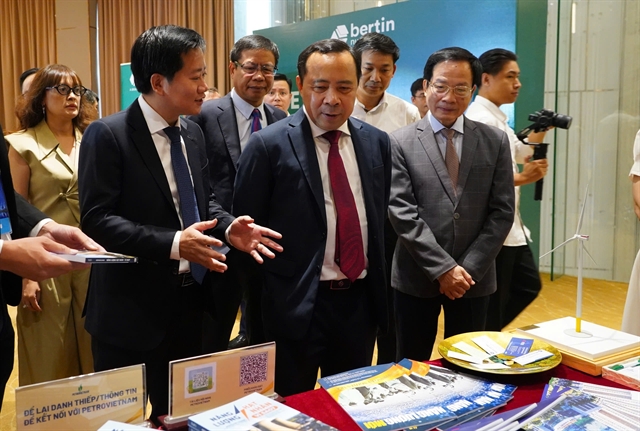 |
| Minister Vũ Hải Quân, Deputy Minister Lê Xuân Định and delegates view products on display at the 7th National Conference on Nuclear Regulation on July 30. Photo mst.gov.vn |
HÀ NỘI — Việt Nam is working to complete its regulatory framework and strengthen State management capacity for radiation and nuclear safety at both central and local levels as the country prepares to restart its nuclear power programme and invest in a new research reactor.
Minister of Science and Technology Vũ Hải Quân said the development of Việt Nam's nuclear power programme and the application of atomic energy represented a strategically important, long-term undertaking directly related to energy security, scientific and technological capacity, the quality of economic growth and the country's international standing.
To fulfil this mission, the Minister stressed the need for a long-term vision, a coherent legal framework, a strong regulatory body, a competent pool of experts and human resources capable of meeting the requirements of the nuclear power programme, as well as a robust safety culture.
Nguyễn Hoàng Linh, Director General of the Department of Radiation and Nuclear Safety under the Ministry of Science and Technology, said the relaunch of the nuclear power programme and the implementation of major policies adopted by the Party, National Assembly and Government on atomic energy development had created an urgent need to improve institutions, enhance the capacity of the national radiation and nuclear safety authority, and improve the effectiveness of State management at both central and local levels.
Linh said the Department would step up implementation of the project "Strengthening the Capacity of the Department of Radiation and Nuclear Safety in Support of Nuclear Power Development to 2035", approved by the Prime Minister under Decision No 624/QĐ-TTg dated April 6, 2026.
The goal is to develop the Department into a modern national regulatory authority fully capable of performing State management functions and coordinating national activities in radiation safety, nuclear safety, nuclear security and nuclear safeguards, in line with International Atomic Energy Agency (IAEA) standards and international treaties to which Việt Nam is a party.
The Department is also accelerating the digitalisation and modernisation of its management activities through the development and operation of a national digital platform covering radiation safety, nuclear safety and nuclear security, as well as the development and application of atomic energy. A unified national database will be established, connecting central and local authorities and providing online monitoring, data analysis and early warning capabilities to strengthen oversight of radiation and nuclear safety.
International co-operation supports regulatory development
During the 2024-26 period, Việt Nam continued to actively pursue international co-operation, with a clear focus on completing the regulatory framework for the National Nuclear Power Programme, strengthening the capacity of the regulatory authority and fulfilling the country's international obligations in the field of atomic energy.
Notably, in 2025, Việt Nam co-operated with the IAEA to conduct an Integrated Nuclear Infrastructure Review (INIR). The resulting report provided 38 recommendations and 13 suggestions aimed at improving the legal and regulatory framework, developing human resources and strengthening the capacity of the regulatory authority.
As the national focal point for the IAEA Technical Co-operation Programme, the Department has coordinated the implementation of national and regional technical co-operation projects and mobilised international resources to support improvements to the regulatory framework, human resource development and capacity building for the National Nuclear Power Programme.
These efforts have also supported the development and application of atomic energy across economic and technical sectors, while ensuring safety and security.
Linh said that through its co-operation programmes with the IAEA, the Department had expanded partnerships with international organisations, nuclear regulatory bodies, technical support organisations and other international partners. These include the Comprehensive Nuclear-Test-Ban Treaty Organization (CTBTO), the OECD Nuclear Energy Agency (NEA), the World Institute for Nuclear Security (WINS), Russia's Federal Environmental, Industrial and Nuclear Supervision Service (Rostechnadzor), as well as partners from France, the United States, Germany, Belgium and the Republic of Korea.
These partnerships have contributed to the development of Việt Nam's atomic energy legislation in line with IAEA standards and international practices.
The Department has also actively participated in the ASEAN Network of Regulatory Bodies on Atomic Energy (ASEANTOM), sharing experience and strengthening regional capacity in radiation and nuclear safety, security and emergency preparedness and response.
International co-operation during the 2024-26 period has increasingly shifted from exchanges of experience towards direct support for building national regulatory capacity. This has contributed to improvements in the legal framework and the development of professional expertise, laying an important foundation for the safe implementation of the National Nuclear Power Programme while reinforcing Việt Nam's commitment to international standards on nuclear safety, security and safeguards.
Through these international co-operation activities, the Department has been progressively developing a team of officials with expertise aligned with international practices and capable of meeting requirements for assessment, licensing, inspection and oversight of nuclear safety, security and safeguards.
This capacity will support the implementation of the Ninh Thuận Nuclear Power Project and the New Research Reactor Project, while strengthening State management of atomic energy at both central and local levels. — VNS
Sci-Tech
 Sci-Tech
 Sci-Tech
 Sci-Tech
 Sci-Tech
 Sci-Tech
 Sci-Tech
 Sci-Tech
 Sci-Tech
 Sci-Tech
 Sci-Tech
 Sci-Tech
 Sci-Tech
 Sci-Tech
 Sci-Tech