 Society

Việt Nam, EU and Belgium seek deeper, practical cooperation
1.
|
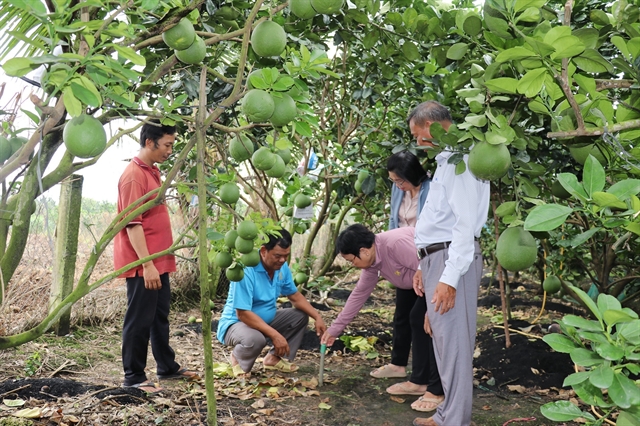
| A green-skin and pink-flesh grapefruit orchard uses a water-saving sprinkler irrigation system in Mỹ Phong Commune, Đồng Tháp Province. — VNA/VNS Photo Hữu Chí |
ĐỒNG THÁP — At green-skin and pink-flesh grapefruit orchards in Đồng Tháp Province’s Mỹ Phong Commune, production records are gradually moving from notebooks to digital platforms.
For members of the Mỹ Phú Green-Skin and Pink-Flesh Grapefruit Farmers’ Club in the commune, technology is being used to manage production, trace product origins and meet increasingly stringent export requirements.
Members are also moving from handwritten production records to electronic logs and digital platforms.
Nguyễn Thị Đầm, a club member who grows 0.6ha of the fruit to export standards, said: “To ensure the fruit meets export standards, farmers need to follow production processes such as Vietnamese good agricultural practices (VietGAP) standards and use organic fertilisers.”
The commune has 385ha devoted to the speciality fruit, producing about 6,160 tonnes annually and involving around 1,500 farming households.
It has been granted five growing-area codes for export to the US, South Korea and Australia, covering 200 households on 103.85ha.
The experience in the commune shows how the Cửu Long (Mekong) Delta province is putting digital transformation into practice by linking technology with the specific needs of farmers.
The efforts are in line with the implementation of the Politburo’s Resolution No 57 on breakthroughs in science, technology, innovation, and national digital transformation issued in December 2024.
|
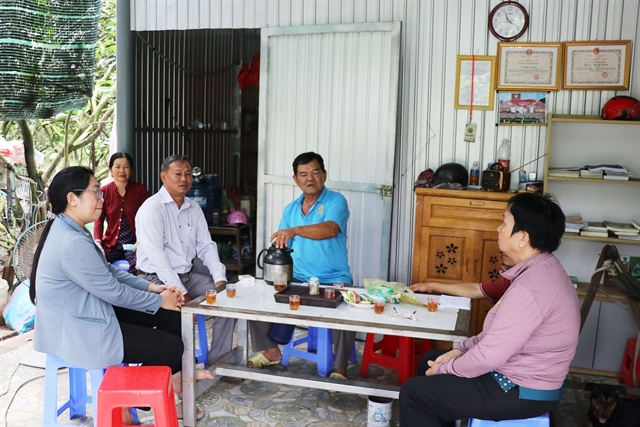
| The management board of the Mỹ Phú Green-Skin and Pink-Flesh Grapefruit Farmers’ Club in Mỹ Phong Commune exchanges experiences in the cultivation of the fruit. — VNA/VNS Photo Hữu Chí |
The province identifies digital skills among farmers, co-operative members and agricultural workers as an important part of bringing digital transformation into production.
Nguyễn Văn Kiệt, deputy director of the Provincial Department of Agriculture and Environment, said the agriculture sector is taking a practical approach to the “Digital Literacy for All” movement, based on the needs of co-operatives, farmers’ clubs and residents.
“Training covers basic skills such as using smartphones, the internet and communication applications, as well as accessing market information and using digital platforms for production management, traceability and agricultural product sales,” he said.
According to the department, digital transformation has been widely applied in agriculture, including digital agricultural data platforms, smart irrigation, drones, and mechanised and automated production and livestock farming.
These measures have helped reduce costs, increase productivity, improve transparency and raise the value of agricultural product chains.
The digitalisation of farming areas for traceability has also been accelerated, particularly for key fruit and aquatic products.
To achieve these results, the department has provided training and guidance to co-operatives on information technology.
A total of 314 agricultural co-operatives and more than 120 farmers’ clubs, with more than 79,000 of their 95,000 members and workers – about 85 per cent – have acquired basic technology and digital skills.
|
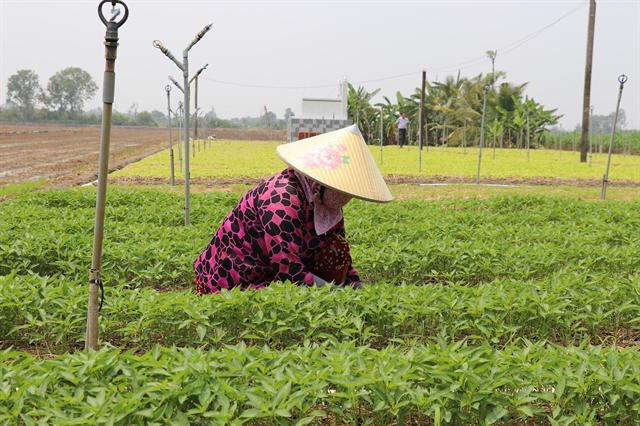
| A vegetable field in Phú Thành Commune uses a water-saving sprinkler irrigation system. — VNA/VNS Photo Hữu Chí |
Digitial agriculture
Đồng Tháp is linking digital transformation with agricultural restructuring, the development of the co-operative economy and value chains.
The province targets 4–4.5 per cent GRDP growth in agriculture, forestry and fisheries in 2026 and aims to digitise 100 per cent of agricultural and environmental databases managed by provincial and commune-level authorities.
Traceability and growing-area management are key priorities.
Through QR codes, information on production areas, cultivation processes, products and harvesting can be updated, helping farmers develop the habit of managing production information digitally.
Up to 229 co-operatives and farmers’ clubs have received growing-area codes for domestic and export markets, including 208 co-operatives with 887 growing areas covering nearly 173,000ha and 21 farmers’ clubs with 46 growing areas covering more than 1,300ha.
Đồng Tháp is Việt Nam’s largest fruit producing province.
Digital transformation in the province is also supporting product promotion and sales, with co-operatives being guided to use e-commerce platforms, livestreaming, social media and digital tools.
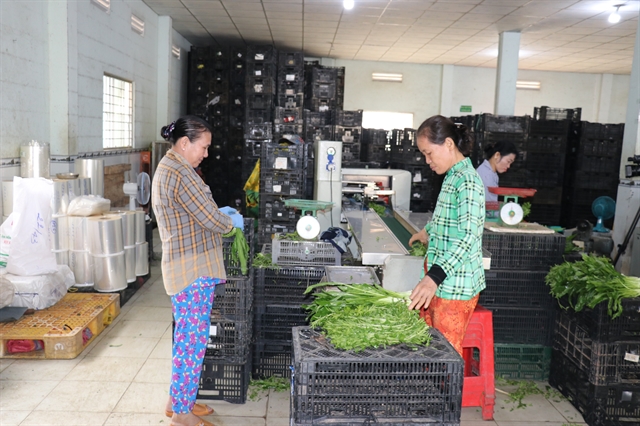
In Long Bình Commune, the Hòa Thạnh General Agricultural Co-operative uses science and technology to grow VietGAP-certified vegetables, supplying about 2,000 tonnes annually.
Nguyễn Thanh Quang, director of the co-operative, said: “The co-operative has invested in automatic packaging machinery.”
|
| The Hòa Thạnh General Agricultural Co-operative in Long Bình Commune uses a post-harvest processing facility to produce safe vegetables that are popular among consumers. — VNA/VNS Photo Hữu Chí |
The province has 25 smart pest-monitoring systems in rice and fruit-growing areas, providing data for pest forecasting and management.
The agricultural sector is also piloting the Vietnam Digital Agriculture Platform Ecosystem and distributing weather information through Zalo groups.
Despite this progress, access to technology remains uneven. About 60 per cent of the province’s fruit-growing areas have adopted digital transformation, while many farmers are still unfamiliar with new technologies.
The province aims to train about 2,250 digital farmers, professional farmers and modern co-operative managers during 2026-30.
Training will cover digital transformation, traceability, food safety, the circular economy, emissions reduction, branding and co-operative management.
At least 80 per cent of co-operatives, co-operative groups, co-operative unions and farmers’ clubs are to receive guidance on applying information technology to management, production, traceability and the use of supply-and-demand data on digital platforms. — VNS
Society
 Society
 Society
 Society
 Society
 Society
 Society
 Society
 Society
 Society
 Society
 Society
 Society
 Society
 Society