 Talk Around Town

Liechtenstein Prime Minister concludes official visit to Việt Nam
1.
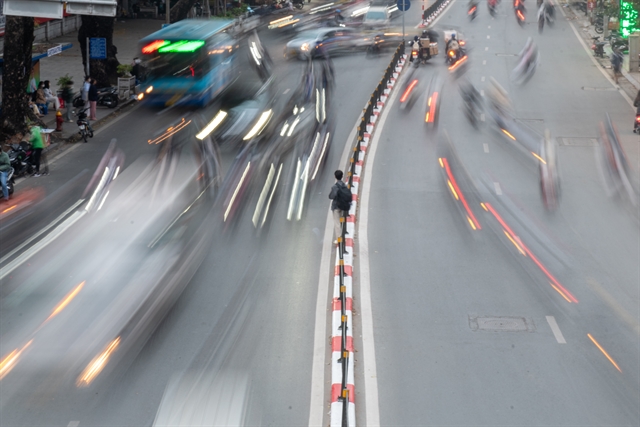 |
| eWAITING GAME: A patient pedestrian waits while vehicles stream by, seeking the right moment to cross the road. |
By Bảo Long
The tension builds up as the red light counts down below ten. Engines rev, wheels inch forward, and everyone braces themselves.
You’d be forgiven for thinking this is the starting grid for a MotoGP race.
In theory, you only move when the light turns green. In reality, you need some nerves to stand your ground when the bikes dart around you, honking, shouting, and riders giving you the evil eye.
As an unwritten rule, the ‘right’ moment to start your engine is when the red light countdown hits five.
When the number counts down to three, people start to move. I call it the 'three seconds of morality'.
What exactly is the right thing to do? Legally, you should stay put until the colour changes green. That’s the moral thing to do.
But when things come to the chase, it's pedal to the metal and off you go.
There’s a logical explanation for the three-second rule that many follow without fully understanding. The all-red interval allows vehicles that entered late to clear the intersection safely before the green light appears for the next direction.
But to many Hanoians on two wheels, it’s three useless seconds that must be stolen.
For a while, I held my position at the red light with my head held high. The honking and shouting did not faze me; they just confirmed my boldness as a protector of moral standards and a proud model citizen.
However, the crossroads in Hà Nội often prove the paradox of following the rule. I once stopped for a red light at Thái Thịnh Street. The lane is broad enough for only one car and a motorbike, but it is open for people to turn right.
The line of motorbikes behind me kept getting longer, and without any sound of a horn, they stared at me in silence, waiting for 90 seconds of red light under the summer sun.
It was the moment I faced a classic moral dilemma of choosing between following the rules or acting for the common good. My standing still was defending an abstract principle of law. But if I just moved my motorbike a little bit, breaking my self-imposed ‘safe zone’, I would free up the flow for dozens of other people.
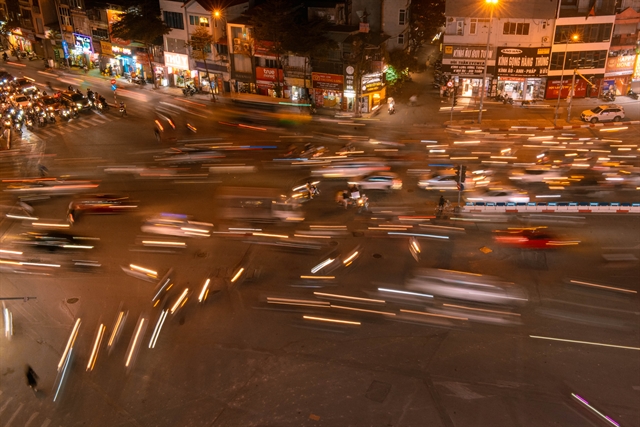 |
| SPEED AND LIGHT: By using a slow shutter speed, the camera captures long light trails from moving vehicles and the complex flow at Ô Chợ Dừa intersection during peak hours. VNS Photos Bảo Long |
I came to realise that such is the infrastructure in the capital – and beyond as the city grows – to accommodate the nearly eight million private vehicles on the roads, my rigid obedience to the rules only worsened the flow of traffic. And starting to move when there are still three seconds left on the red light is the true ethical standard, albeit one that doesn’t follow the letter of the law.
It’s a perceptive observation of the people here who use time and space to cope with the traffic jam.
However, the power that comes with allowing oneself to rise above the rules also carries the risk of defying them. People can easily slip from moral pick-pocketing to outright highway robbery. That is why becoming an ethical driver in Hà Nội demands more of you than you might think.
But Hà Nội traffic philosophy doesn’t end with the stolen three seconds. Once you have mastered the art of timing, another question quickly presents itself: when two lines meet, do you give way, or do you push through?
At intersections without clear markings, the choreography becomes fascinating. Dozens of riders approach each other head-on, none of them stopping, yet somehow weaving through like threads in a loom. To an outsider, it looks lawless. To locals, it is an unspoken pact: trust that the other will adjust just enough, and keep moving forward.
The underlying philosophy of Hà Nội’s traffic is that the flow should never stop. If you are an expat, there’s a good chance you have probably experienced it without having to hop on a motorbike, but as a pedestrian crossing the road.
No vehicle in Hà Nội will stop to let you walk peacefully. It’s not that easy in a city packed with chaotic energy like this. But if you walk steadily, keep eye contact with the drivers and trust them with your life, then you will make it across the street – most of the time.
Why waste time when you could move all at the same time and make things more fluent?
And to set the record straight, it’s not coming from the imbalance of power between pedestrians and motorbikes. Vehicular hierarchy has no ground here. Everyone is equally impatient. Instead of finding a zebra crossing to cross, you can safely walk the roads in Hà Nội if you understand the philosophy.
The most visible expressions of that philosophy appear in the way people change lanes. Vietnamese drivers often switch lanes without checking mirrors (often missing) or knowing the vehicles behind them. It’s a lack of awareness but also a kind of naïve trust in others.
Sometimes driving situations arise that test not only your skills but also your morality as a person. In that moment – and in countless frantic moments each day – a motorbike suddenly swerves into another lane to avoid an obstacle ahead. Do you follow their lead, switch lanes, and pass the problem on to the driver behind you?
Perhaps this is the most peculiar social contract on Hà Nội’s streets, an unspoken, almost instinctive form of collective responsibility. The faster riders fluidly compensate for the slower ones, and the more experienced swerve to create space for the hesitant. It’s not driven by altruism, but by a pragmatic, shared understanding: for the entire ‘school of fish’ to keep moving forward, everyone must instinctively adjust to everyone else.
In recent days, with new traffic laws coming into effect and traffic cameras issuing fines automatically, the illegality on the roads is expected to ease – and you can already see signs of it. Yet one cannot deny that the very disobedience to rules once worked as a surprisingly effective solution, one that even developed countries have learned from: traffic flow is dynamic.
On the Golden Gate Bridge, they use giant machines to create movable barrier lanes, optimising road space with top-down engineering. Hà Nội achieves a similar goal through a cruder, more chaotic, but entirely human-powered method.
Here, the people themselves become the ‘movable barriers', instinctively redrawing the road’s boundaries moment by moment. It's the same principle of dynamic optimisation, executed not by technology, but by a raw, collective improvisation.
So what is the true traffic rule in Hà Nội?
There may be those officially written down on a document you can find online, but then you must take into consideration the unwritten rules.
It’s a system that, to an outsider, may appear dangerous and incredibly frustrating.
Chaotic? Yes, but it’s choreographed chaos. Imagine a thousand ballroom dancers in perfect step, not missing a beat and beautifully manoeuvring around the dance floor in perfect harmony.
And those three seconds at the red light? They are not just about time. They are a daily referendum on morality -- a choice between the cold letter of the law and the warm, relentless and unforgiving flow of the city. VNS
Talk Around Town
 Talk Around Town
 Talk Around Town
 Talk Around Town
 Talk Around Town
 Talk Around Town
 Talk Around Town
 Talk Around Town
 Talk Around Town
 Talk Around Town
 Talk Around Town
 Talk Around Town
 Talk Around Town
 Talk Around Town
 Talk Around Town