 Economy



Hà Nội seeks boundary change to boost ecotourism, protect heritage
1.
|
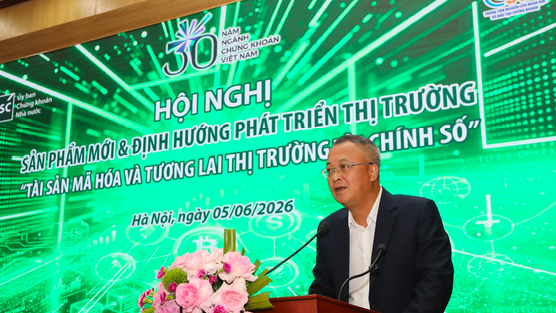
| Bùi Hoàng Hải, vice chairman of the State Securities Commission of Vietnam (SSC) delivers a speech at the conference. — Photo nhipsongkinhdoanh.vn |
HÀ NỘI — Crypto assets and the tokenisation of real-world assets are gradually becoming a key component of the digital economy, according to Bùi Hoàng Hải, vice chairman of the State Securities Commission of Vietnam (SSC).
Speaking at the 2026 conference on New Products and Market Development Orientation held in Hà Nội on Friday, Hải said Việt Nam was entering a critical phase in developing a legal framework for digital finance and pilot crypto-asset trading platforms under Government Resolution No 05/2025/NQ-CP.
“In the context of the Government accelerating the development of digital financial markets, Việt Nam has a major opportunity to attract international capital flows, unlock innovative business models and strengthen its position in the regional fintech landscape,” he said.
The conference, themed Crypto Assets and the Future of Digital Financial Markets, brought together representatives from the SSC, the State Bank of Vietnam, the Ministry of Public Security, financial institutions, securities firms, commercial banks and blockchain industry associations.
Hải said the rapid advancement of digital technologies was reshaping global finance, while tokenised real-world assets (RWAs) were no longer merely experimental concepts but increasingly viewed as part of the future financial infrastructure.
However, he stressed that sustainable market development would require a transparent ecosystem, effective risk governance and stronger investor protection mechanisms.
“These are also central requirements for regulators and businesses in the process of developing new financial markets, including the pilot crypto-asset market in Việt Nam,” he added.
At the conference, officials outlined draft regulatory orientations for the domestic crypto-asset market, while industry representatives discussed international trends in tokenisation and digital asset exchanges.
Chris Chiew, senior advisor at CAEX, said Việt Nam had strong potential to develop the sector thanks to its young, tech-savvy population and rapidly expanding digital economy.
He noted that Việt Nam currently ranks seventh globally in the number of crypto-asset users and fifth in transaction growth.
According to Chiew, tokenisation could help improve access to investment opportunities by allowing ownership of large-value assets such as real estate, infrastructure and commodities to be digitally divided and traded more efficiently.
Potential assets for tokenisation include real estate, gold, industrial infrastructure, data centres, energy projects and port systems, he said.
Citing international examples, Chiew said major financial institutions such as BlackRock and Hamilton Lane had already launched successful tokenised investment products.
Global tokenised asset markets could reach US$19 trillion by 2033, while Việt Nam’s market may expand to between $70 billion and $80 billion by 2030, according to industry projections presented at the conference.
Meanwhile, Phan Đức Trung, chairman of the Vietnam Blockchain Association, said the global crypto market was becoming more stable after periods of sharp volatility.
He noted that the emergence of Bitcoin exchange-traded funds (ETFs) had opened the market to more traditional investors, with BlackRock currently managing around $67 billion in Bitcoin ETF assets.
In the Asia-Pacific region, digital asset transaction values continued to rise strongly, reaching around $2.4 trillion as of June 2025, he said.
Regarding regulatory plans, Tô Trần Hòa, deputy head of the SSC’s Crypto Asset Market Management Board, said investors would still be allowed to keep assets in personal wallets, even after licensed virtual asset service providers (VASPs) begin operations.
However, all trading activities would eventually have to be conducted through licensed domestic platforms.
Under the proposed framework, foreign investors would be allowed to open accounts and participate in Việt Nam’s crypto market, while domestic participation would initially be limited to investors already holding crypto assets.
All trading activities would also be denominated in Vietnamese đồng, including transactions involving Bitcoin, Ethereum and stablecoins such as USDT and USDC, according to officials.
The conference also addressed anti-money laundering measures, cyber-security risks and investor safeguards as authorities move towards establishing a formal legal framework for digital assets in Việt Nam. —VNS
Economy
 Economy
 Economy
 Economy
 Economy
 Economy
 Economy
 Economy
 Economy
 Economy
 Economy
 Economy
 Economy
 Economy
 Economy