 Economy


Việt Nam, EU and Belgium seek deeper, practical cooperation
1.
|
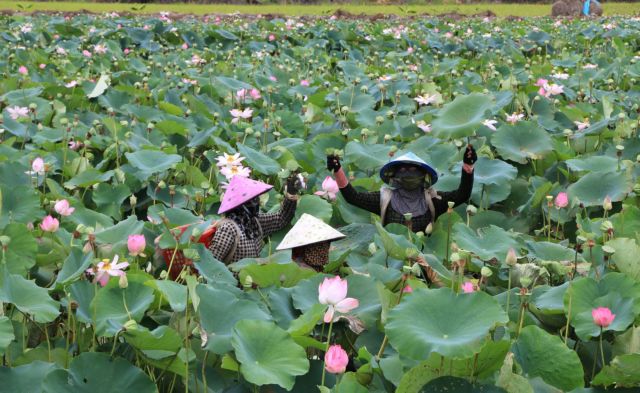
| Farmers in Đồng Tháp Province’s Trường Xuân Commune harvest lotus seed pods. — VNA/VNS Photo |
ĐỒNG THÁP — Đồng Tháp Province is strengthening its lotus industry by improving raw material quality, expanding deep processing, boosting exports and linking the sector with tourism to increase the crop's economic value.
Known as “the Pink Lotus Land”, the Cửu Long (Mekong) Delta province has around 1,800ha of lotus, mainly in Tháp Mười, Tam Nông and Lấp Vò communes and Cao Lãnh Ward.
Nguyễn Hùng Tráng, Secretary of the Cao Lãnh Ward Party Committee, said the lotus industry had made significant progress in recent years, with the development of concentrated growing areas.
Processed lotus products have gradually strengthened their position in the market, and community-based tourism linked to lotus cultivation has created distinctive visitor experiences, he said.
He said geographical indication protection for Đồng Tháp lotus products had laid an important foundation for brand building and value enhancement, but added that the industry's growth potential remained substantial.
Đồng Tháp has identified improving the quality of its lotus growing areas as the key to raising the industry's value.
Associate Professor Lê Minh Tường of the College of Agriculture, Cần Thơ University, said his research team had developed an integrated disease management process for major lotus diseases suited to both specialised lotus cultivation and rice-lotus rotation systems.
Demonstration models in Tháp Mười Commune and Cao Lãnh Ward reduced disease incidence by 70–87 per cent while cutting the use of chemical crop protection products, lowering production costs and increasing yields and profits compared with conventional farming, he said.
"The process also supports environmentally friendly and sustainable lotus production," he said.
|
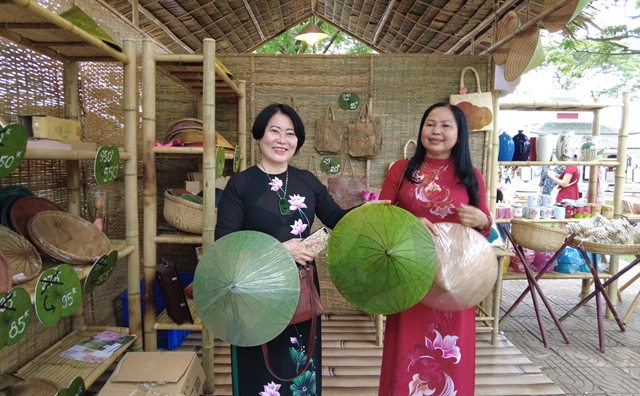
| Souvenirs made from lotus. — VNA/VNS Photo |
According to experts, lotus has far greater potential than food production alone. With appropriate processing technology, the plant could also become a valuable raw material for pharmaceuticals, cosmetics and healthcare products.
Trương Thành Sơn, deputy chairman of the Đồng Tháp Lotus Industry Association, said although the province has the country's largest lotus-growing area, the priority now should be improving quality rather than increasing output.
"The challenge is to grow cleaner, higher-quality lotus and create higher-value products," he said.
Deep processing
Businesses, co-operatives, co-operative groups and household producers in the province are developing a wider range of lotus-based products, including tourism services, food, beverages, pharmaceuticals, cosmetics and souvenirs.
The province has developed more than 100 products from different parts of the plant. Of these, nearly 60 have achieved three-star or higher certification under the national “One Commune–One Product” (OCOP) programme.
Lê Văn Bo of Phong Mỹ Commune has spent 15 years developing lotus farming, cultivating 12ha and producing value-added products, including lotus teas and lotus milk.
By combining processing with tourism, lotus farming generates profits three to four times higher than rice, he said.
"Lotus has high economic value because almost every part of the plant can be used," he said.
Nguyễn Trọng Hương, founder of Huong Sen Dong Thap Production and Trading Company Limited in Thanh Bình Commune, said he had spent many years researching the lotus plant and developing processed lotus products.
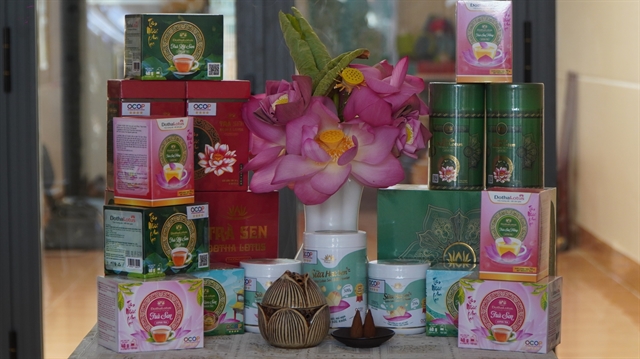
The company has invested in modern equipment and machinery to support production, has developed more than 15 processed lotus products, and plans to launch several more in the near future.
It has seven products recognised as four-star OCOP products, including lotus seed milk, lotus embryo tea, lotus leaf tea and lotus tea bags.
"To fully unlock the benefits of lotus, it should be combined with traditional medicine," he said.
|
| Lotus products certified under the national “One Commune–One Product” (OCOP) programme by Huong Sen Dong Thap Production and Trading Company Limited in Thanh Bình Commune. — VNA/VNS Photo |
To ensure the sustainable development of the lotus industry, the province is reviewing plans for concentrated lotus-growing areas that meet food safety standards and are large enough to provide a stable supply of raw materials for domestic processing, exports and tourism.
The province is also improving sustainable cultivation practices, standardising production and diversifying lotus varieties to meet market demand, including those grown for roots, stems, leaves and seed pods.
To broaden market access, the Đồng Tháp Lotus Industry Association has signed a co-operation agreement with Viettel Post to sell lotus products through e-commerce platforms and multi-channel sales networks.
The association also plans to establish a services and trading joint stock company to support product distribution, connect markets and help lotus growers overcome marketing difficulties.
Ngô Chí Công, chairman of the Đồng Tháp Lotus Industry Association, said: "Besides lotus roots and lotus seeds, products made from lotus leaves and deeply processed lotus flowers will become key export products in the future.”
|
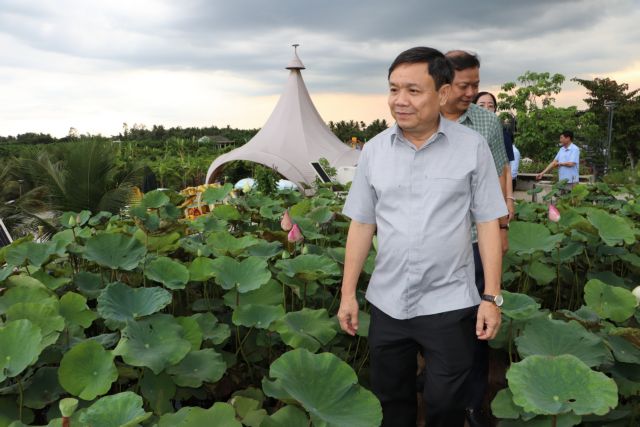
| Leaders of Đồng Tháp Province visit a lotus field at Suối Gạo Farm in Tân Thuận Bình Commune on June 16 to survey its agricultural and experiential tourism model as part of efforts to promote agricultural tourism across the province. — VNA/VNS Photo |
Đồng Tháp aims to use the story of the lotus to strengthen tourism and generate greater value for the industry.
Lê Chí Thiện, deputy director of the Đồng Tháp Department of Agriculture and Environment, said the agriculture sector will continue to improve the quality of lotus-growing areas through standardised, green and low-emission production.
It will also strengthen links among farmers, co-operatives, businesses, tourism operators and distributors to build an integrated lotus value chain, he said.
“Priority will also be given to deep processing and the circular economy to maximise the value of the lotus plant, while gradually developing a comprehensive database for the industry,” he said. — VNS
Economy
 Economy
 Economy
 Economy
 Economy
 Economy
 Economy
 Economy
 Economy
 Economy
 Economy
 Economy
 Economy
 Economy
 Economy