 Economy


Việt Nam, Poland establish Strategic Partnership
1.

|
| An engineer working at the Long Son Petrochemicals Complex, invested by Thailand’s SCG Group, in HCM City. Newly registered FDI saw strong growth, with 2,429 newly licensed projects attracting $21.05 billion from January to July. — VNA/VNS Photo Đoàn Mạnh Dương |
HÀ NỘI — Việt Nam attracted more than US$38 billion in registered foreign investment in the first seven months of 2026, up 58 per cent year-on-year, as the country continued to strengthen its appeal as a destination for global manufacturing and high-tech investment.
The surge came amid efforts to carry out the Politburo’s Resolution 10-NQ/TW on promoting the development of the foreign-invested economic sector.
Data released by the National Statistics Office (NSO) under the Ministry of Finance showed that total registered foreign investment, including newly registered capital, adjusted capital and capital contributions through share purchases, reached over $38 billion as of July 31.
Disbursed investment also recorded strong growth, estimated at $15.2 billion from January to July, up 11.8 per cent year-on-year and marking the highest seven-month disbursement level in the past five years.
Of note, 82.6 per cent of the disbursed capital flowed into the manufacturing and processing industry, showing that multinational corporations continue to expand factories and production facilities in Việt Nam.
Newly registered foreign direct investment (FDI) saw strong growth, with 2,429 newly licensed projects attracting $21 billion. While the number of projects increased by only 7.8 per cent, the registered capital was 2.1 times the level of the same period last year, indicating a shift towards larger investment projects.
Manufacturing and processing continued to dominate new FDI commitments, accounting for 55 per cent of the total with $11.6 billion. The electricity, gas and water production and distribution sector ranked second, attracting $3.1 billion, or 14.9 per cent.
Singapore was the largest among 69 economies investing in Việt Nam with $7.5 billion, representing 35.6 per cent of total newly registered capital. The Republic of Korea followed with $5.6 billion, Hong Kong (China) with $2.9 billion and China with $1.7 billion.
Of the foreign-invested projects already underway, 666 saw additional capital of $10.4 billion, up 4.4 per cent year-on-year.
Foreign investors also conducted 1,815 capital contribution and share purchase transactions worth $6.6 billion, a sharp increase of 61.6 per cent. This capital mainly flowed into professional, scientific and technological activities ($2.7 billion) and wholesale and retail trade (nearly $2 billion).
The NSO said the acceleration in capital inflows reflect stronger investor confidence in Việt Nam’s economic outlook, particularly in strategic sectors such as high-tech manufacturing, energy production and industrial processing.
Attraction priorities
|
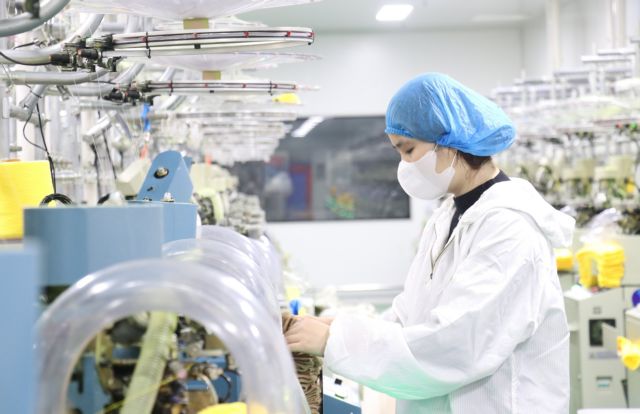
| A worker at a foreign-invested company in Tây Ninh Province. Việt Nam is moving to reshape its foreign investment strategy with priority given to projects using advanced technologies. — VNA/VNS Photo Bùi Giang |
Việt Nam is moving to reshape its foreign investment strategy under Resolution 10, which was issued on June 8 and sets out a new approach to FDI attraction, focusing on selective investment rather than broad expansion. Priority will be given to projects using advanced technologies, creating stronger links with domestic enterprises and supporting sustainable economic growth.
The Ministry of Finance said that it is focusing on institutional reform, strategic infrastructure, workforce development and investment promotion to attract quality FDI inflow.
Accelerating legal reforms to make investment regulations more transparent and predictable will be necessary, as competition for foreign investment intensifies across Southeast Asia and the introduction of the global minimum corporate tax reduces the effectiveness of traditional tax incentives, the ministry said.
It called for faster administrative procedures in investment, land, construction and environmental approvals, particularly for projects involving semiconductors, artificial intelligence, data centres, renewable energy and other high-tech industries.
The ministry also stressed the need for transport, logistics and energy infrastructure development, including expressways, deep-water ports, airports and integrated industrial-logistics hubs. This would strengthen Việt Nam's role in global supply chains while ensuring sufficient electricity supply for data centres, semiconductor manufacturing and other technology-intensive industries, according to the ministry.
To address labour shortages, the ministry proposed expanding cooperation between universities and foreign-invested enterprises, increasing training in semiconductors, information technology, electronics and artificial intelligence, and simplifying procedures for recruiting foreign specialists. It also proposed simplifying work permit and visa procedures for foreign experts to facilitate large-scale and high-tech investments.
The finance ministry also pledged to strengthen investment promotion targeting leading global technology companies, while encouraging greater cooperation between foreign-invested and domestic enterprises to raise localisation rates and boost technology transfer.
Overseas investment
Việt Nam’s overseas investment also expanded sharply, with domestic firms investing $2.4 billion overseas in the seven-month period, 4.5 times higher than a year earlier.
Of the total, newly registered overseas investment reached $1.2 billion from 106 projects, nearly three times higher year-on-year, while additional capital for existing projects surged to $1.2 billion, more than nine times higher.
Overseas investment largely focused on infrastructure, logistics and energy.
Laos remained the top destination for Vietnamese investment, receiving $638.3 million, equivalent to 27 per cent of total outbound capital. Cambodia ranked second with $449.9 million, followed by Indonesia with $308.6 million.
Other markets, including India, the Philippines and Kazakhstan, have also emerged as new destinations for Vietnamese investors. — VNS
Economy
 Economy
 Economy
 Economy
 Economy
 Economy
 Economy
 Economy
 Economy
 Economy
 Economy
 Economy
 Economy
 Economy
 Economy




