 Society

Việt Nam, Singapore promote cooperation through Party-to-Party channel
1.
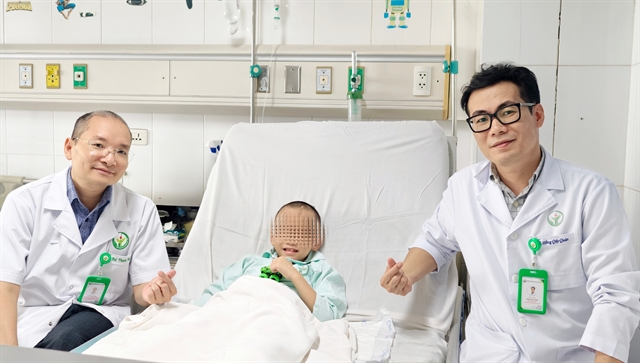 |
| Doctors are delighted as the boy gradually stabilised. — Photo courtesy of the hospital |
HÀ NỘI — The Việt Đức University Hospital on Monday announced they have successfully saved a six-year-old boy who suffered from particularly severe multiple injuries after an iron fence post impaled his abdomen and perineum.
Bùi Thanh Phúc, deputy head of the Emergency Digestive Surgery Ward, said the child in Hà Nội had been brought to hospital in haemorrhagic shock, with an unrecordable pulse and blood pressure.
Relatives said the accident occurred when the boy fell from a height of about 10m and landed on a fence post, which pierced through his abdomen and perineum.
The suddenness of the incident plunged the family into panic. To transport the child to hospital, the family had to use a saw to cut the fence and keep the metal post in place while bringing him to the facility, which has proved a right thing to do.
Doctors assessed that the large foreign body penetrating the abdominal cavity posed a risk of simultaneous injury to multiple vital organs, including the gastrointestinal tract, urinary system, musculoskeletal structures, and major blood vessels.
Faced with an exceptionally critical case that directly threatened the child’s life, the on-duty team activated a ‘red alert’, coordinating a multidisciplinary response to provide emergency care and proceed to emergency surgery.
The operation lasted four tense hours. Immediately after the foreign body was removed, the surgical team addressed a series of complex injuries: suturing small-bowel wounds, repairing the bladder neck, placing a urethral drain, performing a suprapubic cystostomy, creating a temporary colostomy, suturing and reconstructing the external anal sphincter, and irrigating and draining the abdominal cavity.
After many hours of intensive surgery, the child initially overcame the critical phase.
Resuscitation of the child proved difficult and complex.
According to Associate Professor Lưu Quang Thuỳ, director of the Centre for Surgical Intensive Care, children are not simply small adults. All treatment parameters – from ventilatory strategy and tidal volume to haemodynamics, fluid therapy and drug dosing – must be precisely calculated according to each child’s weight, age and physiological characteristics. Even a minor deviation can affect treatment outcomes.
In addition, given the severity of the child’s multiple injuries, the risks of multi-organ failure, coagulopathy and infection remained ever-present. Therefore, doctors had to continuously monitor every vital sign and closely assess all developments in order to adjust the treatment protocol in a timely manner.
After approximately 10 days of intensive treatment, the child’s condition improved markedly. He is now fully conscious, interacts well, can answer doctors’ questions and moves normally.
The patient has since been transferred to the Paediatric and Neonatal Surgery Ward for continued monitoring and assessment of his recovery.
Doctors advised parents to pay special attention to their children in daily activities. Children are highly active, and accidents can occur at any time if due caution is not exercised. Therefore, parents must always supervise their children to protect them from unfortunate incidents.
“When a child is unfortunately impaled by a sharp object or foreign body, do not attempt to remove it yourself, as this may cause further damage to internal organs or trigger massive bleeding, worsening the condition. If possible, stabilise the foreign object and promptly take the child to a medical facility capable of providing emergency care and advanced surgery for timely management,” Phúc advised. — VNS
Society
 Society
 Society
 Society
 Society
 Society
 Society
 Society
 Society
 Society
 Society
 Society
 Society
 Society
 Society