 Society
Việt Nam, Denmark strengthen cooperation in official statistics, digital transformation
1.
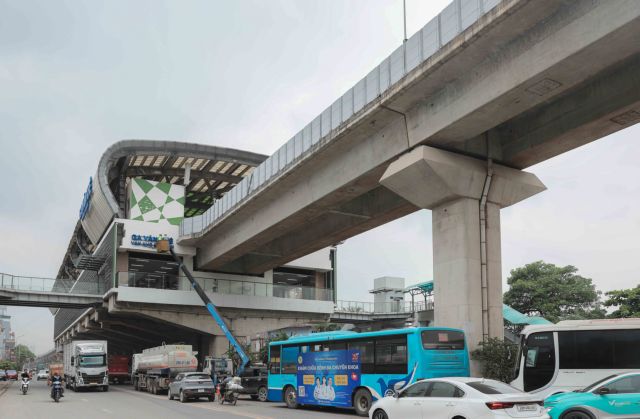 |
| Văn Khê Station on the Cát Linh-Hà Đông metro line in Hà Nội. — VNA/VNS Photo |
HÀ NỘI — Hà Nội aims to mobilise resources to accelerate the development of its urban railway network, with about 100km expected to be completed by 2030, according to the city’s latest plan.
The plan, signed recently by municipal People's Committee Chairman Vũ Đại Thắng, outlines measures to carry out a Government resolution and the city Party Committee's action programme to implement a Politburo resolution on developing the capital in the new era.
For the 2026-2030 period, Hà Nội targets average annual GRDP growth of more than 11 per cent, with GRDP exceeding US$113 billion and per capita GRDP reaching at least $12,000.
The digital economy is expected to account for at least 40 per cent of GRDP, while the cultural industry is projected to contribute around 9 per cent.
The city also aims to address major bottlenecks involving flooding, environmental pollution, traffic congestion, urban management and food safety at the same time.
From 2031 through 2035, Hà Nội targets average annual GRDP growth of at least 11 per cent, with GRDP reaching around $200 billion and per capita GRDP at least $18,800.
Total factor productivity is expected to contribute 60 per cent of growth, while the digital economy is projected to account for 50 per cent of GRDP and the cultural industry at least 10 per cent.
Between 2036 and 2045, the capital plans to achieve average annual GRDP growth of more than 11 per cent, with GRDP reaching around $640 billion and per capita GRDP at least $42,000 dollars.
From 2046 through 2065, the city targets average annual GRDP growth of more than 5 per cent, with GRDP reaching around $1.92 trillion and per capita GRDP at least $95,000 dollars, placing Hà Nội among the world's high-income economies.
City authorities say the capital will develop detailed urban and rural planning in line with its 100-year master plan.
It will also complete a planning information system, digitise geographic information system data and make planning databases publicly available for monitoring by residents and businesses.
Hà Nội plans to reshape its structure into a multi-layer and multi-centre urban cluster. The Hồng (Red) River will serve as the city's main ecological and cultural landscape axis, while the Đuống, Đáy, Nhuệ, Tô Lịch and Cầu Bây rivers, together with the Ba Vì special-use forest, will form a foundational ecological framework.
City authorities will also study upgrades and propose measures to gradually develop dual-use operations at Gia Lâm and Hòa Lạc airports.
The capital has proposed the construction of a second international airport in the southern part of the city, linked to free trade zones and modern logistics hubs.
It will also develop plans to exploit the underground economy and low-altitude airspace in connection with metro stations.
Hà Nội authorities will accelerate urban restructuring and the renovation and reconstruction of old apartment buildings, particularly those classified as Level D, which are considered dangerous.
The city aims to complete the renovation and reconstruction of such buildings by 2030, alongside improvements to surrounding urban areas and deteriorated infrastructure.
In the cultural sector, the capital will prioritise investment in the preservation, restoration and promotion of the value of the nation's special, historical and cultural heritage sites, with a focus on the Thăng Long Imperial Citadel, Cổ Loa Citadel and the Temple of Literature. — VNS
Society
 Society
 Society
 Society
 Society
 Society
 Society
 Society
 Society
 Society
 Society
 Society
 Society
 Society
 Society