 Features
Theatrical arts shine on Hà Nội stage
1.
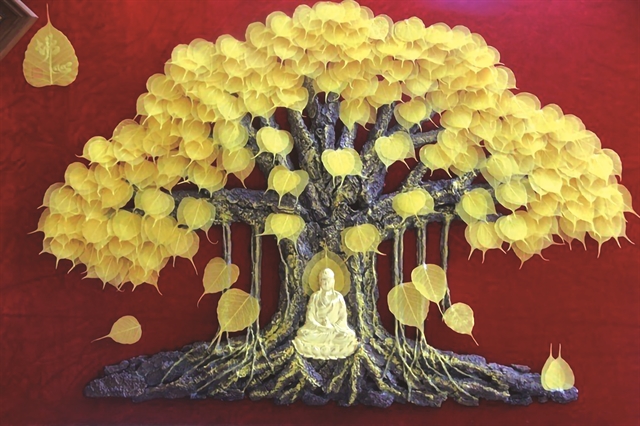 |
| This artwork depicts Buddha attaining enlightenment beneath the Bodhi Tree. Bodhi leaf artworks can fetch millions of 'đồng', with particularly elaborate pieces valued at tens of millions. — Photo vietnamnet.vn. |
When bodhi leaves fall to the ground in Ninh Bình, their journey does not necessarily end. Collected and carefully transformed by hand, these delicate leaves are given a second life as intricate artworks that carry spiritual meaning, local identity and a growing economic value.
Behind these creations is the Sinh Dược Cooperative in the province's Tây Hoa Lư Ward, where local workers and master artisans have turned what might once have been regarded as waste into products of artistic, spiritual and economic value.
The cooperative’s Vạn Hạnh Bodhi Leaf Pictures were recognised as a national five-star One Commune One Product (OCOP) product in April 2026, marking a new milestone after its bodhi leaf pictures received a four-star OCOP rating from Ninh Bình Province.
A sacred leaf
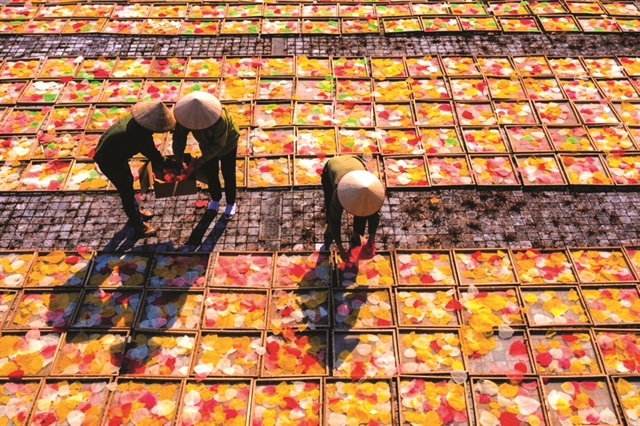 |
| Colourful bodhi leaf skeletons are sun-dried. The leaves, from trees closely associated with Bái Đính Pagoda, are transformed into distinctive artworks. Photo vietnamnet.vn |
The Bodhi Tree has long held a special place in Buddhist tradition. It is associated with wisdom, enlightenment and inner peace, recalling the story of Siddhartha Gautama attaining enlightenment while meditating beneath a Bodhi tree.
That symbolism has particular resonance in Ninh Bình, a land closely associated with Vietnamese history and Buddhist culture. The ancient royal capital of Hoa Lư, the temples dedicated to the Đinh (968–980) and Early Lê (980–1009) dynasties, and the immense Bái Đính Pagoda complex have helped make the province a major destination for spiritual and cultural tourism.
For local artisans, the bodhi leaf is therefore more than a natural material.
Bodhi leaves used in an artistic collage must first be processed into skeletons, which retain their delicate networks of veins, before being transformed into a visual expression of serenity and contemplation. Many artworks depict Buddhist figures, lotus flowers, temples and landscapes, while others combine the leaves with calligraphy and traditional decorative motifs.
The idea of turning the leaves into handicrafts was developed in 2018 by Sinh Dược Cooperative director Vũ Trung Đức and his friend Hoàng Thanh Phương, who wanted to create a distinctive souvenir for visitors to their home province. After numerous experiments, they developed a process for preserving the leaves and incorporated it into the cooperative’s production.
“When I saw Bodhi leaves falling on the surface of a pond, and learned that Buddhist pilgrims brought Bodhi leaves home from India, I began thinking about how to turn them into artworks,” Phương recalled.
What started as an experiment would gradually develop into a distinctive craft and a new way of telling the story of Ninh Bình through art.
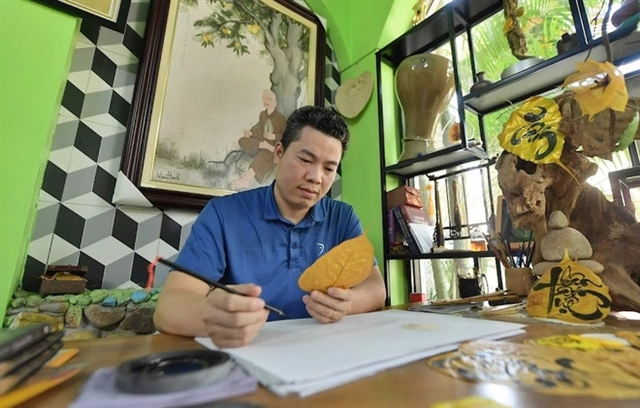 |
| Hoàng Thanh Phương works on a bodhi leaf artwork at the Bồ Đề Tây Phương Gallery in Ninh Bình. — Photo kenh14.vn |
From leaf to art
Creating a bodhi leaf picture collage is a painstaking process that can take several hours, several days or even months, depending on the size and complexity of the work.
The process begins around July and August, when mature leaves with strong veins and attractive shapes are collected. The leaves are sorted according to their size, shape and appearance before being soaked in clear limewater for roughly two months.
The treatment allows the softened green/brown tissue of the leaf to decompose naturally while preserving the delicate vein structure.
Artisans then gently brush away the remaining softened tissue, leaving behind what looks like a fragile botanical skeleton. The leaves are dried in mild sunlight before damaged pieces are removed and the remaining material is carefully sorted once again.
To increase durability and create a distinctive appearance, the leaf skeletons are treated with colour and metallic compounds, producing a characteristic golden sheen.
Only then can the artistic work begin.
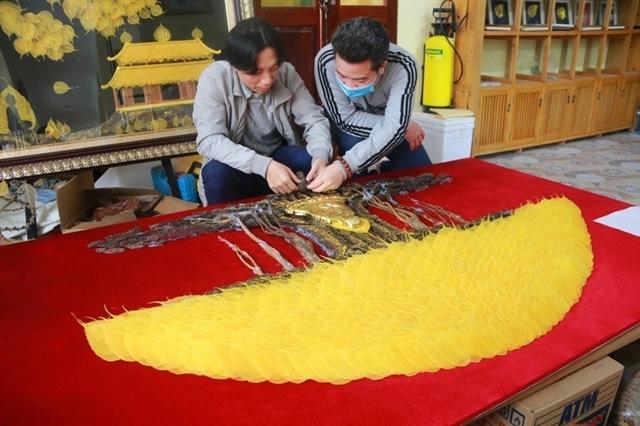 |
| A large bodhi leaf skeleton collage takes shape through painstaking handwork, with some artworks incorporating hundreds or even thousands of individual leaf skeletons. Photo vietnamnet.vn |
A single collage picture may incorporate hundreds or even thousands of individual leaves. Artisans arrange, cut, shape and combine them to create complex compositions, sometimes working alongside painters, calligraphers and other craft specialists.
Some works are completed in four or five hours. Others require four or five days, while particularly elaborate pieces can take several months.
Prices vary accordingly, ranging from several hundred thousand đồng to tens of millions of đồng.
A new livelihood
The story of bodhi leaf collages is also a story about young people seeking new ways to build livelihoods from local resources.
At the Bồ Đề Tây Phương Gallery, many works are inspired by Buddhist stories, including depictions of the Buddha attaining enlightenment beneath the Bodhi Tree. Others portray historical figures, national landmarks and symbols of Vietnamese culture.
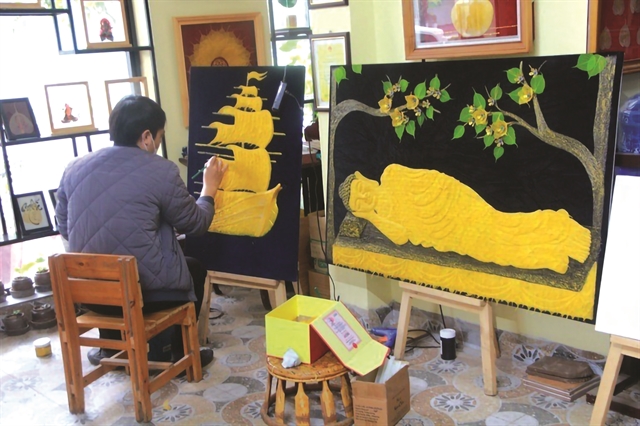 |
| An artisan carefully arranges and shapes bodhi leaf skeletons to create intricate artworks inspired by Buddhist stories and symbols.Photo vietnamnet.vn |
For the artisans, however, preserving the cultural meaning of the leaf is as important as creating an attractive work of art.
“This work not only gives me an income to support my family, but also allows me to pursue my passion,” said Hoàng Hoài Nam, who creates and arranges bodhi leaf artworks at the Bồ Đề Tây Phương Gallery.
“When each artwork reaches someone, it carries with it the deeper meaning of the bodhi tree and its leaves. In a way, we are helping spread something good.”
The cooperative now provides stable jobs for more than 70 local workers across its production activities, helping turn a traditional craft into a sustainable source of income for the community.
The products are sold to domestic visitors through shops and online channels, while the cooperative is also seeking to expand their reach to international markets.
The master artisans have further experimented with combining bodhi leaves with other local craft materials, including Minh Trang embroidery, Bồ Bát ceramics, Kim Sơn sedge, woodwork and gilded details.
Such collaborations allow them to create one-of-a-kind pieces while strengthening links among traditional craft producers.
The development reflects a broader effort to turn local cultural and natural resources into distinctive products, generate sustainable livelihoods and promote the identity of Ninh Bình.
For Ninh Bình, the delicate bodhi leaf is proving that heritage does not have to remain confined to monuments and old stories. With creativity and patient craftsmanship, even something as ordinary as a fallen leaf can become a vehicle for cultural expression, a meaningful gift for visitors and a source of income for local communities.
Perhaps that is the quietest beauty of the craft: the leaves may have fallen from the tree, but in the hands of artisans, they have found a new way to remain alive. — VNS
Features
 Features
 Features
 Features
 Features
 Features
 Features
 Features
 Features
 Features
.jpg) Features
Features
 Features
 Features
 Features
 Features