 Features

Ministry proposes fund to boost energy efficiency
1.
More than six centuries after serving as the spiritual and political heart of the Later Lê Dynasty, the Lam Kinh Special National Relic Site in Thanh Hóa Province is embracing digital technology, bringing its remarkable history to life for a new generation of visitors.
The heritage complex was named “Leading Tourist Destination for the Restoration and Development of Traditional Cultural Activities” at the VITA Awards 2026, recognising its efforts to preserve cultural heritage while developing innovative tourism experiences.
 |
| An aerial view of the Lam Kinh Special National Relic Site in Thanh Hóa Province. VNA/VNS Photo Hoa Mai |
Established in the early decades of the 15th century alongside Đông Kinh – the political, economic and cultural centre of the country under the Later Lê Dynasty (1483-1789) – the site is an architectural complex of outstanding historical, cultural and artistic value. It is a place of worship dedicated to the ancestors of the Lê clan and the final resting place of the emperors and queens of the Later Lê Dynasty.
With its architectural structures harmoniously integrated into the surrounding natural landscape, Lam Kinh was recognised as a national-level relic site in 1962 and as a special national relic site in 2012.
After more than six centuries, Lam Kinh has preserved a remarkable historical and cultural legacy, while firmly establishing itself as one of Thanh Hóa’s foremost cultural and spiritual destinations.
Of particular significance are its five ancient stone steles, recognised by the Prime Minister as national treasures for their exceptional historical, cultural and artistic value.
In addition, the heritage site hosts a wide range of distinctive traditional cultural activities, most notably the annual Lam Kinh Festival, held in the eighth lunar month to recreate the heroic spirit of Emperor Lê Thái Tổ and the fighters who took part in the Lam Sơn uprising against Chinese Ming rule from 1418 to 1427.
The festival will continue to be held with all traditional rituals and ceremonies this year, following a solemn yet practical approach, thereby helping preserve and promote the recognised intangible cultural heritage.
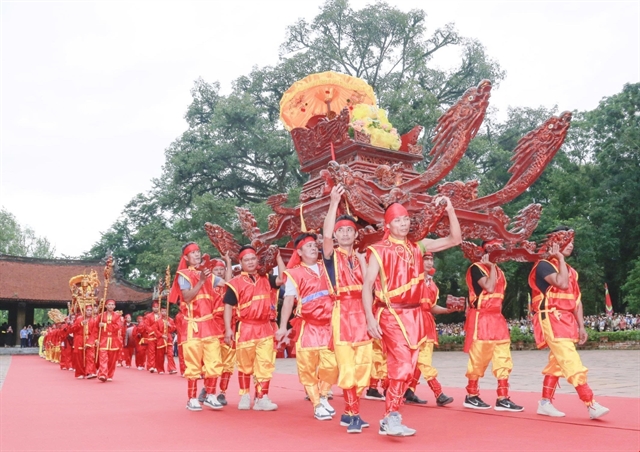 |
| The Lam Kinh Festival is held annually, offering visitors a range of cultural experiences. VNA/VNS Photo Hoa Mai |
Covering nearly two square kilometres of hills, rivers, lakes, streams and ancient forests, including a protected woodland that is home to many rare plant species, Lam Kinh combines majestic antiquity with scenic natural beauty.
Smarter tourism
Its unique landscape and rich heritage have made it a distinctive destination for both domestic and international visitors.
Lê Anh Dũng from Hà Nội said what impressed him most upon arriving at Lam Kinh was the harmony between the natural landscape and the ancient architectural structures, creating a peaceful setting steeped in historical value.
“More than six centuries have passed, yet the heritage site, a symbol of national pride from a glorious period of resistance against foreign invaders and nation-building efforts, has retained its historical, cultural, architectural and artistic values, which have been preserved, honoured and safeguarded,” Dũng said.
Over the years, Thanh Hóa Province has allocated substantial resources to preserving and promoting the value of the relic site.
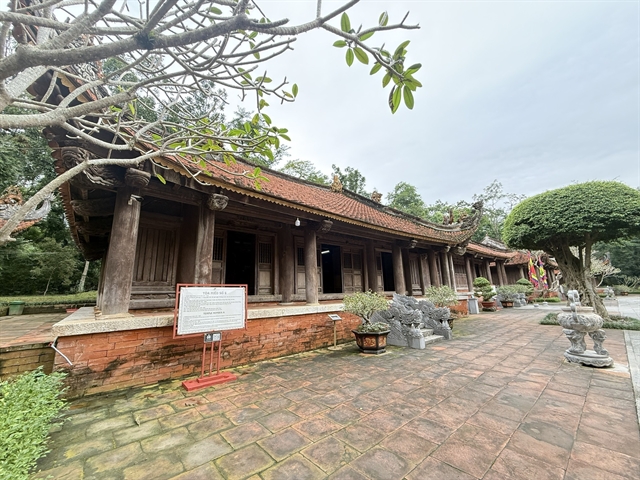
Major components, including Lam Kinh Palace, Dragon Courtyard, the system of lakes, ceremonial gates and five of the nine buildings of Thái Miếu (Imperial Ancestral Temple), have been restored or reconstructed, gradually helping recreate the appearance of ancient Lam Kinh.
Building on these conservation efforts, Thanh Hóa is implementing a project to restore and rehabilitate the site during the 2025–27 period, with a total investment of more than VNĐ81 billion (US$3.1 million).
Alongside conservation efforts, Lam Kinh is continuously innovating to improve the quality of visitor services. The opening of Lam Kinh Palace, the launch of smart tourism products and a range of new visitor experiences have helped enhance the destination’s appeal.
The implementation of a smart tourism platform is considered a breakthrough in digital transformation, providing fresh impetus for the development of cultural tourism in Thanh Hóa.
In 2021, Lam Kinh introduced an automated audio-guide system, while also applying virtual reality and augmented reality technology to enhance the visitor experience. The system underwent a comprehensive upgrade in 2024.
 |
| A visitor uses the automated audio-guide system. — VNA/VNS Photo Việt Hoàng |
With just a smartphone and a scan of QR code, visitors can access 18 multilingual interpretation points in Vietnamese and English, featuring vivid visuals and rich content.
In addition, a smart speaker system integrated with AI-powered cameras has been put into operation, helping modernise heritage interpretation and enhance visitor services and experiences.
Digital discovery
The integration of such technology has made it easier for visitors to explore the heritage site while enriching their overall experience.
“The site is an impressive heritage complex, both in scale and in its historical and architectural value. Each structure within the site can leave visitors amazed and inspire them to learn more about its history," said Nguyễn Thị Lan, a visitor from Hải Phòng.
"It is also very convenient that every attraction within the site has been digitised, allowing visitors to explore information at their own pace even without a guide. As a visitor, I find this extremely useful.”
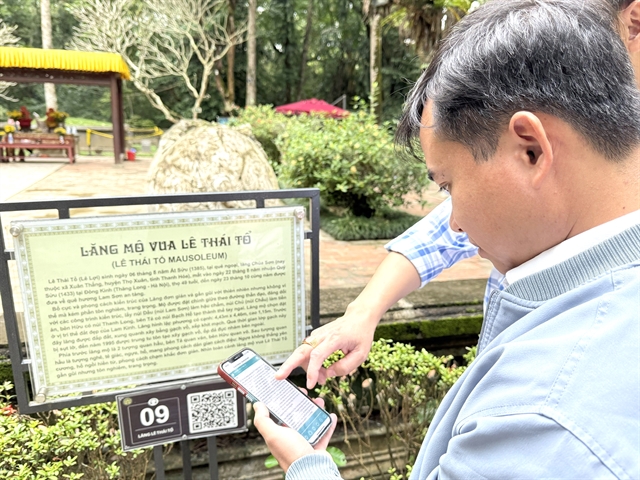 |
| A tourist scans a QR code to learn about Emperor Lê Thái Tổ Mausoleum at the Lam Kinh Special National Relic Site. — VNA/VNS Photo Việt Hoàng |
For local students, the digital transformation of the Lam Kinh heritage site has given them greater opportunities to learn about the heritage of their homeland.
“As a native of Lam Sơn, I often visit the site to explore and learn more about its history. Besides its architectural structures, I am particularly interested in learning about the emperors buried there," said Hương Giang, a student at Lam Sơn Secondary School in Lam Sơn Commune.
"By scanning the QR codes, I have learned more about Emperor Lê Thái Tổ, who founded the Later Lê Dynasty, and Emperor Lê Thánh Tông, one of the nation’s most enlightened monarchs. In addition to learning from books and other materials, exploring history through heritage sites is truly valuable,” Giang said.
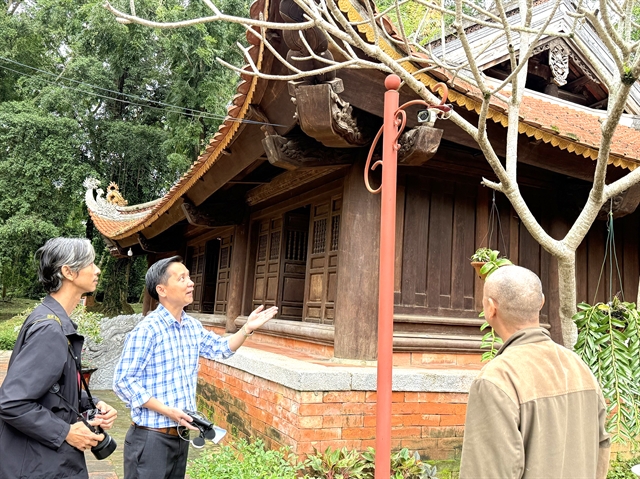 |
| AI cameras scan visitors and automatically provide audio commentary about points of interest at the site. — VNA/VNS Photo Việt Hoàng |
According to Nguyễn Bá Linh, director of the site's Management Board, Thanh Hóa is transforming its approach to heritage management.
"The mindset of simply preserving heritage has shifted to managing it as a unique internal resource for socio-economic development," he noted.
Lam Kinh’s recognition at the VITA Awards 2026, he said, was not only a source of pride but also a significant milestone for the management board in its efforts to preserve and promote the value of the heritage site.
"The award also serves as an incentive for the management board to further improve the quality of its services, offering visitors enriching experiences that reflect the distinctive character of Vietnamese culture, while contributing to the promotion of Việt Nam’s cultural heritage around the world," he added. VNS
 |
| The Lam Kinh Special National Relic Site receives recognition at the VITA Awards 2026. — VNA/VNS Photo Việt Hoàng |
Features
 Features
 Features
 Features
 Features
 Features
 Features
 Features
 Features
 Features
 Features
.jpg) Features
Features
 Features
 Features
 Features