 Restaurant Review
Việt Nam, Singapore promote cooperation through Party-to-Party channel
1.
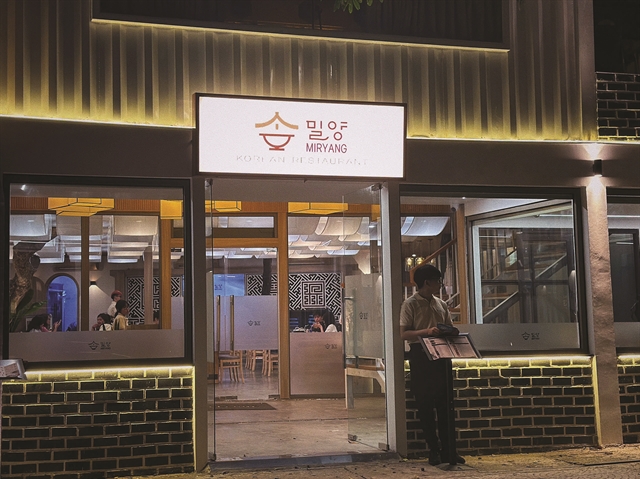 |
| MIRYANG: A bright and modern space which should prove popular with the Tây Hồ community. |
AF Reeves - @afreeves23
I have had the fortune and pleasure of visiting South Korea. I remember touching down in Seoul with two mates, checking into our hostel and heading out to watch the baseball. I remember enjoying it. Perhaps a little too much. That is where things get fuzzy.
In the years since, the three of us have tried to piece together a timeline. Other than the occasional flash, a pot simmering in front of me, the sweet and smoky smell of sizzling meat, it is a hopeless case. I intend to go back one day and repair the soju-laden erasure of self I experienced. Maybe this year.
Barbecue is a regular fixture of my dinner plans here in Việt Nam too. Cooking your own meat at a restaurant table was not an option in the North East English towns of my youth, and the novelty has not worn off. It appeals to the most primal of urges and rarely disappoints a group. So when I was invited out for Korean food last week and told it was not barbecue, I was more interested, not less.
In comes Miryang, the latest addition to Hà Nội's Korean scene, from the people behind Don Chicken, the most established Korean fried chicken chain in the country.
Expectations of quality come with that, though what follows should be read as I experienced it, as a customer eating during a soft opening. Night one, two good friends and fellow 'foodies'. Night two, my godson and his parents, dinner before their first trip to Europe.
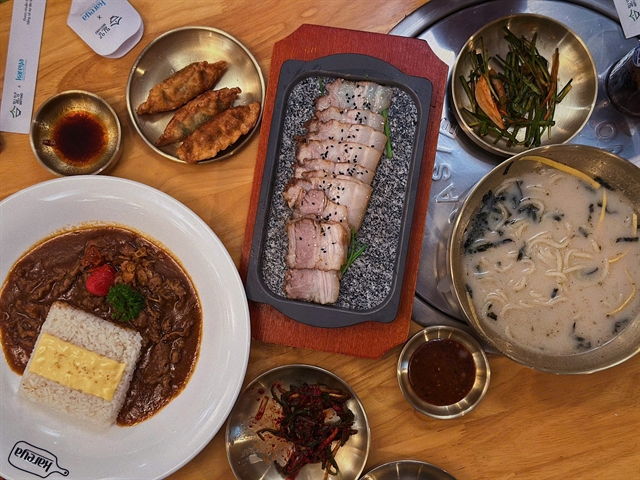 |
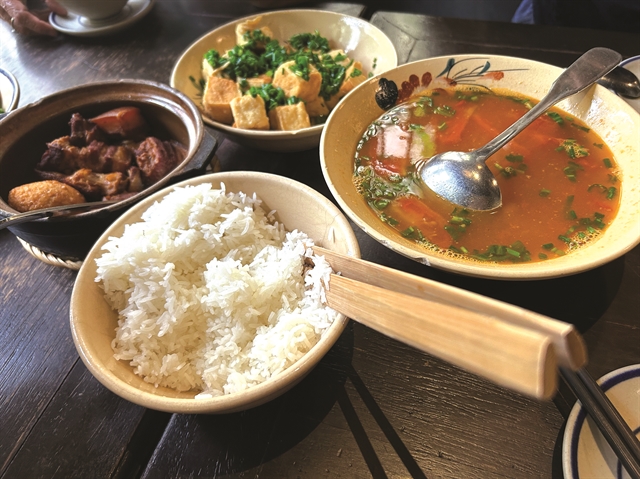
| FOR SHARING: From beef bone broth to Korean style curry, there’s plenty of options to be shared with dining companions. |
Allow me to conflate the two. First, beef bone broth noodles. I want two things: texture, and a broth worth finishing. The noodles were firm in the way that matters, the slightest chew, your teeth needing extra pressure rather than gliding through, and they held it in a broth that could cure the worst of hangovers.
Had my grandma served me these when I was ill, I would have perked up enough for seconds. Simple, not especially bold, but hearty and warming. An early victory, marks deducted only for the lack of a spoon large enough to share the broth. A training issue, not a kitchen one.
The cold buckwheat noodles stuck with the texture programme but delivered something else, less hearty, more reliant on flavour. Next time I will take the spicy option. The bossam, boiled pork, was a touch too fatty for me, but the meat was rich and deeply savoury, and the spring onions frying underneath made a very good roll. The jokbal was not available, braised pig's trotters. After a quick Google, you will understand why I’ll be going back when it arrives.
The dumplings were grand. Fried veggie, not too greasy, they dipped well and kept their crunch. The surprise across both evenings was the soft tofu stew, filed under soup rather than stew, spicy and sour and far more complex than it had any right to be.
Work into the stew section proper and you realise this is closer to hotpot than barbecue. Memories of Seoul and Busan start returning, along with old Bourdain footage of stews built on spam and baked beans, and the rosé label on the Buldak noodles in my cupboard. Things start to make sense.
On night one we took the rosé dakgalbi. Rosé here has nothing to do with wine. It refers to a creamy, dairy-based sauce blended into gochujang, sometimes finished with butter and garlic, and the pinkish blush gives it the name.
A recent invention, roughly 2019 onwards, since spread to everything from instant noodles to fried chicken. Chunks of chicken, tteokbokki rice cakes and cabbage sat in a mild, creamy heat that deepened as it simmered at the table. Whether it was a complexion-based judgement call from the staff or the house setting, I would ask for extra heat next time. The spice never threatened a sweat.
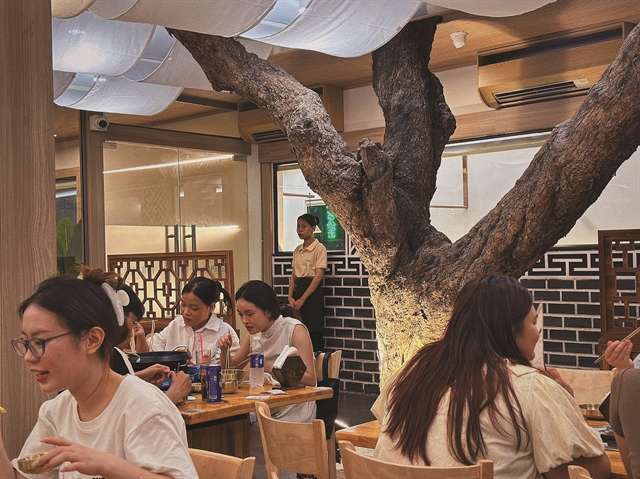 |
| FOCAL POINT: A tree emerging through the floor forms a striking focal point in the main dining room. VNS Photos Alex Reeves |
The second night was non-negotiable. Budae jjigae, army stew, was on the menu, and I had to try it again after being thoroughly perplexed by it in Busan. Spam, sausage, baked beans, kimchi, instant ramyeon, tteokbokki rice cakes and a slice of American cheese worked in there. A hangover from harder times, born of surplus smuggled out of American army bases after the war. Necessity, invention, and now cult devotion. Like so many of history's greatest dishes.
Initially I was disappointed. The broth lacked character and did little to draw the components together, exactly the mismatch it sounds on paper. The kimchi had given up its ferment to the pot, left as texture rather than flavour, no more assertive than cabbage. The ramyeon was soft, possibly by design.
What rescued it were the six small pots brought to the table: gochujang, pepper, salt, sugar, and a finer, less pungent shrimp paste. After some tinkering we got there, and where we got to was addictive and restorative. Whether the need for self seasoning is an authentic aspect of the dish is a fair question. I don’t recall having to do so in Korea, but equally I enjoyed the ability to manipulate the flavour to my taste.
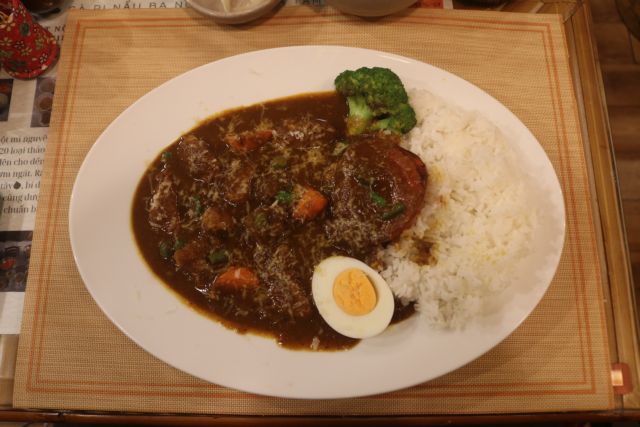
The room is busy and well lit with a golden glow, the staff polite and attentive, a real tree at the centre as its visual anchor. Miryang shares its premises with Kareya, a Korean curry kitchen next door, a sister restaurant with a diner feel, and the menu works across both. Korean curry descends from the Japanese version rather than rivalling it, inherited during the colonial period.
Where the Japanese lean dark, sweet and roux-thickened, the Korean runs looser, yellower with turmeric and more peppery. This sits in the middle: it would make for a great lunch, but there’s no real distinction to most Japanese offerings throughout the city.
The banchan, the small side plates that arrive unrequested and are refilled without ceremony, kept coming all evening. Kimchi and pickled radish, the right balance of fermented funk against sweet and sour, gave the evening its baseline, and did the job the stew's kimchi could not. Draught Sapporo was the tipple of choice, though a Korean beer on the list would be the finishing touch.
Miryang is not trying to be the most exciting Korean restaurant in Hà Nội. It feeds a table well, at a fair price, with good service. Take a group and you will not go far wrong.
What I did not expect was the rest of it. Somewhere between the pot simmering at the centre of the table and the smell off the hot plate, those stray flashes began lining up into a picture. South Korea is still gone. But I got an evening of it back, and this time I remember all of it. VNS
Miryang
Address: 98 Tô Ngọc Vân, Tây Hồ, Hà Nội
Price: VNĐ1.4 million for three/four dishes, unlimited banchan, plus drinks.
Dining companions: Three or more, and hungry.
Top tip: Take friends, as everything here is built to be shared.
Restaurant Review
 Restaurant Review
 Restaurant Review
 Restaurant Review
 Restaurant Review
 Restaurant Review
 Restaurant Review
 Restaurant Review
 Restaurant Review
 Restaurant Review
 Restaurant Review
 Restaurant Review
 Restaurant Review
 Restaurant Review
 Restaurant Review