 Society
LOAN Foundation awards scholarships to disadvantaged students on 10th anniversary
1.
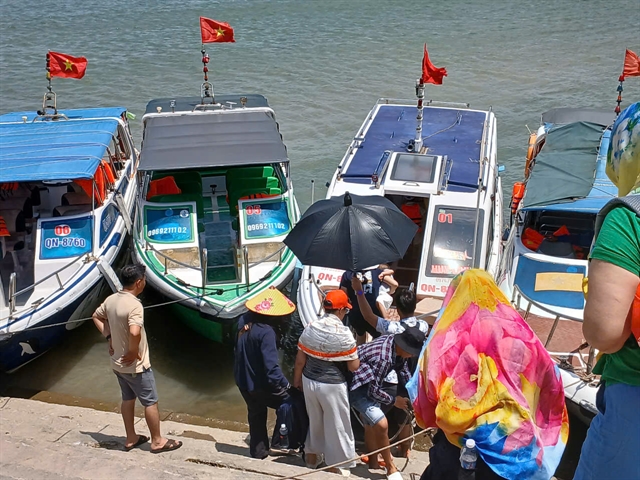 |
| Residents and tourists wait at Ghềnh Võ Port to catch boats to Cái Chiên Island. — VNS Photos Minh Hằng |
Minh Hằng
QUẢNG NINH — As dusk settles over Cái Chiên Island, Phi Vừng homestay’s wooden cottages glow in the early evening light beneath the casuarina trees.
For Lương Thị Vừng, 68, the scene would have been hard to imagine when the island had no electricity and reaching the mainland could take hours.
Her family once earned a living mainly by farming and fishing. Today, they run a 20-room homestay, one small part of a tourism boom that is reshaping life on the remote island.
“The homestay carries my husband’s and my name, but in reality, my child runs it,” Vừng said.
“My family has lived here for four generations. Before we had electricity, life was difficult in every way. Things are much better now.”
They have hired staff to cook and clean, but when guest numbers surge the family still jumps in.
When her family first entered tourism, they had little idea how to run a guesthouse. Her son travelled to nearby Cô Tô Island, where tourism was more developed, to learn from businesses there.
From two rooms converted from an old house in 2017, Phi Vừng has grown into a 20-room operation employing 13 people, seven of them hired workers and six family members.
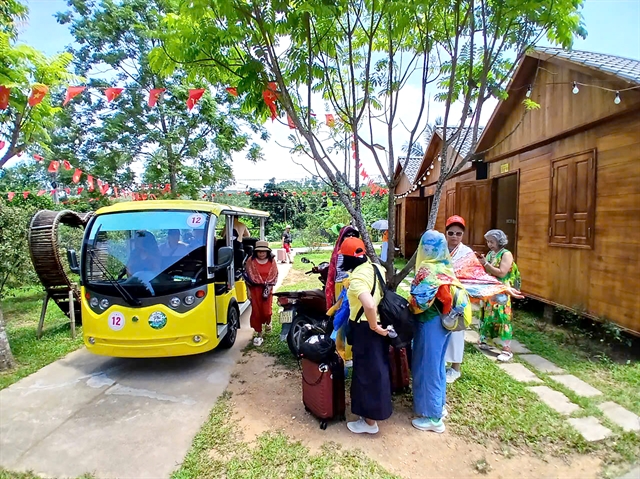 |
| Tourists wait to check in at Phi Vừng Homestay. |
From fishing to tourism
For years, Cái Chiên Island in Hải Hà District, about 119km northeast of the centre of Quảng Ninh Province, was an isolated community where electricity was unavailable and a trip ashore could take three or four hours by boat.
It was one of the last two island communes to gain access to the national power grid in 2016. Before that, residents relied on diesel generators, with power available for only five hours a day, from 5pm to 10 pm, severely limiting daily life on the island.
“Life was very hard back then. We were far from the mainland and short of almost everything,” said Phạm Thái Việt, Vừng's son.
Việt said that his family built small rafts, paddled offshore to set nets and made traps for squid, shrimp and fish.
Even rice farming was uncertain. Saltwater affected some fields, while in bad years crops could be lost altogether.
Illness was another worry. With the island far from medical facilities and equipment, a serious injury could quickly become an emergency.
"I still remember a cousin of mine who fell and broke his leg, bleeding heavily," Việt said.
"We tried to get him to the mainland for treatment, but it was too late, the journey to the hospital took too long. His death has stayed with me ever since."
The arrival of grid electricity in 2016 changed that rhythm of life. Visitors had begun arriving in small numbers in 2014 and 2015. After electricity reached the island, tourism began to develop more steadily.
In 2017, Việt converted the family's old house into two guest rooms.
“At first, we were very inexperienced,” he said.
“We did not know how to communicate properly with guests. We did not know how to measure ingredients in the kitchen, and we had no established suppliers.
“When choosing bed sheets, I simply thought we should choose a colour that would make dirt less visible, such as blue.”
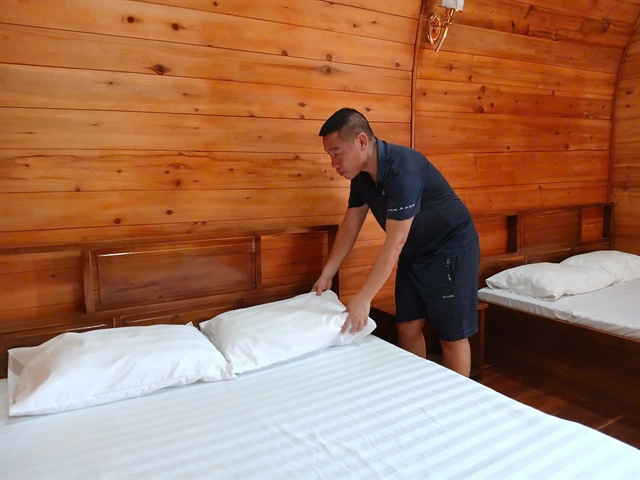 |
| Phạm Thái Việt, owner of Phi Vừng Homestay, inspects rooms ahead of the arrival of guests. — VNS Photo Minh Hằng |
Tourism training later taught him that running a guesthouse involved far more than just providing a bed.
“What was once an hours-long trip now takes just 10–15 minutes by boat, making daily life easier and spurring tourism,” said Trịnh Thị Yến, 44, the chef of the homestay.
Yến previously worked in agriculture and fishing. She took cooking classes before applying for a job at the homestay.
“At first, I learned as I worked. I did not know what would suit tourists' tastes,” she said.
Over time, she learned from both praise and criticism.
“We simply try to do the best we can so that visitors will come and stay with us longer,” Yến added.
The work created by tourism has also brought back islanders who once left in search of jobs.
Phạm Hồng Phú, who completed high school and spent several years working on the mainland, now drives an electric cart for Phi Vừng.
“Every day I pick guests up from the boat landing and take them to tourist sites included in the tours,” he said.
“I also take individual visitors around the island according to their requests.”
The electric carts have become part of the new tourism infrastructure, carrying visitors between the landing, homestays and beaches.
A community business
Across Cái Chiên Island, households are developing their own ways of earning from visitors.
Phạm Văn Tài, owner of Huấn Khải guesthouse, combines accommodation with experiences such as collecting shellfish and night squid fishing.
“Visitors really like the simple way of life here and the fresh seafood caught by local fishermen,” he said.
His family tries to make guests feel at home, he said, and improvements to local infrastructure at the end of 2025 have encouraged them to invest further in their services.
Competition between households is often replaced by cooperation.
“If one house is full, I send guests to the house next door,” Việt said.
“When there is a large group, several families work together and share their kitchens so guests do not have to wait.”
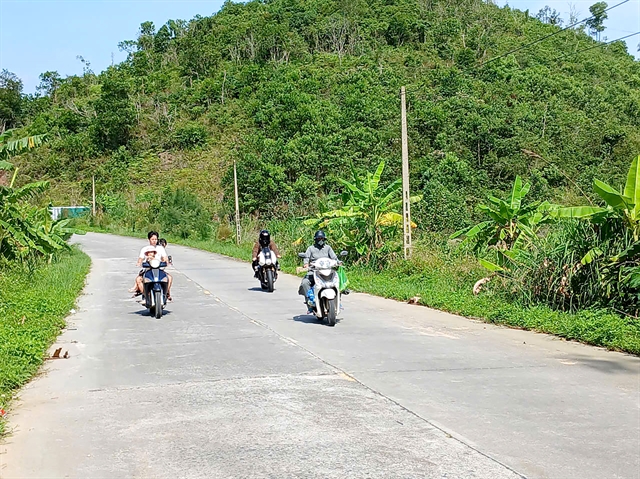 |
| Concrete paving on many island roads has made travel easier. — VNS Photo Minh Hằng |
Each afternoon, a garbage collection vehicle circles the island, helping to keep the beaches clean and the landscape intact. That balance, between attracting visitors and preserving what they came to see, is becoming increasingly important as tourism expands.
“When we first started, a season might bring in VNĐ80 million (US$3,000),” Việt said.
“Later, as tourism developed, some seasons brought in several hundred million đồng.”
But income is not the only measure of change.
“The most valuable thing is that local people have changed. Their communication and behaviour have become more civilised through contact with visitors,” he said.
Some islanders who once left to work in factories or construction have returned. Tourism gives them the possibility of earning a living close to their families.
During rough weather or the low season, younger people can still travel to the mainland for temporary work.
Nature remains the attraction
Covering an area of approximately 2,500 hectares, Cái Chiên island commune, located about 20km from the mainland, consists mainly of hills, mountains, and beaches. It is home to more than 700 people, most of whom belong to the Kinh, Tày, and Sán Dìu ethnic groups.
As tourism grows, local residents have worked to preserve the island’s unspoiled character. The industry has also helped revive traditional festivals at the island’s communal house and temple after a 77-year hiatus, bringing its cultural heritage back into focus.
Nguyễn Kim Dung, 62, a tourist from Hà Nội, said Cái Chiên is peaceful and largely unspoiled, with friendly locals. But she believes more needs to be done if tourists are to stay longer.
“I hope the local authorities will continue diversifying tourism experiences and, in particular, improve port and transport infrastructure so that access to the island becomes more convenient and professional,” she said.
The island now has more than 100 households and 23 accommodation establishments offering 237 rooms, in addition to a higher-end resort, Đầu Rồng resort.
Yet homestays and community-based tourism remain central to the island's identity.
The commune received around 150,000 visitors in 2025 and is targeting more than 200,000 in 2026.
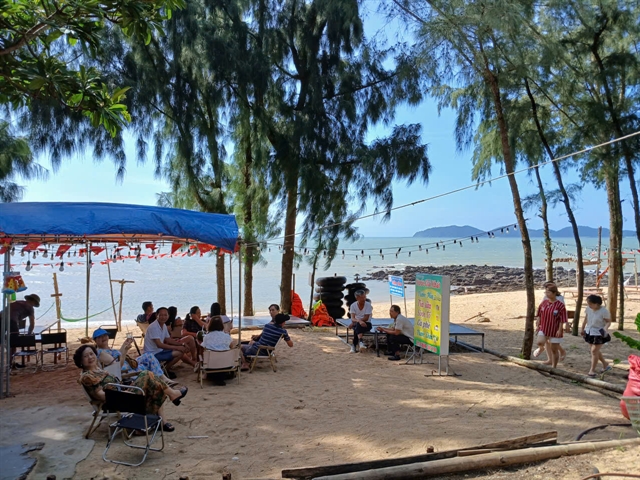 |
| Tourists enjoy the unspoiled beauty on Cái Chiên Island. — VNS Photo Minh Hằng |
Local authorities say they want development to remain rooted in the island's culture and landscape rather than follow a model of intensive construction and mass entertainment.
Hoàng Văn Hải, secretary of the Cái Chiên Party Committee, said local culture should be the foundation of sustainable tourism.
“We will not pursue a path of excessive concrete construction or noisy entertainment services,” he said.
Instead, the commune plans to develop experiences that allow visitors to engage more closely with nature and local culture.
“The goal is to create a destination that retains its authenticity and romance,” Hải said.
For a community that once marked time by fishing trips and the struggle to reach the mainland, the arrival of visitors has ushered in a new kind of season.
The fishing season carries on, but now there’s a tourist season too. — VNS
Society
 Society
 Society
 Society
 Society
 Society
 Society
 Society
 Society
 Society
 Society
 Society
 Society
 Society
 Society
.jpg)