 Environment

AXA Global Healthcare Mind Health Report reveals global differences in how cost and stigma affect access to professional mental health care
1.
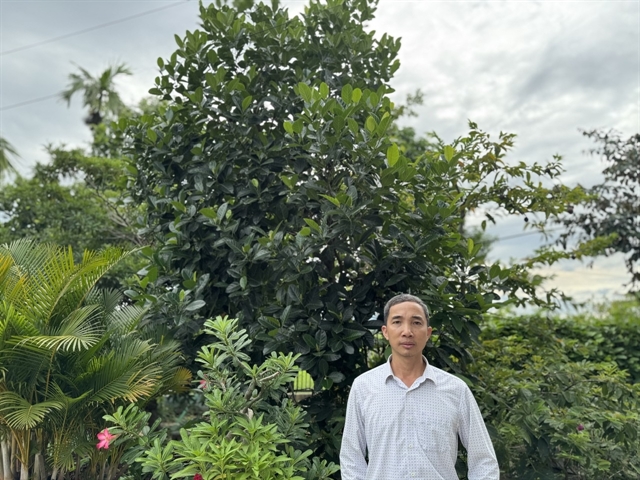 |
| Nguyễn Văn Vũ, deputy director of the Chàm Islands Nature Reserve management board. Photo courtesy of Nguyễn Văn Vũ |
Seagrass provides vital habitat for marine species, protects coastlines and stores carbon, making it crucial to biodiversity conservation at the Chàm Islands Nature Reserve. Nguyễn Văn Vũ, deputy director of the reserve’s management board, discusses seagrass restoration with Việt Nam News reporter Công Thành.
Can you tell us about the role of seagrass in marine ecosystems and the status of seagrass in Việt Nam?
Seagrass, a flowering plant that lives entirely in the marine environment, forms a coastal ecosystem that supports biodiversity, with key roles including providing safe habitats, spawning grounds, food sources and nurseries for fish, shrimp, crabs, sea turtles and other marine species.
It also supports sustainable fisheries and the livelihoods of coastal communities, while stabilising the seabed and mitigating erosion.
Seagrass absorbs carbon in the sediments beneath its meadows, making it a vital blue-carbon store.
However, the seagrass ecosystem is vulnerable to pressures from coastal ecosystems. The United Nations Environment Programme (UNEP) estimates that global seagrass coverage may be shrinking by approximately 2-5 per cent annually in monitored areas.
The degradation would result from sea reclamation, coastal construction, wastewater discharge, sediment deposition, unsustainable aquaculture and over-fishing practices, vessel anchoring, and climate change.
In Việt Nam, seagrass coverage has declined by approximately 46.5 per cent since 1990.
Meanwhile, seagrass on Chàm Islands was recorded at around 50ha in 2014, but the figure dropped to less than 17ha by 2016.
What is the carbon credit value of seagrass?
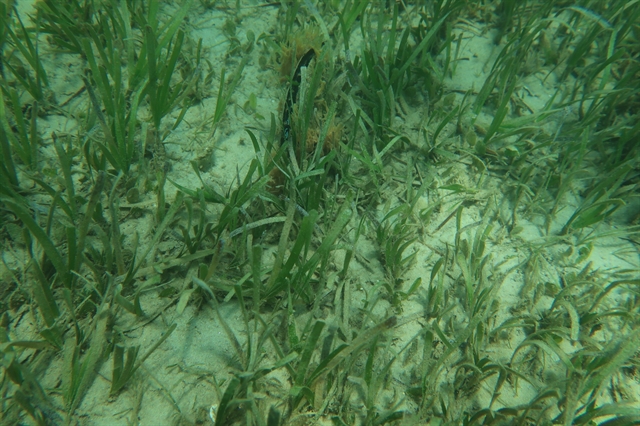 |
| Seagrass is conserved in the waters off Chàm Islands Nature Reserve. A pilot seagrass restoration project has been implemented in the area with support from WWF-Vietnam. Photo courtesy of Trần Phương Thảo |
The total amount of carbon currently present in the biomass and sediment of seagrass meadows determines their carbon stock.
Seagrass meadows possess a significant advantage because the majority of carbon is stored in the sediment and can remain there for the long term.
The UNEP notes that seagrass contributes significantly to the ocean's carbon storage capacity, even though it only occupies a very small area of the sea bottom.
Việt Nam has established a legal framework for carbon market development and a scheme for establishing and developing a carbon market as well. Việt Nam, however, has been collecting data and building a feasibility study on integrating ‘blue carbon’ into climate policy.
Chàm Islands began surveying carbon stocks while piloting restoration solutions on 2ha of seagrass with support from WWF-Vietnam.
How can the biodiversity value of seagrass beds be conserved and promoted in a long-term manner?
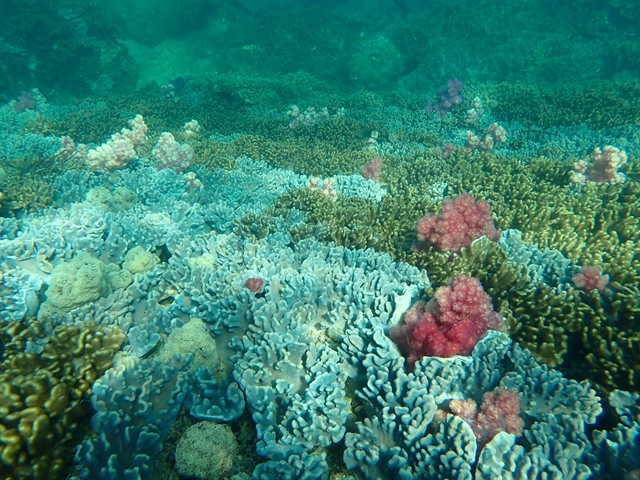 |
| A well conserved marine environment is being monitored under a programme run by Chàm Islands Nature Reserve. Chàm Islands are one of the most popular ecotourism destinations in central Việt Nam. Photo courtesy of Chàm Islands Nature Reserve |
I think several solutions need to be implemented simultaneously, with the protection of existing seagrass meadows taking priority over artificial restoration measures.
First, it is necessary to map the current seagrass area in terms of coverage, species composition, sediment and water quality, and the degraded sections.
Second, the causes of seagrass degradation should be identified so that appropriate solutions can be developed. It is also necessary to mark a strict protected zone on well-conserved seagrass meadows in the area, while strengthening monitoring of boat anchoring, dredging, wastewater discharge and garbage from the mainland, and overfishing.
Third, restoration of seagrass must be implemented with scientifically based solutions, and pilot projects on small areas should be selected before applying effective measures on a larger scale.
Fourth, the involvement of the community should be central to seagrass restoration activities, including monitoring and surveys. Education and awareness on seagrass protection and conservation should be included in action plans to improve the sustainable livelihoods of local islanders.
Fifth, the development of environmental education programmes, scientific research, and strictly controlled eco-tour services could be used to boost environmental protection and tourism, but they must be subject to strict regulations.
Tourists visiting the seagrass conservation area are restricted, and the seagrass protective zone will ban boats from anchoring, as well as fishing activities.
Finally, long-term diversified financial sources from the state budget, international funds, businesses, eco-tour services and carbon credits are required for seagrass conservation and restoration.
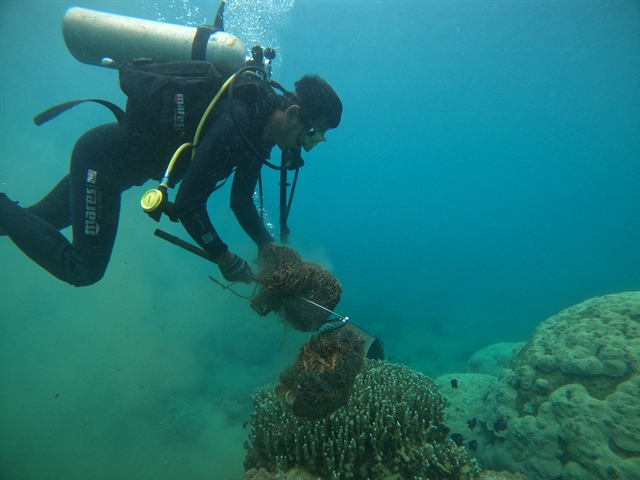 |
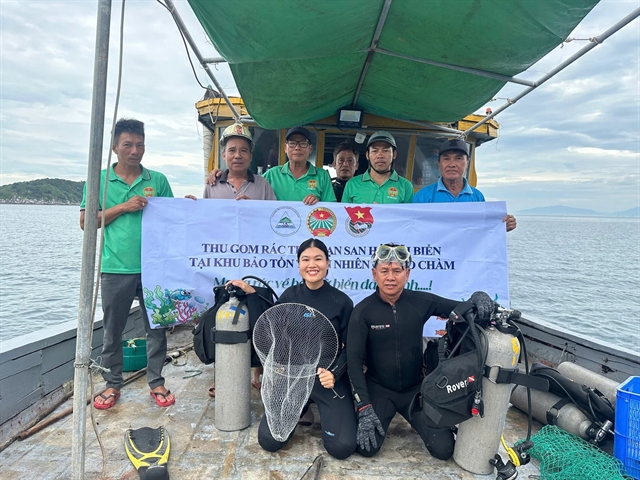
| A diver collects waste underwater in waters off Chàm Islands. Environmental protection activities have become regular programmes involving local communities, businesses and state agencies. Photo courtesy of Chàm Islands Nature Reserve |
How advanced are personnel training programmes and scientific research in seagrass conservation?
This is a very urgent matter. Databases on seagrass are still scattered, while survey methods still vary among marine protected areas (MPAs) and reserves in Việt Nam. The country should build a strategic master plan for seagrass research, including ecology, aquatic species, oceanography, remote sensing technology and environmental economics and policy.
Marine environment and restoration monitoring knowledge and skills are needed, including regular training courses for all staff in marine protected areas, while a network of state agencies, institutes, universities, MPAs, businesses and communities should be established for better co-ordination and implementation of restoration solutions.
A national level database centre should be built to provide information on the locations and quality of seagrass meadows and their carbon storage capacity. We also need experts to prepare reports and evaluations on blue-carbon credits that help Việt Nam develop seagrass conservation and restoration projects.
Funds should be reserved for applied research, monitoring equipment and facilities at sea, while satellite images, labs and more scientific reports on seagrass are needed.
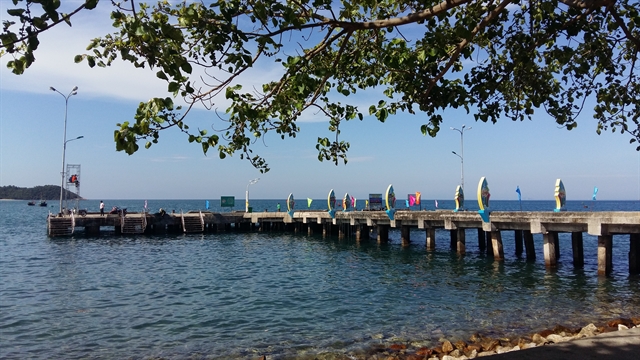 |
| Chàm Islands, off the coast of the ancient town of Hội An, lure tourists with well-conserved and protected environment, as well as the hospitality of islanders. VNS Photo Công Thành |
The seagrass restoration project in the Chàm Islands is not only implemented at the local level, but has also been designed as a model for wider application in MPAs and reserves in Việt Nam.
Investment in seagrass restoration and conservation will help protect seafood resources, coasts and community livelihoods, while improving biodiversity and the country's resilience to climate change. VNS
Environment
 Environment
 Environment
 Environment
 Environment
 Environment
 Environment
 Environment
 Environment
 Environment
 Environment
 Environment
 Environment
 Environment
 Environment