 Economy



AIMCONNECT 2026 Held in Singapore, Bringing Global Automotive Leaders Together to Explore the Future of AI, Trust and Connected Mobility
1.
|
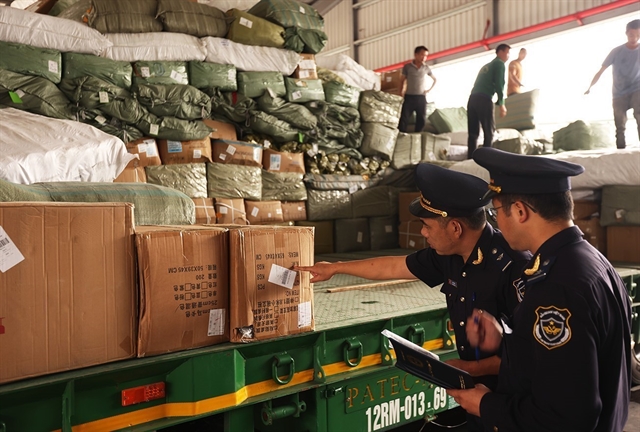
| Two customs officers inspect a shipment of imported goods at Hữu Nghị International Border Gate, June 10. — VNA/VNS Photo |
HÀ NỘI — Customs officials on Saturday walked businesses through a new decree governing administrative penalties for customs violations, offering guidance on how fines will be calculated and which violations qualify for leniency under the revised rules.
The briefing, hosted by the Hanoi Support Centre for Enterprise and Investment Promotion, focused on Decree 169, which took effect on July 1 and replaced the previous penalty framework under Decree 128.
Nguyễn Mạnh Hảo, an official of the General Department of Customs' risk management division, told the gathering that the overhaul would bring sweeping changes that would ease compliance burdens for import-export businesses.
Under the new rules, penalties for a given violation will generally be set at the midpoint of the applicable fine range. For example, a violation carrying a range of VNĐ2 million to VNĐ5 million would draw a default fine of VNĐ3.5 million.
That baseline shifts depending on mitigating or aggravating circumstances. A single mitigating factor cuts the fine by 10 per cent, while two or more mitigating factors bring it down to the minimum of the range.
Conversely, one aggravating factor adds 10 per cent, and two or more push the fine to the maximum. Where both types of factors apply, they can offset each other on a one-for-one basis.
The decree also revises how repeat violations are treated. Businesses that commit the same violation multiple times will typically be fined separately for each instance — but Hảo noted several exceptions where only a single penalty applies regardless of how many times the violation recurs, including late submission of customs documents, misdeclaration of quantity, value or origin for tax-exempt goods, and filing an export declaration before goods have actually arrived at the designated location.

|
| The briefing on Decree 169 on Saturday. — VNS Photo Lê Việt Dũng |
On timing, the official clarified that violations committed before the July 1 effective date but discovered or penalised afterward will be judged under the new decree if it treats the offender more leniently than the old rules did.
For tax evasion violations that fall short of criminal prosecution, including underpayment caused by false declarations, the statute of limitations for imposing a fine is five years.
Even after that window closes, taxpayers are not off the hook entirely – they remain liable for any underpaid, wrongly exempted or evaded tax, going back up to ten years from the date the violation is discovered.
Trần Lâm, a representative of the centre, said the session was designed to give businesses a direct channel to raise real-world compliance questions rather than simply publicise the new rules.
He said the centre's goal was to help firms apply the decree consistently, spot compliance risks early and avoid unnecessary costs or legal exposure while also gathering practical feedback for regulators to refine future guidance.
"Supporting businesses means more than helping with investment and production; it means standing with them through legal compliance and helping remove barriers to a stable, transparent business environment," Lâm said, adding that the centre hoped the dialogue would reinforce Hà Nội's broader push for a more open and competitive investment climate. — VNS
Economy
 Economy
 Economy
 Economy
 Economy
 Economy
 Economy
 Economy
 Economy
 Economy
 Economy
 Economy
 Economy
 Economy
 Economy