 Economy


HCM City honours fallen soldiers with solemn musical tribute
1.
|
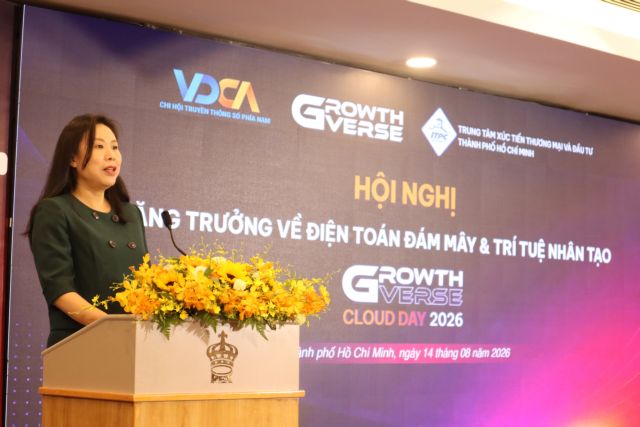
| Hồ Thị Quyên, deputy director of the Investment and Trade Promotion Centre of HCM City, speaks at GrowthVerse Cloud Day 2026 in HCM City on August 14. — Photo courtesy of ITPC |
HCM CITY — The rapid adoption of artificial intelligence (AI) and cloud computing is creating new growth opportunities for Việt Nam’s digital economy, but rising investment in data centres, AI infrastructure and cybersecurity is putting greater focus on investment efficiency and returns, speakers said at GrowthVerse Cloud Day 2026 in HCM City on August 14.
Organised by the Investment and Trade Promotion Centre of HCM City (ITPC), the Southern Vietnam Digital Communication Association and Navee Group, the conference discussed the latest developments in AI, cloud computing, data and digital infrastructure.
The event also highlighted the importance of strengthening businesses’ capabilities in data management and utilisation to improve decision-making, enhance competitiveness and strengthen information security, while connecting businesses with the broader technology ecosystem.
Hồ Thị Quyên, deputy director of ITPC, said: “The rapid development of artificial intelligence, cloud computing, data and digital infrastructure is bringing profound changes to the way businesses manage, operate, produce and serve customers.”
The Politburo’s Resolution No. 57-NQ/TW identifies science and technology, innovation and national digital transformation as key breakthroughs. It sets a target for the digital economy to account for at least 30 per cent of GDP by 2030, for Việt Nam to rank among Southeast Asia’s top three countries in AI research and development, and for more than 40 per cent of businesses to engage in innovation activities, Quyên said.
The resolution also identifies infrastructure, data, strategic technologies and human resources as core priorities, while cybersecurity, data security and information safety must be maintained throughout the digital transformation process, she said.
For HCM City, the digital economy is targeted to account for 30 per cent of GRDP in 2026 and 40 per cent by 2030. To support this roadmap, the city plans to establish a data exchange platform, build at least two data centres and two concentrated digital technology parks, and expand the use of digital platforms across industries including manufacturing, logistics and retail, she said.

|
| Speakers at GrowthVerse Cloud Day 2026 highlight how rapid advances in AI, cloud computing, data and digital infrastructure are reshaping businesses. — Photo courtesy of ITPC |
Nguyễn Minh Liêm, co-founder and CEO of BYTE Technology JSC, said many businesses had yet to turn AI investment into measurable financial results because of fragmented data, inaccurate or outdated information, and a disconnect between analysis and execution.
To turn AI into a growth engine, businesses need to comprehensively standardise customer data to ensure consistency, accuracy, real-time updates, privacy compliance and readiness for activation.
Cleaning and consolidating customer data could generate measurable financial benefits, including a 35 per cent improvement in return on advertising spend (ROAS) after 12 months, about a 40 per cent reduction in cost per order among existing customers and a threefold increase in cross-selling revenue by identifying the right time to engage customers, he said.
These improvements can help businesses optimise operating costs and protect profit margins, he added.
Vũ Hữu Sơn, head of solutions consultant at GreenNode, said businesses were gradually moving from AI proof-of-concept (PoC) projects towards practical applications capable of generating economic value in 2026.
This transition is fuelling rapid growth in the global AI infrastructure market, which is forecast to expand from US$158 billion to $419 billion by 2030, he said.
At the same time, businesses face rising infrastructure costs. An AI server rack can cost around $3.9 million, about eight times the cost of a conventional rack, while rapid technological depreciation could make such infrastructure obsolete within two to three years.
The shift in AI FinOps from outright asset purchases under a capital expenditure model towards flexible services under an operating expenditure model could help address both financial and operational challenges, Sơn said.
Bùi Song Toàn, deputy director of the Cloud Platform Services Development Centre at FPT Smart Cloud, said Việt Nam’s cloud computing market was forecast to reach $6.98 billion by 2030, growing at an annual rate of 10.94 per cent.
More than half of businesses now consider cloud computing a mandatory component of their business strategies, while generative AI (GenAI) has emerged as a major growth driver, he said.
The rise of GenAI is also accelerating software development. Around 75 per cent of new code at Google is currently generated by AI, with the share forecast to approach 95 per cent within the next five years, Toàn said.
However, faster coding also brings new cybersecurity risks. As many as 94 per cent of executives regard AI as the biggest factor driving change in information security, while the proportion of AI-generated code containing potential security vulnerabilities ranges from 38 per cent to more than 70 per cent across common programming languages.
Businesses also often overlook internal network traffic, or East-West traffic, which accounts for 70–80 per cent of total system traffic. This creates an urgent need to automate information-security monitoring and strengthen multi-layer risk management to enable more proactive defence, he said.
ITPC said the event aimed to equip the business community with in-depth knowledge and practical solutions for the effective adoption of AI, cloud computing and digital infrastructure. — VNS
Economy
 Economy
 Economy
 Economy
 Economy
 Economy
 Economy
 Economy
 Economy
 Economy
 Economy
 Economy
 Economy
 Economy
 Economy