 Economy



HCM City honours fallen soldiers with solemn musical tribute
1.
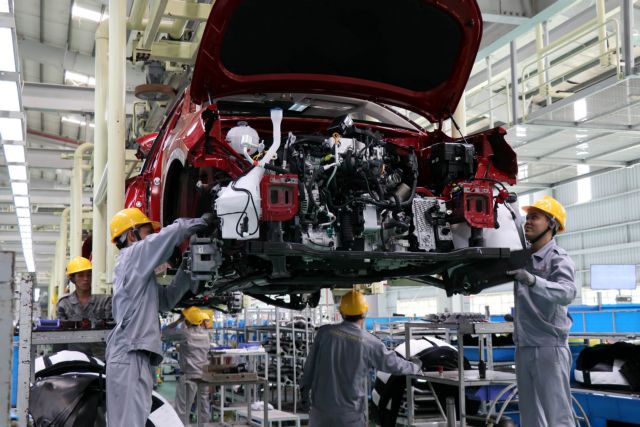 |
| Automobile manufacturing at a THACO plant. The Ministry of Industry and Trade has proposed easing restrictions on the transfer of Euro 5 automotive technology. — VNA/VNS Photo Trần Tĩnh |
HÀ NỘI — The Ministry of Industry and Trade has proposed easing restrictions on the transfer of Euro 5 automotive technology, arguing that the country needs to strike a balance between preventing outdated technologies from entering the market and preserving the competitiveness of its automotive industry.
The proposal comes after automakers and industry associations reported difficulties in implementing Decree 101/2026/NĐ-CP, which took effect on April 1 and placed Euro 5 automobile manufacturing technology on a list of technologies subject to transfer restrictions.
Associations said the policy has created a contradiction, pointing out that vehicles meeting Euro 5 emission standards remain eligible for production, sale and circulation in Việt Nam, but the technologies used to manufacture them require additional approvals before they can be transferred.
The Việt Nam Automobile Manufacturers' Association (VAMA), the Việt Nam Association of Motorcycle Manufacturers (VAMM), TC Group and THACO have all warned that the restriction can undermine investment, production and exports in the automotive industry.
VAMA said the decree is creating additional administrative burdens by requiring manufacturers to obtain approval and licences for technology transfers rather than simply registering contracts, as they did before.
This could prompt manufacturers to increase imports instead of expanding domestic production capacity, which is not in line with the Government's objective of developing a competitive domestic automotive industry, VAMA said.
TC Group said the restrictions can affect the industry's exports. The company is preparing to export vehicles and components to markets including Laos, Myanmar, Kenya, Mexico, Australia, New Zealand and several Middle Eastern countries, some of which continue to apply emissions standards below Euro 5.
It warned that difficulties in signing new technology transfer agreements or renewing existing ones could disrupt the production of vehicles intended for those markets.
THACO similarly cautioned that applying the same rules to products destined for both domestic consumption and export markets could limit opportunities for international expansion.
Meanwhile, VAMM warned that the restrictions can disrupt motorcycle supply chains involving hundreds of domestic suppliers. Honda Vietnam alone works with around 200 suppliers, more than half of which are Vietnamese companies.
The trade ministry said the automotive sector plays a crucial role in Việt Nam's industrialisation drive, stressing the need to revise regulations to ensure consistency while safeguarding investment, production and export growth.
According to the ministry, restrictions should not apply to technologies used exclusively to manufacture products for export, provided that companies can demonstrate their intended markets, maintain separate production records and comply with post-inspection requirements.
Existing classification criteria rely mainly on emission standards applicable to vehicles when they are put into operation, the ministry said, adding that these are environmental benchmarks for the final product rather than a measure of the sophistication, safety or environmental impact of the manufacturing technology. — VNS
Economy
 Economy
 Economy
 Economy
 Economy
 Economy
 Economy
 Economy
 Economy
 Economy
 Economy
 Economy
 Economy
 Economy
 Economy