 Politics & Law
EVNNPT seeks over $224 mln in bank loans for grid expansion
1.
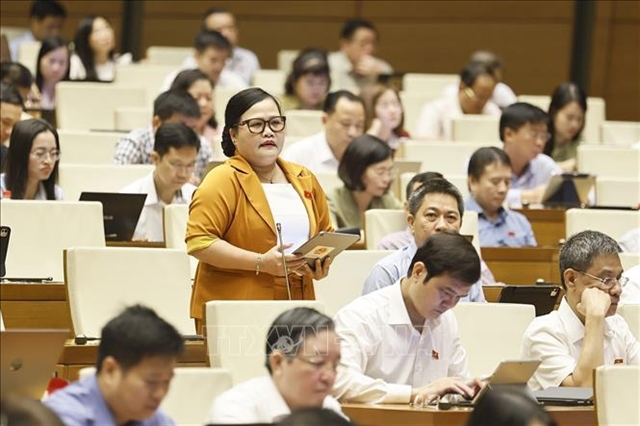 |
| National Assembly deputy Nguyễn Thị Sửu from Huế City comments on the draft amendments to the Law on Radio Frequencies during the NA discussion in Hà Nội on Thursday morning. — VNA/VNS Photo Doãn Tấn |
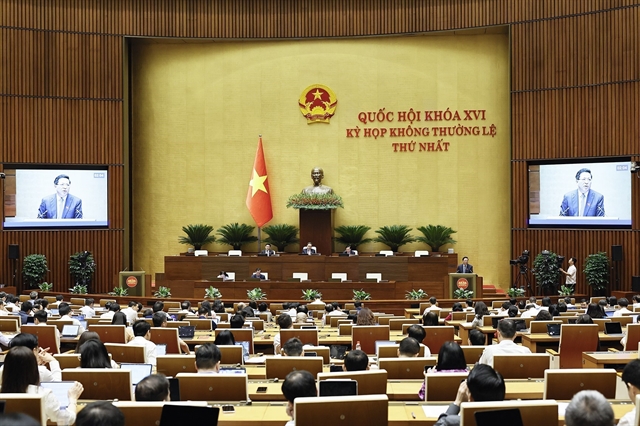
HÀ NỘI — National Assembly deputies on Thursday discussed a draft that amends four laws related to digital technology, with the amendments aiming to reduce unnecessary business conditions and procedures for businesses in the science and technology sector.
The meeting concludes the first part of the NA’s extraordinary session before they take a break through August 18, to allow time for Government agencies to study feedback and finalise the draft laws and resolutions.
The laws under discussion were those on radio frequencies, telecommunications, electronic transactions and technology transfer.
Commenting on the draft law, NA deputy Nguyễn Thành Trung from Hải Phòng City proposed a comprehensive review of all licensing conditions and procedures based on the principle of ‘eliminating what is unnecessary, justifying what is retained’.
“The drafting agency should not merely list procedures for elimination but must evaluate each condition against three questions, which are: ‘What is regulatory objective? What risks need to be controlled? What mechanism will replace the procedure if it is removed?,” said Trung.
In addition, while supporting the shift from a licensing-based approach to one based on standards, technical regulations and enforcement monitoring, Trung argued that simply abolishing licences without designing alternative management tools could lead to two extremes: either lax oversight or the emergence of new procedures created by enforcement agencies.
Therefore, the draft law needs to clearly define provisions regarding specialised databases, electronic reporting regimes, risk-based inspection mechanisms and sanctions for violations, he said. Priority should be given to shared data systems rather than requiring businesses to repeatedly provide the same information.
"The guiding principle for database development must be clearly established: while the State requires information for management purposes, businesses should not be obligated to submit the same information multiple times to various management agencies," Trung said.
Other data-related issues must also be clarified, including what data could be shared, which agencies are authorised to access it and where liability lies in the event of incorrect data, delayed updates or misuse, Trung added.
Saving resources
Commenting on amendments to the Law on Radio Frequencies, NA deputy Nguyễn Thị Sửu from Huế City expressed concerns over the handling of revoked licenses to provide telecommunications services that invovle network infrastructure.
Amendments to point d, clause 1, Article 23 of the law stipulate that the radio frequency usage licence will also be revoked if its corresponding license to provide telecommunications services involving network infrastructure is revoked.
While agreeing with this principle of linkage because it helps to ensure legal consistency and save frequency resources, Sửu also pointed out that the draft has only identified the grounds for revocation, but not specified how the revoked licences will be handled afterwards.
“The draft needs to clarify the procedure and timing for the revocation, as well as the enterprise's responsibilities during the transition period regarding service users, infrastructure and equipment, as well as their financial obligations,” she said.
She also emphasised the need for a mechanism to relocate the recovered frequency resources to prevent wastefulness and ensure the possibility of rapid, transparent reuse, and one to ensure the consistency between the telecommunications and radio frequency laws to minimise disputes.
Commenting on the amendments to the Law on Telecommunications, NA deputy Tào Đức Thắng from HCM City applauded the continued simplification of business investment conditions, the streamlining of procedures, and the emphasis on post-licensing supervision.
He proposed that the Ministry of Science and Technology start planning infrastructure to prepare for the transition to the sixth and seventh generations of cellular technologies, known as 6G and 7G.
"Once the passive infrastructure plan is in place, enterprises can proceed with early network construction, creating a foundation for high rates of infrastructure sharing in the future," Thắng said. — VNS
Politics & Law
 Politics & Law
 Politics & Law
 Politics & Law
 Politics & Law
 Politics & Law
 Politics & Law
 Politics & Law
 Politics & Law
 Politics & Law
 Politics & Law
 Politics & Law
 Politics & Law
 Politics & Law
 Politics & Law