 Politics & Law
EVNNPT seeks over $224 mln in bank loans for grid expansion
1.
|
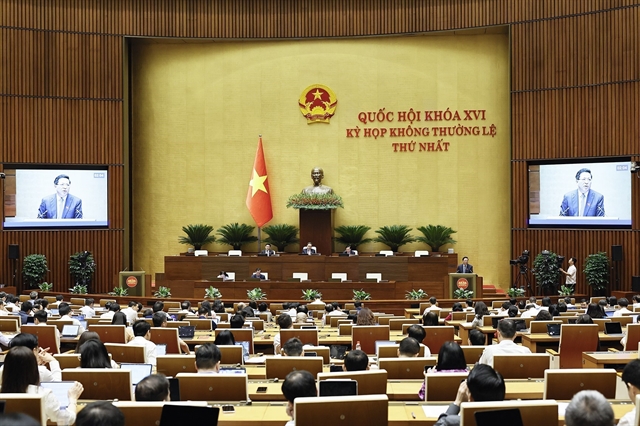
| Minister of Construction Trần Hồng Minh speaks at the ongoing first extraordinary session of the 16th-tenure National Assembly on Wednesday. VNA/VNS Photo |
HÀ NỘI — The National Assembly continued its agenda on Wednesday, discussing the investment policy for the Hà Nội Capital Region Ring Road No. 5 project.
At the ongoing first extraordinary session of the 16th-tenure National Assembly, most deputies agreed on the need to invest in Ring Road No. 5, stressing that the project should be viewed not merely as a transport route but as a development corridor capable of unlocking new economic space.
Deputy Tạ Thị Yên of Điện Biên Province's delegation said the project should be approached as a network of development corridors rather than simply a road.
“If we see it merely as a ring road of about 349km, we will not capture its full value. Its greatest value lies in its ability to connect radial expressways, divert traffic from a distance, link production centres, logistics hubs, seaports and airports, and open up new development space,” she said.
The effectiveness of the route should be assessed based on its ability to expand access to the Hà Nội Capital Region and major economic hubs for the northern midland and mountainous areas and western localities, Yên said.
Therefore, investment priorities should take into account not only traffic volumes and funding capacity, but also inter-regional connectivity and the potential to create new development corridors.
“Project implementation must be based on the capacity to balance resources and the efficiency of the project throughout its lifecycle,” she stressed.
The planned Ring Road No. 5 will stretch approximately 349km, but only about 116km have been prioritised for investment during 2026–30.
Given the limited resources, Yên said priority should be given to sections that can be completed and operated independently, immediately improve the overall transport network, open new development corridors and have sufficient land clearance and funding conditions.
Site clearance and preparation of construction material supplies should also be carried out in advance, with clear agencies responsible and specific deadlines, she said.
Deputy Yên also noted that the Ring Road No. 5 project involves a number of special mechanisms concerning authority and implementation. The parliament should therefore retain decision-making authority over issues that could fundamentally alter the approved investment policy, including objectives, scope, basic scale, total investment and funding structure.
Technical adjustments within those parameters, meanwhile, should be delegated to the Government and competent agencies, subject to accountability, reporting and supervision, she said.
The central budget is expected to allocate around VNĐ59.7 trillion (nearly $2.3 billion) for the Ring Road No. 5 project during 2026–30, while the preliminary investment cost for the main route is estimated at approximately VNDĐ215.1 trillion.
Deputy Nguyễn Ngọc Sơn from the Hải Phòng City's delegation proposed adding a principle of prioritising funding for sections that can be completed and operated independently, while ensuring that land clearance and construction are carried out in a coordinated manner to avoid spreading resources too thinly.
Deputy Lý Thị Lan of Tuyên Quang Province noted that the Government’s explanatory report states that land should not be acquired before funding sources are identified, in order to prevent unused land from being left idle and affecting local residents.
However, she said this principle was not clearly reflected in the draft resolution. She therefore proposed explicitly stipulating that land acquisition must be linked to the investment schedule and funding capacity of each component project, and that land should not be acquired for sections for which investment decisions and funding sources have yet to be determined.
Lan also called on the Government to review all 10 groups of policy mechanisms being submitted to the National Assembly for Ring Road No. 5, together with mechanisms applied to major transport projects in recent years.
Policies that have been sufficiently tested and proven effective should be promptly incorporated into the Law on Public Investment, Land Law, Construction Law, Forestry Law and other relevant legislation, she said.
For policies that require further testing, the Government should consider developing a common framework for major inter-regional transport projects, with clear criteria, conditions and scope of application, Lan proposed.
Responding to lawmakers’ concerns, Minister of Construction Trần Hồng Minh said the Government has carefully reviewed and assessed the process of studying and preparing the investment policy proposal.
Under the approved transport network planning for the Hà Nội Capital Region, Ring Road No. 5 will be structured around radial routes connecting with ring roads. Each ring road has its own location, role and function in organising transport and spatial development, Minh explained.
Regarding the project’s scale and long-term vision, Minh said the Ministry of Construction had assessed transport demand through 2050, taking into account links among five modes of transport.
Based on that assessment, the entire route is preliminarily planned to comprise six main expressway lanes, with two parallel lanes on each side. Once completed, Ring Road No. 5 would therefore have a total of 10 lanes, he said.
Taking into account lawmakers’ comments, the Ministry of Construction will continue reviewing and explaining key issues raised during the session and further clarify the proposed investment policy for the project, Minh said.
Concluding the session, National Assembly Vice Chairman Nguyễn Hồng Diên asked the Government to provide a clearer assessment of the project’s necessity and investment efficiency.
Particular attention should be paid to its socio-economic, national defence and security benefits, the efficiency of public investment and its potential to expand and create new economic corridors, he said.
Diên also called for a thorough review of the basis for determining the total investment cost and an assessment of the feasibility of the proposed investment plan.
The Government should clearly explain the funding structure, the capacity to balance central and local budget resources, and the potential to mobilise other lawful sources of capital, he said. — VNS
Politics & Law
 Politics & Law
 Politics & Law
 Politics & Law
 Politics & Law
 Politics & Law
 Politics & Law
 Politics & Law
 Politics & Law
 Politics & Law
 Politics & Law
 Politics & Law
 Politics & Law
 Politics & Law
 Politics & Law