 Environment

Vietnamese scientist wins ASEAN-US Science Prize for Women
1.
|
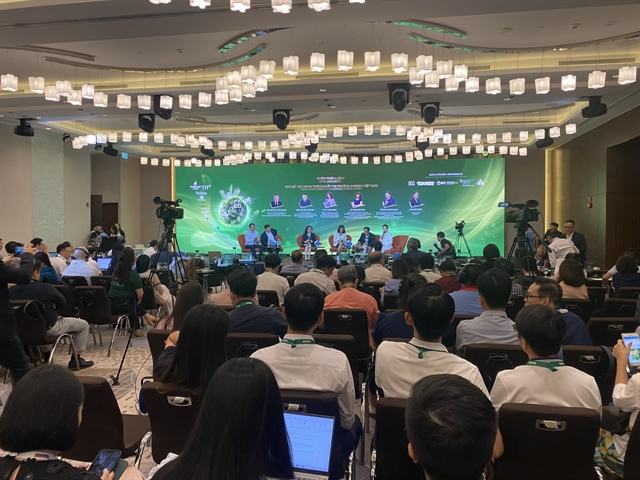
| The Vietnam Carbon Forum 2026 opens in HCM City on August 14, serving as a platform for policymakers, experts and organisations to discuss carbon market participation requirements in Việt Nam. — VNS Photo Hồng Linh |
HCM CITY — Việt Nam's carbon market is entering a new phase, with policies, regulations and direction gradually being put into practice while creating a strong need for information, capacity, connections and co-operation, Nguyễn Ngọc Thạch, editor-in-chief of Nông Nghiệp và Môi Trường (Agriculture and Environment) Newspaper, said at the Vietnam Carbon Forum 2026 in HCM City on August 14.
The forum featured the participation of 400 delegates representing policymakers, experts and organisations, providing a comprehensive overview of Việt Nam's carbon market.
The event is co-organised by Nông nghiệp và Môi trường (Agriculture and Environment) newspaper, the Department of Climate Change under the Ministry of Agriculture and Environment, the Institute for Consultancy on Development, and the International Finance Corporation with support from the Swiss State Secretariat for Economic Affairs.
Lê Công Thành, Deputy Minister of Agriculture and Environment, said the Government has built and completed a policy system on climate change adaptation.
The legal framework for greenhouse gas emission reduction and carbon market development has been established and is being further improved, offering a legal foundation for Việt Nam to carry out international co-operation activities on carbon credits.
This contribute to the implementation of the country's Nationally Determined Contribution (NDC) and help mobilise additional resources for emission reduction and green transition, he added.
He also highlighted that on June 29, the domestic carbon exchange has officially commenced pilot operations.
This move towards establishing an economic tool to drive greenhouse gas emission reductions offers businesses cost-effective mitigation solutions and helps them gradually adapt to increasingly stringent green standards in the international market.
|
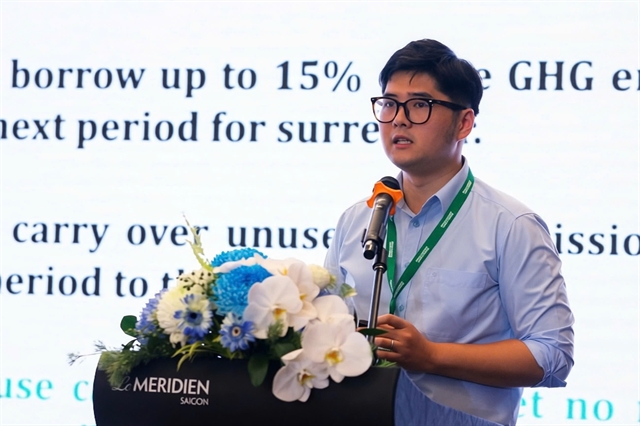
| Nguyễn Thành Công, deputy head of the Carbon Market Division under the Department of Climate Change, speaks at the forum on August 14. — Photo courtesy of the organiser |
Nguyễn Thành Công, deputy head of the Carbon Market Division under the Department of Climate Change, said according to a World Bank report in 2025, global carbon pricing revenue exceeded US$100 billion and is projected to continue growing in the coming years.
There are now more than 80 carbon pricing instruments in operation worldwide, including in Việt Nam.
He said that under the roadmap for developing the domestic carbon market to 2028, the pilot market would apply to about 150 major emitting businesses in three sectors, such as thermal power, steel production and cement.
Greenhouse gas (GHG) emission allowances are allocated free of charge for a period.
At the end of each compliance period, businesses must surrender allowances corresponding to their actual verified emissions. If emissions exceed the allocated quota, businesses have several options, including purchasing additional allowances from entities with a surplus or using carbon credits to offset the excess.
Trần Trọng Kiên, deputy director of the Derivatives Market Department, Hà Nội Stock Exchange (HNX), said entities eligible to exchange GHG emission allowances are entities allocated allowances in accordance with Government Decree No. 06/2022/ND-CP (as amended and supplemented by Decree 119/2025/ND-CP).
Furthermore, entities eligible to exchange carbon credits are agencies and organisations in Việt Nam.
To trade allowances and carbon credits, businesses must open trading accounts with, and transact through securities companies under the Vietnam Stock Exchange (VNX).
Under the put-through trading method, the principle is that trading parties directly negotiate and agree on all transaction terms.
An agreement is established when either the buyer or the seller enters a trading order into the carbon trading system and it is confirmed by the counterparty.
Trading takes place in two daily sessions: a morning session from 9am to 11:30am, and an afternoon session from 1pm to 2:45pm.
As for trading units: one allowance unit is equivalent to one tonne of CO2-equivalent, and one credit unit is equivalent to one tonne of CO2-equivalent. — VNS
Environment
 Environment
 Environment
 Environment
 Environment
 Environment
 Environment
 Environment
 Environment
 Environment
 Environment
 Environment
 Environment
 Environment
 Environment