 Economy



AIMCONNECT 2026 Held in Singapore, Bringing Global Automotive Leaders Together to Explore the Future of AI, Trust and Connected Mobility
1.
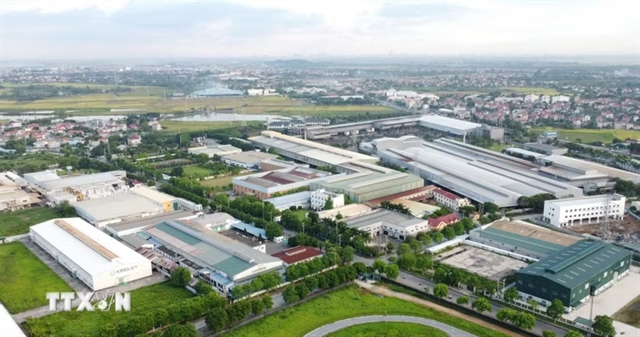 |
| The Bình Xuyên Industrial Park in Phú Thọ Province. — VNA/VNS Photo |
HÀ NỘI — ESG is moving beyond corporate reporting requirements to become a practical management tool that can help businesses cut energy consumption, reduce waste, manage risks and improve productivity, as pressure for sustainable operations spreads across global supply chains.
Experts say environmental, social and governance practices can generate tangible business value, but only when companies integrate them into everyday production and investment decisions rather than treating ESG as a separate reporting exercise.
Speaking at a recent seminar, Trần Hậu Ngọc, vice chairman of the Commission for Standards, Metrology and Quality under the Ministry of Science and Technology, said the essence of ESG was turning environmental, social and governance requirements into concrete activities.
Such an approach allows companies to use energy, materials and human resources more efficiently while strengthening operational risk management, according to Ngọc.
Pressure to adopt ESG is no longer coming solely from multinational corporations. Investors, customers, export markets and global supply chains increasingly require businesses of all sizes to demonstrate their sustainability performance, particularly companies seeking to expand exports or participate more deeply in international supply chains.
Associate Professor Nguyễn Hồng Quân, director of the Institute for Circular Economy Development at Việt Nam National University, HCM City, said ESG should not simply be regarded as a compliance cost.
If companies only complete forms and collect information for disclosure purposes, ESG would risk becoming an isolated and expensive exercise that generates little business value.
When ESG targets are connected with electricity and water savings, material efficiency, technological innovation, workplace improvements and risk prevention, however, the investment could deliver direct returns.
Monitoring electricity consumption, for example, could serve not only emissions reporting requirements but also help identify energy-intensive production stages where equipment or processes can be adjusted.
Yulia Dobrolyubova, an Asian Productivity Organisation expert and head of corporate sustainability and climate change for Asia-Pacific, said ESG was evolving from a reporting mechanism into a tool for risk management and value creation.
According to Yulia, 96 per cent of the world's 250 largest companies by revenue undertake sustainability reporting, while 93 per cent of surveyed private equity investors believe focusing on ESG could create significant investment opportunities.
For Vietnamese companies, requirements from international markets, including the European Union, are increasing demand for information on emissions, climate impacts, supply chains and product sustainability.
Companies increasingly need to demonstrate not only product quality but also how products are manufactured and their impacts on the environment, workers and communities.
Their ESG capabilities can therefore affect their ability to retain orders, enter supply chains and access green finance.
A major challenge, however, lies in turning ESG data into investment decisions.
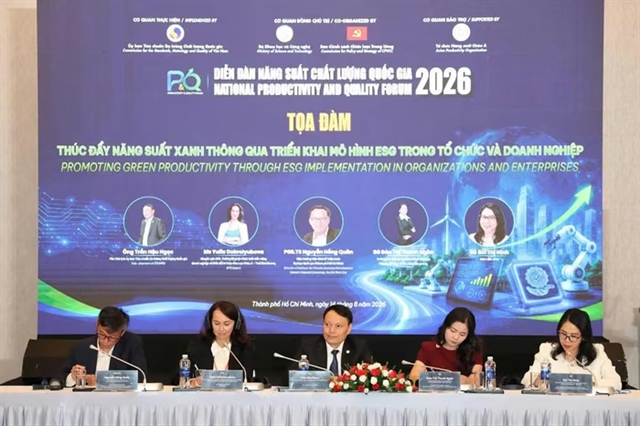 |
| Delegates at the seminar "Promoting green productivity through ESG implementation in organisations and enterprises" on August 14. — Photo courtesy of the organiser |
PwC Việt Nam's 2025 ESG Progress Tracker found that 82 per cent of surveyed businesses had ESG data or metrics, but only 10 per cent used advanced data analytics tools.
Quân said circular economy practices would offer one way of converting ESG requirements into measurable actions. Companies could reduce material inputs, reuse by-products, recycle materials and extend product lifecycles rather than following the conventional extract-produce-dispose model.
Experts also highlighted IWA 48:2024 as guidance for integrating ESG into organisational governance. Rather than serving as a separate reporting standard, the ISO document provides common principles to help organisations implement, measure and communicate ESG performance more consistently.
Việt Nam has meanwhile introduced a national framework for circular development through Prime Ministerial Decision No. 222/QĐ-TTg, issued on January 23, 2025, approving the National Action Plan for Circular Economy Implementation through 2035.
At Tien Phong Plastic JSC, digital and green transformation are being treated as a 'passport' for improving productivity without compromising environmental objectives.
Digital transformation provides data and management tools, while green transformation uses that information to conserve resources, cut emissions and optimise production, according to company representative Đào Thị Thanh Ngân.
Quân said renewable energy alone could address only about half of global emissions-reduction objectives, with recycling, reuse and longer material lifecycles needed for the remainder.
Global resource circularity currently stands at only around 6.9 per cent, leaving considerable room to reduce virgin resource consumption and generate additional value from materials.
Experts cautioned, however, against pursuing circular economy initiatives without measurable results.
Promoting a project as green without verifiable data or substantive production changes could create greenwashing risks.
For small and medium-sized enterprises, ESG would not necessarily require an expensive management system from the outset.
Existing frameworks such as ISO 9001 and ISO 14001 could be leveraged, while companies could begin with measurable priorities including energy savings, material efficiency, waste reduction, traceability and improved working conditions.
Experts said each target should be linked to performance indicators, implementation resources and clearly assigned responsibilities, allowing ESG data to feed directly into operational, technological and investment decisions. — BIZHUB/VNS
Economy
 Economy
 Economy
 Economy
 Economy
 Economy
 Economy
 Economy
 Economy
 Economy
 Economy
 Economy
 Economy
 Economy
 Economy