 Environment
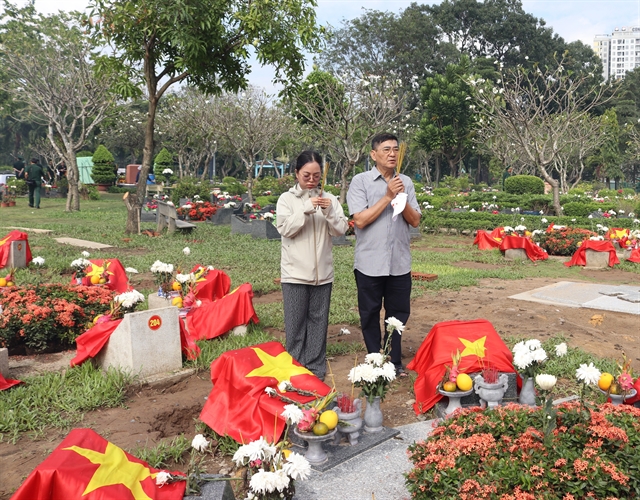
Incense for the fallen: Visitors honour fallen soldiers at the HCM City Martyrs’ Cemetery
1.
|
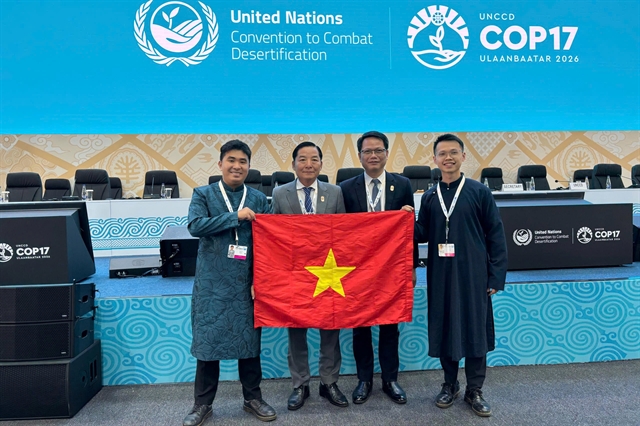
| The Vietnamese delegation taking part in the 17th Session of the Conference of the Parties to the United Nations Convention to Combat Desertification (UNCCD COP17) in Ulaanbaatar. Photo from the Department of Forestry and Forest Protection under the Ministry of Agriculture and Environment. |
ULAANBAATAR — Việt Nam has reaffirmed its commitment to working alongside the international community to combat land degradation and desertification, while sharing its experience in sustainable forest management, land restoration and climate change adaptation at the 17th Session of the Conference of the Parties to the United Nations Convention to Combat Desertification (UNCCD COP17).
The conference officially opened in Ulaanbaatar, Mongolia, on August 17 and will run until August 28 under the theme “Restoring Land, Restoring Hope”, bringing together high-level representatives from 197 countries, scientists, international organisations, businesses and other stakeholders.
Addressing the opening ceremony, Mongolian Prime Minister Nyam-Osoryn Uchral, representing the host country, and the UNCCD Secretariat highlighted the urgency of tackling land degradation, drought and desertification, which are threatening food security and livelihoods across the world.
Against this backdrop, COP17 is focusing on turning international commitments into concrete action, with particular emphasis on mobilising and diversifying financial resources for land restoration and drought resilience.
The conference is also promoting the Land Degradation Neutrality (LDN) target, integrating sustainable land management with biodiversity conservation, forest landscape restoration and climate change adaptation at the landscape level.
Another priority is strengthening inclusive, multi-stakeholder dialogue. COP17 has created dedicated spaces for Indigenous Peoples and local communities, as well as the Business4Land Forum, aimed at promoting social responsibility and mobilising private-sector investment for land restoration.
The overarching message of the conference is that restoring land is not merely an environmental objective. It is also essential to food security, livelihoods, climate resilience and a sustainable future for communities.
Việt Nam steps up efforts to combat land degradation
As a country deeply affected by climate change, drought, soil erosion in mountainous areas and saltwater intrusion, Việt Nam has consistently affirmed its role as an active and responsible member of the UNCCD since joining the convention in 1998.
In recent years, Việt Nam has implemented a range of programmes, policies and measures to protect land resources, restore ecosystems and strengthen the resilience of forests and local communities.
The country has pursued forest restoration programmes, the “One Billion Trees” Project and its forestry development strategy, maintaining national forest coverage at more than 42 per cent.
Forests are regarded as a vital ecological shield, helping retain water, prevent landslides and soil erosion, and slow land degradation.
In drought-prone areas, Việt Nam has prioritised the restoration and expansion of watershed protection forests and coastal forests designed to prevent sand encroachment, particularly in the south-central coastal region. Measures to protect sloping land and prevent erosion have also been strengthened in the northern mountainous region and Central Highlands.
Meanwhile, climate-smart agroforestry models have been expanded, including the use of soil-covering crops and the cultivation of medicinal plants beneath forest canopies. These models provide additional income for local people while helping protect and regenerate soil resources.
Việt Nam has also continued implementing its Payment for Forest Environmental Services (PFES) policy and integrating LDN objectives into national forestry planning and climate change adaptation plans.
Of particular significance, Việt Nam has adopted a National Action Programme on Combating Desertification through 2030, with a vision to 2050, providing a framework for coordinated and long-term measures to prevent land degradation and desertification.
The programme is designed to promote proactive and effective desertification prevention and control, while linking these efforts with biodiversity conservation and sustainable management of forest, land and water resources.
Sharing experience and strengthening international cooperation
The Vietnamese delegation to COP17 is headed by Nguyễn Văn Diện, Deputy Director of the Department of Forestry and Forest Protection under the Ministry of Agriculture and Environment.
On the opening day, the Vietnamese delegation actively participated in plenary discussions, sharing practical experience in sustainable forest management, land restoration, combating desertification, and adapting to climate change.
The participation demonstrated the Vietnamese Government's strong commitment to working with the international community to translate the COP17 message of “Restoring Land, Restoring Hope” into practical action.
On the sidelines of the conference, the Vietnamese delegation is scheduled to hold bilateral meetings with the UNCCD Secretariat and major international partners, including the United Nations Development Programme (UNDP) and the Global Environment Facility (GEF), as well as regional and international cooperation organisations.
Discussions will focus on technology transfer for remote-sensing monitoring of land and forest resources, mobilisation of climate finance, strengthening international cooperation, and sharing practical experience in sustainable forest landscape restoration.
Throughout the two-week conference, Việt Nam will continue making substantive contributions to the COP17 joint declaration and technical decisions, while promoting initiatives and cooperation opportunities that are appropriate to the country's circumstances and priorities.
With active participation in COP17, Việt Nam is reaffirming its role, responsibility and national commitment to global efforts to combat land degradation and desertification, restore forests and ecosystems, and advance sustainable development, and environmental protection. — VNS
Environment
 Environment
 Environment
 Environment
 Environment
 Environment
 Environment
 Environment
 Environment
 Environment
 Environment
 Environment
 Environment
 Environment
 Environment