 Life & Style
Việt Nam, Denmark issue joint statement on establishment of Comprehensive Strategic Partnership
1.
|
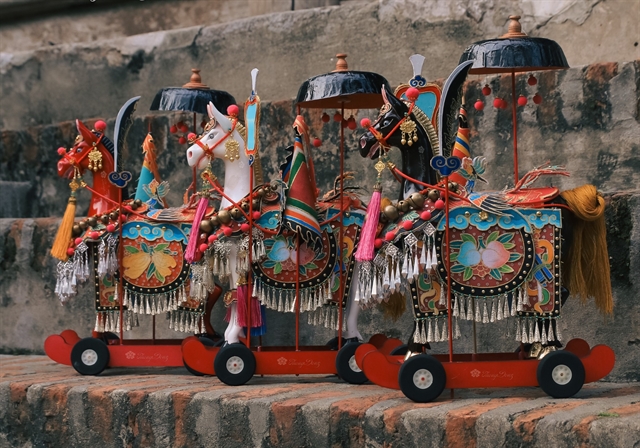
| Traditional pulling horse toys are revived by Thong Dong project. — Photos courtesy of the project |
HÀ NỘI — With every cheerful jingle of its wheels, the brightly coloured horse toy gallops back into the sounds of early spring, stirring memories of a time when traditional playthings filled every street corner and family home.
The return of this traditional toy not only rekindles memories of Vietnamese childhood but also revives cultural values that appear to have faded over time.
Its reappearance on Hà Nội’s streets marks the initial success of the Thong Dong project initiated by young artist Nam Chi. Rather than simply restoring a nostalgic toy, the project poses a broader question about how cultural heritage can continue to thrive in today’s society.
|
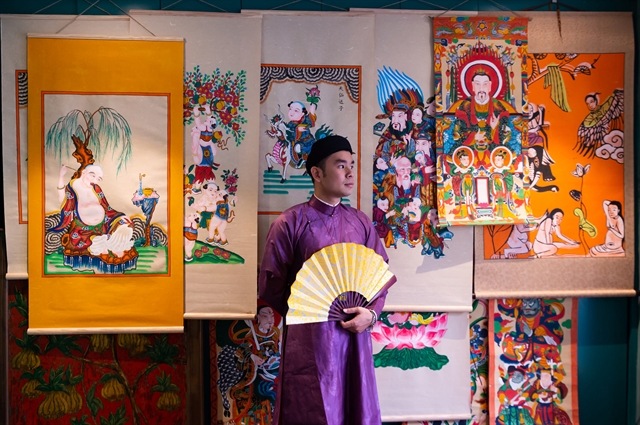
| Folk artist Nam Chi, the initiator of the Thong Dong Project. |
The idea for Thong Dong came to Nam Chi unexpectedly when he came across archival photographs of toy stalls from the French colonial period, showing small pull-along horses sold on the streets of old Hà Nội.
The toy was once popular in the capital about a century ago, particularly on Hàng Thiếc Street, where metal craftsmen of the ancient city gathered. The iron horses, fitted with wheels, produced a distinctive jingling sound when pulled by children, making them a familiar sight during festive occasions.
Yet the toy is more than simple entertainment. It forms part of a system of cultural symbols in which the boundary between daily life and spirituality is almost indistinguishable. The image of the horse has long appeared in temples, on altars and at festivals; from the realm of worship it moves into everyday life in the form of scaled-down models for children. In this sense, toys represent a form of cultural transformation.
|
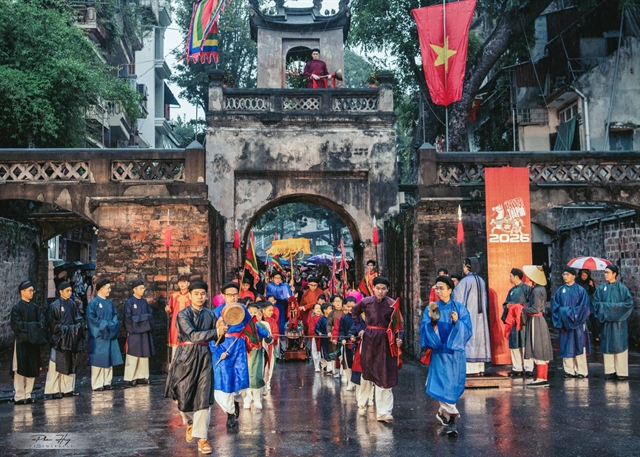
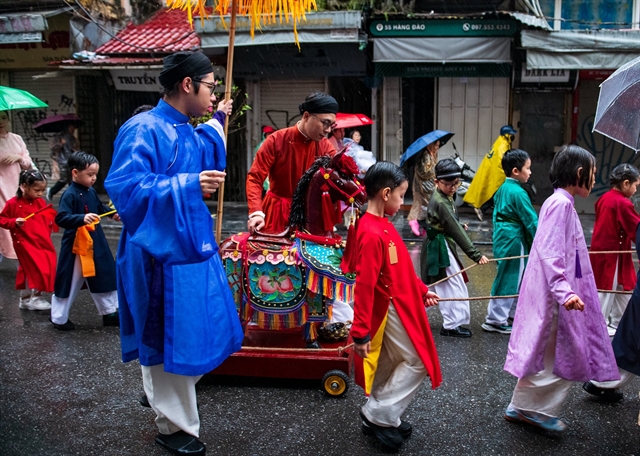
| The traditional toys present in Tết Việt-Tết Phố 2026 procession. |
"The aesthetics and play of the Vietnamese flow from daily life into spirituality, then return to daily life from spirituality," Nam Chi said. "The image of the horse in temples is adorned in vibrant attire and that very image is transformed into a small model for children to play with. In my research, I found that each symbol carries its own significance."
This awareness became the starting point for the Thong Dong project. Instead of replicating the original, Nam Chi chose to approach it through the lens of traditional aesthetics and form. He did not simply copy old models but analysed the proportions of the horse's body, the structure of its attire and folk colours, then redesigned them to ensure the product could exist in a contemporary context.
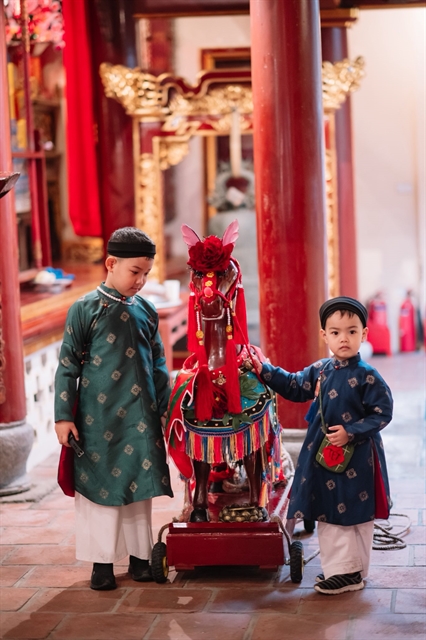
The change in materials is the clearest reflection of this approach. While traditional pull-along horses were made from iron, in keeping with past craftsmanship, the new version uses wood and modern materials such as epoxy resin to ensure safety for children. This is not merely a process of modernisation but a necessary adaptation to allow the heritage to continue within contemporary life.
|
| Modern kids are pictured with revived tradtiional toys. |
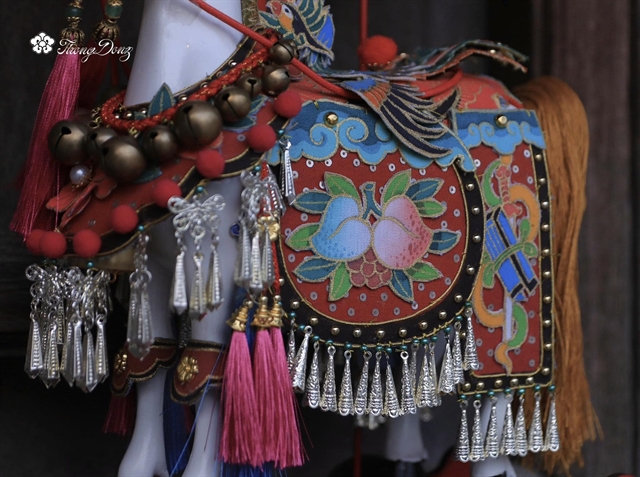
More importantly, the project sets clear boundaries for creativity. Core details such as the armour, canopy system, structure of the pull-along cart and the image of the phoenix are retained from the traditional altar horse model. However, authoritative motifs such as dragons and phoenixes are softened in favour of more rustic symbols that resonate with a child’s world.
|
| A close-up look at the decorative patterns of the horse toy. |
The project also develops a set of doctoral horses with four canopies, evoking the traditional ceremony of recognition and respect for one’s ancestors and reflecting the scholarly aspirations of ancient Vietnamese society.
The Red Horse symbolises vitality and good fortune, while the White Horse represents peace and protection. Through these designs, it is clear that folk toys have never served as mere entertainment; they carry the social aspirations, beliefs and life philosophies of the community across generations.
Through a fully handcrafted production process, from creating prototypes and painting to refining every small detail, Thong Dong not only revives a long-forgotten toy but also restores the way in which Vietnamese people have historically embedded culture into everyday life.
The return of these pull-along horses is therefore not simply about childhood play; it becomes a way of continuing the cultural narrative in today’s world.
|
| The project aims to integrate Vietnamese traditional culture into modern life. |
"When children pull the horses along, I see the spirit of Phù Đổng, or the heroism and movement of Vietnamese culture from the past to the present," Nam Chi said.
This is only the beginning. In the future, Thong Dong will continue to explore other folk symbols and cultural icons, expanding the journey of discovering Vietnamese culture through a respectful and creative approach.
Nam Chi, whose real name is Nguyễn Văn Bắc, was born in 1996 in the former Hải Dương Province, now Hải Phòng City. A self-taught folk painting artist, he has quickly drawn attention in research and creative circles by pursuing an independent path, conducting studies and exploring new directions for Vietnamese folk painting in contemporary life. — VNS
Life & Style
 Life & Style
 Life & Style
 Life & Style
 Life & Style
 Life & Style
 Life & Style
 Life & Style
 Life & Style
 Life & Style
 Life & Style
 Life & Style
 Life & Style
 Life & Style
 Life & Style