 Life & Style
84 individuals investigated for transnational online frauds
1.
|
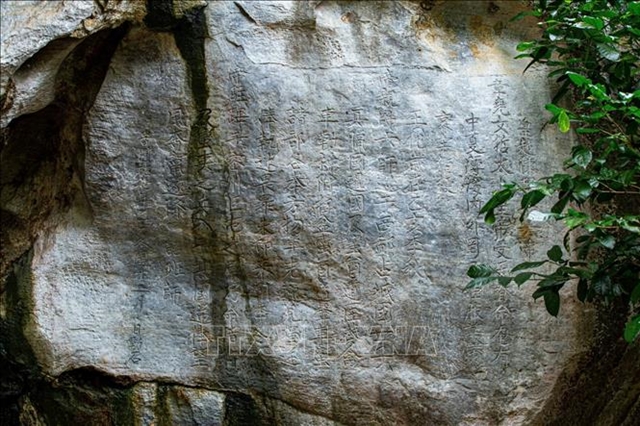
| The carved stone stele during the Trần Dynasty in Nghệ An has been recognised as a national treasure. — VNA/VNS Photo |
HÀ NỘI — Deputy Prime Minister Mai Văn Chính has signed a decision to recognise 30 new national treasures, 16 of which are located in museums in Hà Nội, the highest number of newly recognised artefacts in the country.
The Thăng Long-Hà Nội Heritage Conservation Centre houses five of these artefacts. They include the stepped dragon throne from the Lý Dynasty (1009–1054), a brown floral ceramic basin from the Trần Dynasty (1225–1400), a collection of bronze lamp plates from the Trần Dynasty, a green-glazed ceramic box lid from the Lý Dynasty, and a white-glazed ceramic vase painted with dragons from the Early Lê period (980–1009).
Kính Hoa Museum in Hà Nội has four artefacts, including a collection of bronze spoons, a set of bronze bells, bronze armour and a bronze drum, all from the Đông Sơn culture (800–200 BCE).
Two items within the private collection of Đào Danh Đức have also been recognised, including a stone Buddha statue and a stone statue of the deity Vishnu, both from the Óc Eo culture (1–630).
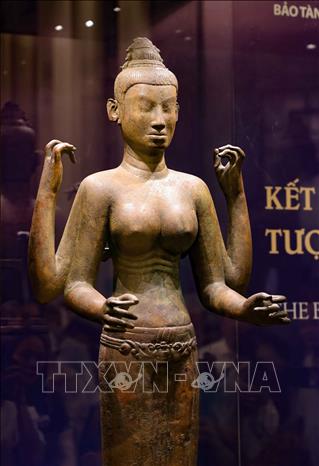
In addition, the National Museum of History houses two new national treasures: a bronze statue of the goddess Durga from the Champa culture (192–1832) and the notebook from Nguyễn Ái Quốc School preserving instructions from President Hồ Chí Minh and 28 leaders and veteran revolutionaries of Việt Nam.
|
| The bronze statue of the goddess Durga from the Champa culture is kept in the National Museum of History. — VNA/VNS Photo |
Hương Pagoda has a stone Buddha altar from Hương Trai during the Trần Dynasty, while Bắc Biên Pagoda has a stone Buddha altar from Đại Bi during the Trần Dynasty and an An Xá bell from the Later Lê period (1428–1789), which have also been recognised.
Ninh Bình Province has five new national treasures, including a stone stele from Nghĩa Xá Pagoda dated to 1122, a stone Buddha altar from Thượng Nương Pagoda dated to 1364, a collection of 18 carved stone portraits of Arhats from the Trần Dynasty in Liên Hoa Cave, a bronze book from the reign of Lê Thánh Tông and three stone steles from Keo Hành Thiện Pagoda from the Later Lê period.
.jpg)
|
| The collection of ceramic statuettes of the Tam Quan Đại Đế in HCM City. — Photo tienphong.vn |
Nghệ An has two new national treasures, namely a collection of bronze drums from Vạc Village belonging to the Đông Sơn culture, and a carved stone stele during the Trần Dynasty.
Two items in HCM City are inscribed in the list of national treasures: a ceramic bowl from the Hoa Lộc culture (about 2000–1200 BCE) and a collection of multi-coloured ceramic statuettes of the Tam Quan Đại Đế, three deities of the heavens in Taoist and Chinese beliefs.
Gia Lai has two new national treasures, a collection of gold worship items from the Chăm An Phú tower and a set of Kơ Đơ gongs from the early 20th century.
Hưng Yên Province has two new national treasures: a stone Buddha altar at Nhạn Tháp Pagoda and three wooden thrones at Đa Hòa Temple, all dated from the Mạc period (1527–159).
Bắc Ninh Province also has a new national treasure, a wooden statue of Buddha Mẫu Man Nương housed at Phúc Nghiêm Pagoda.
According to the decision, the Minister of Culture, Sports and Tourism, as well as the chairpersons of local governments where the national treasures are located and various agency heads are tasked with managing the recognised national treasures within their respective responsibilities and according to cultural heritage laws.
With the new recognition, the country now has a total of 267 national treasures. — VNS
Life & Style
 Life & Style
 Life & Style
 Life & Style
 Life & Style
 Life & Style
 Life & Style
 Life & Style
 Life & Style
 Life & Style
 Life & Style
 Life & Style
 Life & Style
 Life & Style
 Life & Style