Life & Style
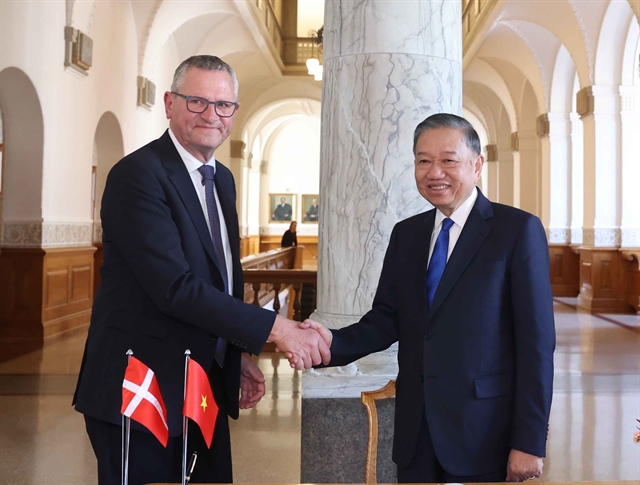
Top leader meets with Danish Parliament Speaker Henrik Frandsen in Copenhagen
1.
|
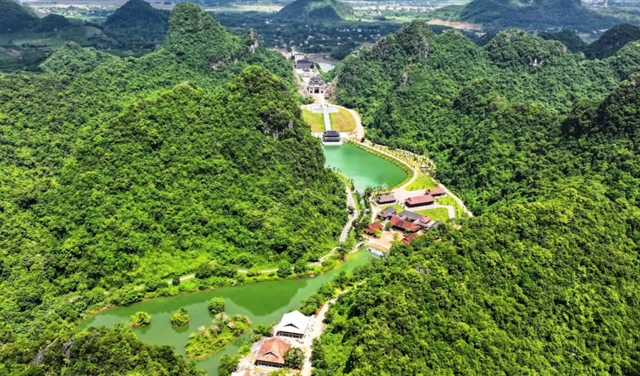
| Thung Ui, a paradise of natural beauty, seen from above. — Photos courtesy of Ninh Bình Province |
Thanh Hà
I was excited to accept an invitation to visit Thung Ui, which offers beautiful natural scenery, warm local hospitality, and stunning photos and videos that I will cherish forever.
Thung Ui is a new destination that I – and many other travellers – have only just heard of for the first time.
You might be familiar with Bái Đính, one of the largest spiritual complexes in Việt Nam, located in the heart of the Tràng An Scenic Landscape Complex – a UNESCO World Cultural and Natural Heritage Site in Ninh Bình Province.
Thung Ui is also located there, approximately 3km from Bái Đính, the largest pagoda complex in the country.
This secluded limestone valley is completely surrounded by towering mountains, with a clear blue natural lake at its centre, creating a space that feels almost entirely isolated from the outside world.
It has only recently opened to tourists and is still under construction for additional facilities. Nevertheless, it is already enough to leave visitors in awe.
Although the place remains almost a secret to most visitors, it is a unique destination of historical and spiritual significance.
|
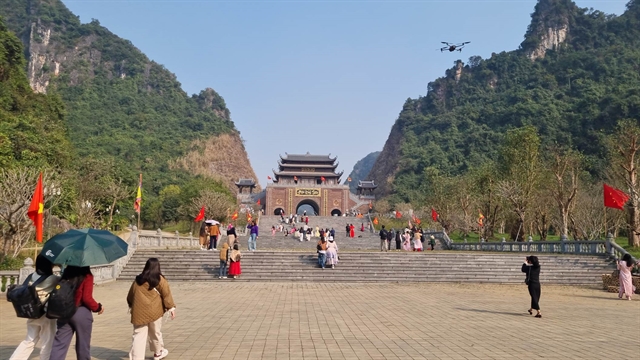
| Đàn Kính Thiên, the place where emperors prayed for national peace and prosperity. |
During our visit, a tour guide explained the historical records and folk legends associated with the land to our group.
At Thung Ui's highest point, King Đinh Tiên Hoàng established the Altar of Heaven to pay homage to heaven and earth, formally proclaiming himself emperor, founding Đại Cồ Việt — Việt Nam’s first feudal state — and selecting Hoa Lư as the capital.
This act is regarded as both a political and spiritual declaration, marking the transition from the chaotic 'Anarchy of the 12 Warlords' period to an era of national independence and self-reliance.
"For a long time, Thung Ui was almost completely outside the Ninh Bình tourism map. This was due to its difficult terrain, which is considered by local residents to be sacred land, requiring minimal intervention and development," the tour guide told us.
"Elders here told us that, in ancient times, when people's lives were difficult and they mainly cultivated rice and corn, to reach the valley they had to cross many steep limestone mountain ranges.
"Everyone who climbed the mountains into the valley would be exhausted, exclaiming things like 'Ui mệt quá' (Oh, I'm so tired) or 'Ui giời ơi' (Oh my god), leading to the name Thung Ui (Ui Valley)."
The guide went on to explain: "The secluded space and spiritual elements have prevented Thung Ui from being subjected to massive urbanisation, preserving its natural landscape almost intact."
"Only in recent years, when Ninh Bình started developing its tourism sector for greater cultural and historical depth, has Thung Ui gradually been awakened by projects that promise to attract the attention of tourists," she said.
Our guide led us through several newly renovated areas, such as Đàn Kính Thiên – Kính Địa – Kính Nhân, sites where emperors of feudal dynasties conducted rituals to worship heaven, earth and humanity to pray for peace, prosperity and harmony.
|
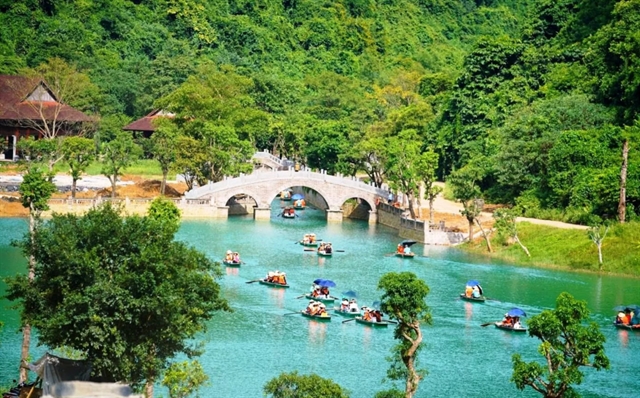
| Tourists can take boats for the best view of Thung Ui. |
Every year, on the 10th day of the third lunar month, Ninh Bình organises the Đàn Kính Thiên Festival to commemorate the contributions of King Đinh Tiên Hoàng.
This is not only a religious event; this year, it also serves as a catalyst to awaken Thung Ui from its dormant state, transforming it into a destination with unique depth and character, distinct from many purely sightseeing tourist areas.
Continuing deeper into the valley, we arrived at a boat dock, where local farmers paddled us along a narrow stream, allowing us to explore Thung Ui from the water.
From the boat, we admired the landscape as limestone mountains, lakes and lush vegetation unfolded gently and serenely before us — a striking contrast to the crowded atmosphere of many other routes within the Tràng An complex.
It felt as though we were among the first large groups of visitors to the area, although many young people have already discovered Thung Ui as an ideal place for check-ins. Every corner is perfect for photographs; all we needed to do was choose a pose, press the shutter and take home beautiful images.
|
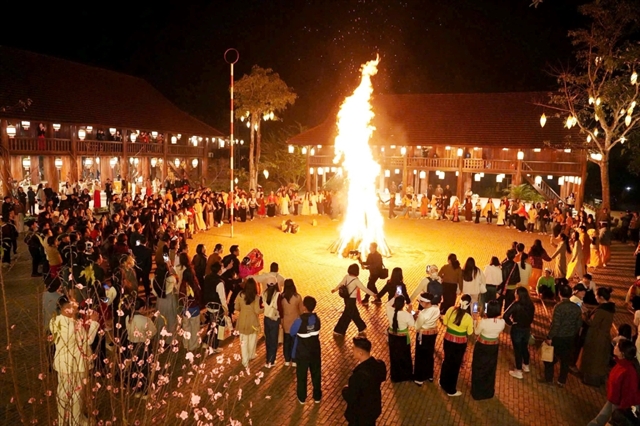
| A campfire in the Mường community is great for team building. |
Within the 270-hectare area, a large space has been created to replicate the cultural environment of the Mường ethnic group, enriching the visitor experience and offering deeper insights into the lives of the indigenous people who were once closely connected to this land.
We were also given the opportunity to enjoy local dishes, take part in traditional folk games and sing together around a campfire — a truly memorable experience.
Our guide told us that the final stages of construction are being completed rapidly, with the project expected to open to visitors during the upcoming Lunar New Year holiday.
She added that in the near future, the Tràng An complex will be expanded to approximately 2,000 hectares, highlighted by the construction of the world’s largest tower dedicated to storing Buddhist scriptures.
This development will form a large integrated resort, combining spiritual spaces, medicinal gardens and ecological areas. It will provide around 30,000 rooms for accommodation, offering visitors environmentally friendly and restorative spaces while preserving and safeguarding traditional cultural values and heritage.
"From Hà Nội, it takes you only about two hours to reach Thung Ui via the Pháp Vân - Cầu Giẽ Expressway, or you can take a train to Ninh Bình Station and then continue on by taxi," the guide said.
"Thanks to its central location, Thung Ui is also conveniently connected to other popular destinations in the complex, such as the Tràng An tourism area, Bái Đính Pagoda, Múa Cave and Tam Cốc - Bích Động.
"From the valley you can also easily travel to Ninh Bình's another major destination, Tam Chúc, which is known as the world's largest spiritual tourism complex. There, you can contemplate another spectacular landscape and learn more about Buddhism," she added. — VNS
Life & Style
 Life & Style
 Life & Style
 Life & Style
 Life & Style
 Life & Style
 Life & Style
 Life & Style
 Life & Style
 Life & Style
 Life & Style
 Life & Style
 Life & Style
 Life & Style
 Life & Style