 Economy

Bắc Ninh and Samsung launch new business support programme
1.
|
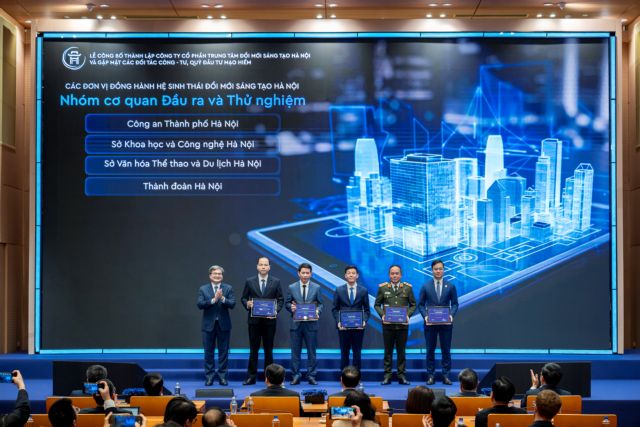
| Vice Chairman of the City People’s Committee Trương Việt Dũng presented certificates to the units partnering in the innovation ecosystem. — Photo courtesy of the organiser |
HÀ NỘI — The Hanoi Innovation Centre (HIC) JSC was officially launched on February 26 at the headquarters of the Hà Nội People’s Committee, marking the establishment of a strategic institution aimed at advancing innovation, digital transformation and the creative industries in the capital.
The centre is envisioned as a core platform linking data, resources, policy, technology and culture to address urban development challenges and strengthen the national innovation ecosystem.
It is expected to contribute to the growth of the digital economy and digital society, while promoting cultural and creative industries rooted in Hà Nội’s identity.
The launch comes as Việt Nam and Hà Nội accelerate digital transformation amid rapid urbanisation.
Hà Nội benefits from a young population, a large domestic market and strong openness to new technologies.
Speaking at the event, Dr Trần Quang Hưng, Chairman of HIC, said that Hà Nội has the opportunity to position itself as a global hub for controlled experimentation with emerging technologies and new business models.
“In a multipolar world, where the US remains the source of breakthrough technologies and high-performance computing infrastructure, China is shifting towards an internally driven innovation model centred on large-scale data accumulation, and India serves as the world’s office, Việt Nam – particularly Hà Nội – can define itself as a hub for controlled experimentation with new technologies and business models,” Hưng said.
He added that attracting global creative talent to address Hà Nội’s urban challenges, including congestion, environmental pressures and data governance, would help place the capital firmly on the global innovation map.
The centre outlined three strategic pillars. The first focuses on attracting the global innovation community to help solve real urban problems through technologies such as artificial intelligence (AI), fintech and smart mobility.
The second emphasises international engagement, including creating favourable conditions for overseas Vietnamese entrepreneurs to return and establish operations in Hà Nội.

|
| Dr Trần Quang Hưng, Chairman of HIC, delivers a speech at the event. — Photo courtesy of the organiser |
“When they return, the benefits are not limited to revenue or tax contributions. They bring global technology networks, entrepreneurial talent and connections with international venture capital funds,” Hưng said.
The third pillar centres on strengthening domestic creative industries, particularly as digital sectors such as e-commerce and social media face growing dominance from multinational platforms.
The centre aims to foster healthy competition driven by innovation and create greater space for startups to scale up.
Nguyễn Trung Chính, chairman and executive chairman of CMC Technology Group, said CMC’s joint investment with Hà Nội and Hanoi University of Science and Technology to establish HIC reflects the implementation of major Party resolutions on science, technology and private sector development.
“This can be regarded as the first three-party cooperation model between Hà Nội, CMC and Hanoi University of Science and Technology in response to the spirit of Resolution 57 and Resolution 68 on science and technology, innovation and private sector development. We are proud to be a founding member, together with Hà Nội and the university, in building this centre,” Chính said.
To implement its strategy, HIC has introduced a four-stage incubation model.
The first stage focuses on linking public- and private-sector problem statements with innovation talent from schools, universities, research institutes and overseas Vietnamese networks.
The second stage centres on research and development, including the creation of Minimum Viable Products (MVPs). The centre plans to deploy AI tools as a “co-founder” to support market research, business planning, coding and testing, with the aim of shortening development cycles and reducing startup costs.
The third stage supports company formation, offering legal advisory services, intellectual property registration, access to shared digital infrastructure and participation in sandbox mechanisms for controlled testing.
The final stage concentrates on commercial acceleration, with backing from venture capital funds and public–private partnerships.
The centre has also proposed developing shared data infrastructure, capital mobilisation mechanisms, legal sandbox frameworks and a unified digital platform integrating public services.
HIC is expected to contribute to Hà Nội’s smart city development plan and Việt Nam’s cultural industry strategy, which aims for the sector to account for 7 per cent of GDP by 2030 and 9 per cent by 2045. — BIZHUB/VNS
Economy
 Economy
 Economy
 Economy
 Economy
 Economy
 Economy
 Economy
 Economy
 Economy
 Economy
 Economy
 Economy
 Economy